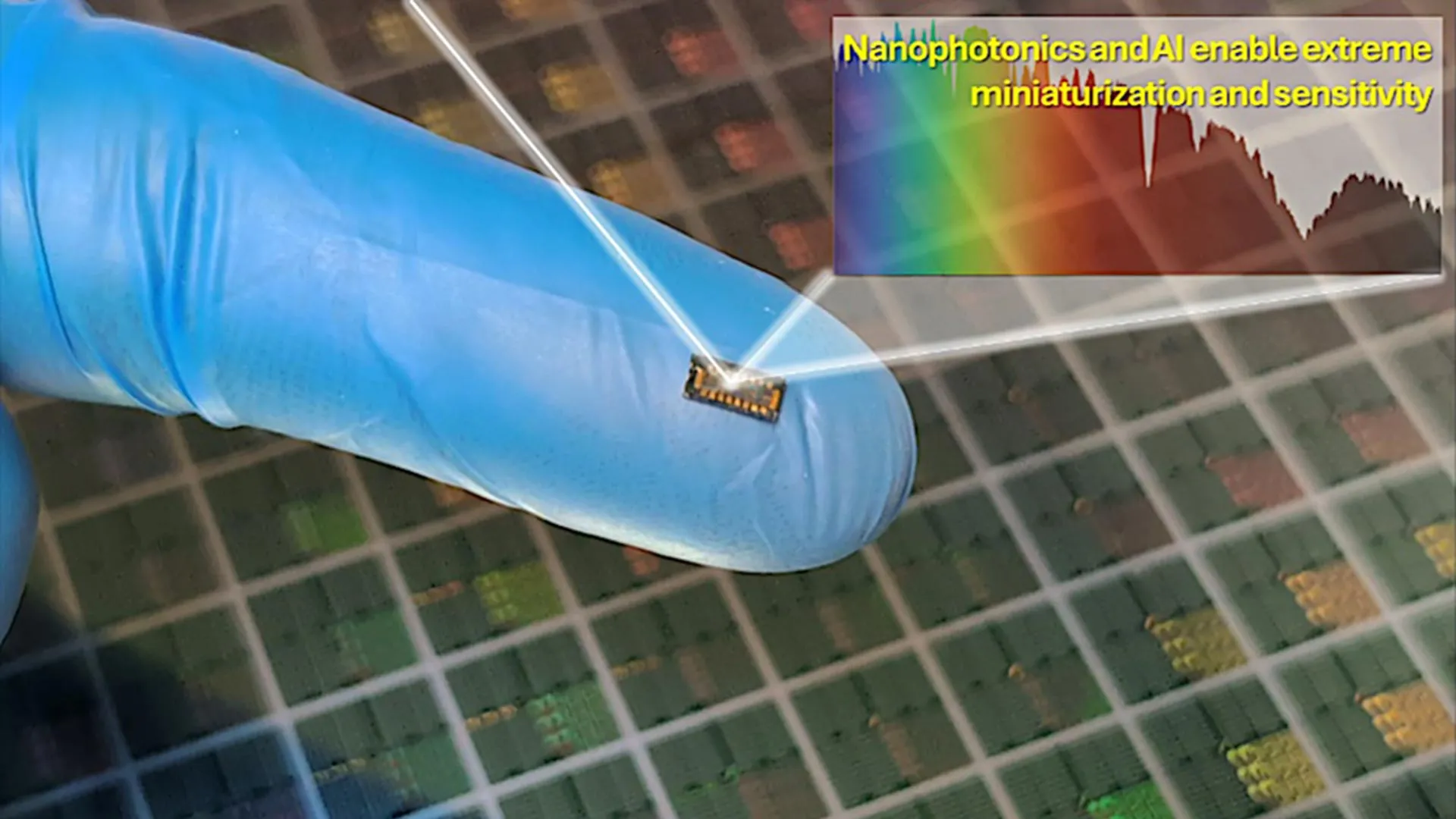
Researchers at UC Davis have engineered a spectrometer smaller than a grain of sand, collapsing laboratory technology that once demanded an entire bench into a silicon chip measuring just 0.4 square millimeters. The breakthrough, published in Advanced Photonics, replaces the bulky prisms and gratings that have defined chemical analysis for decades with a radically different approach: artificial intelligence reading signals from just 16 specialized sensors to reconstruct the full spectrum of light.
For years, analyzing what light reveals about a material's chemical makeup required large, costly instruments that split light into its component colors and measured each wavelength's intensity—a process that demands the light travel a considerable distance, which is why traditional spectrometers have remained stubbornly oversized. These tools are everywhere in modern life, from diagnosing disease and inspecting food to monitoring pollution, making their miniaturization a problem worth solving.
The UC Davis team found an elegant workaround. Instead of physically separating light into a rainbow, their chip uses 16 silicon detectors engineered to respond slightly differently to incoming light. Think of them as specialized tasters sampling different aspects of the same complex mixture. Individually, each detector captures only part of the picture, but together they generate enough encoded information for a fully connected neural network—trained on thousands of examples—to reconstruct the original spectrum. The system achieves roughly 8 nanometer resolution, the precision needed for real-world applications, without any bulky optical hardware.
A major challenge was extending the chip's sensitivity into the near-infrared range, the part of the spectrum especially valuable for biomedical imaging because it penetrates deeper into human tissue than visible light can reach. Silicon photodiodes normally struggle with infrared light, but the team solved this by texturing the silicon surface with specialized photon-trapping structures. These microscopic textures scatter infrared photons repeatedly across the silicon layer, dramatically increasing the odds that the material absorbs them rather than letting them pass through. The result is a sensor sensitive across a far wider range than standard silicon allows.
The engineering goes deeper still. The chip incorporates high-speed sensors capable of measuring photon lifetime with extraordinary precision, allowing it to detect ultrafast interactions between light and matter that traditional spectrometers would miss entirely—a capability that could unlock forms of sensing and imaging that previously required much larger, far more expensive equipment.
What makes the achievement truly remarkable is that the finished system maintains high sensitivity and strong resistance to electrical noise even in chaotic, noisy environments, a perennial challenge for portable, low-cost electronics. The AI-assisted design preserves clear signal quality where older approaches would fail.
The implications are wide open. UC Davis researchers envision this technology powering compact, real-time hyperspectral sensing devices small enough to embed in portable medical diagnostics, wearable health monitors, environmental remote sensing systems, and food quality analysis tools. What once required a room can now fit in your pocket—or even on your skin.