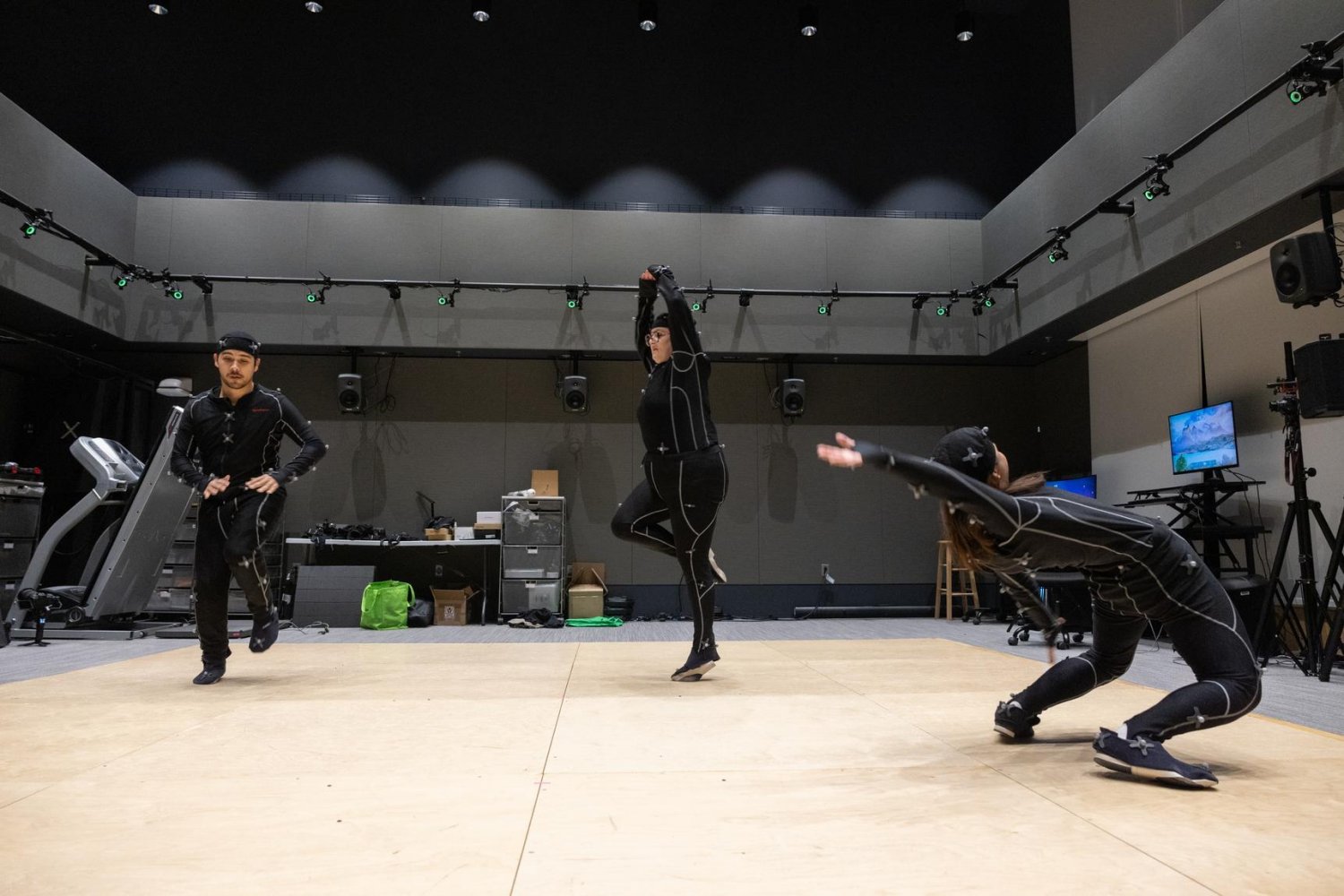
Daniel Pillis watches his students don full-body motion-capture suits and transform into digital avatars—one dancing like a member of The Beatles, another fighting an invisible opponent, a third playing guitar—all in real time on a computer screen. This is not a Hollywood backlot. It's the MIT.nano Immersion Lab in Boston, where Emerson College students are learning the same technology that powered "Avatar," the highest-grossing film of all time, and reshaping what they thought possible in their own creative work.
For most filmmaking students, access to cutting-edge motion-capture technology remains a distant dream—the kind of resource reserved for major studios with budgets measured in hundreds of millions of dollars. But Pillis, now an assistant professor at Emerson College and an MIT Media Lab alumnus, recognized that this technology could be democratic. Each semester, he brings his undergraduate and graduate students across the river to MIT, where they harness the capabilities of the Immersion Lab to create their own virtual productions, bridging a gap between aspiration and access that defines so much of arts education.
"Motion capture, like that in 'Avatar,' bridges real human movement with digital technology," says Pillis. "In this digital age, and as artificial intelligence becomes more involved in film studios, technology that enables the authenticity of human expression and performance is becoming increasingly important." The Immersion Lab, equipped with a 28-camera OptiTrack system, captures every subtle movement students make and translates it into animation data they can see, adjust, and refine instantly. They take that data back to Emerson to build into short films for their final projects—work that, in Pillis's words, ends up "light-years beyond what these students thought they could achieve."
The impact has been tangible. Over the past two years, more than 60 Emerson students have used the lab. Undergraduate Nick Forsch's project "Enter," a film about a human transported into a digital world to meet an artificial intelligence, earned him an EVVY Award nomination—the Emerson equivalent of an Emmy, selected by industry experts judging for creativity, quality, and professionalism. Another undergraduate, Evan Costa, recreated The Beatles performing on "The Ed Sullivan Show," capturing each musician's movement and reconstructing a simulation of 1950s television. That work impressed enough that Costa will spend the summer as an intern with MIT's Learning Engineering and Practice Group, continuing to explore virtual production at a deeper level.
What makes this partnership work is the Immersion Lab's unique position: world-class technology, unusually accessible to those outside MIT's own community. Talis Reks, who manages the lab, has watched something remarkable unfold. "It has been truly gratifying to support this course and to see the curiosity and ingenuity students have brought to the stage," Reks says. "This class highlights the range of what our lab can offer, extending well beyond research and into art and the performing arts."
Pillis first discovered the Immersion Lab as a graduate student working on a Haitian folklore dance project—building a living archive where participants could dance with an interactive AI-driven ancestral avatar. He carried that vision into his teaching. The students, many untrained as actors, discover something unexpected the moment they see themselves as virtual characters: they become fully present, fully committed to performing. The technology doesn't distance them from their humanity—it amplifies it. In an era when artificial intelligence increasingly touches creative work, this matters: students are learning that the most powerful tool in any filmmaker's arsenal remains authentic human movement, simply made visible in new ways.