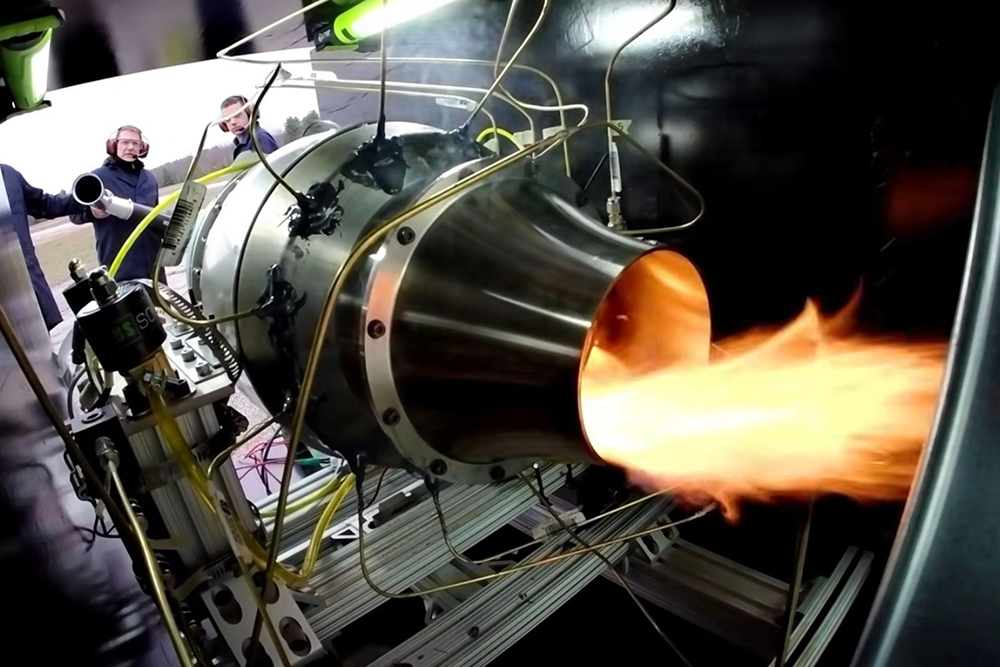
When 31 MIT undergraduates signed up to build jet engines from scratch, they expected a serious engineering challenge. What they probably didn't expect was that AI would become their most important teammate.
The students, organized into seven teams spanning nearly every department in MIT's School of Engineering, had just four weeks to design, build, and test working gas turbine jet engines. Their goal: create engines producing 50 to 100 pounds of thrust, running on jet fuel, and completing five 60-second test runs. Many had never taken a class in turbomachinery or compressible flows. Some first-years hadn't even studied thermodynamics yet.
"We see this as the future of engineering," Ryan Hefron of Voyager Technologies told the students. "You're honing skills that are not just nice to have — they're going to be the future baseline in the engineering workforce."
The competition, called the JARVIS Challenge (Jet-engine AI Research and Validation Intensive Sprint), gave students access to MIT Parley — a new platform that brings together multiple large language models through one interface. Through Parley, organizers could watch exactly how students used AI: their questions, which AI models they chose, and how much it cost. Sponsors including Safran, Voyager Technologies, and Beehive Industries, along with MIT Lincoln Laboratory, covered the costs so students could use AI essentially without limits.
Students used AI to learn design software, find technical references, compare different engineering approaches, and answer specific questions about jet engine components. One team even created an AI agent to act as a project manager.
But Professor Zolti Spakovszky, who directs MIT's Gas Turbine Laboratory, watched carefully to make sure students weren't just copying AI answers. His technique: ask probing questions after presentations. "Do you know what a rabbet fit is? Take in the comment," he'd say, guiding teams without giving away solutions.
The results showed both AI's power and its limits. By the end of the first week, one team withdrew. The others struggled with fabrication — actually cutting and assembling parts — rather than design or analysis. Manufacturing, not engineering know-how, became the biggest bottleneck.
"The JARVIS challenge showed that AI can substantially accelerate safety-critical hardware engineering, but engineering judgment remains the decisive differentiator," Spakovszky said. "An AI-native engineer is not defined by using AI, but by leading it."
Vincent Garnier of Safran Tech, one of the sponsors, came away impressed by how quickly students figured out what AI could and couldn't do well — and adapted accordingly.
"This makes me confident that this generation of leading engineers will probably not fall prey to easy and shortsighted use of AI," he said.