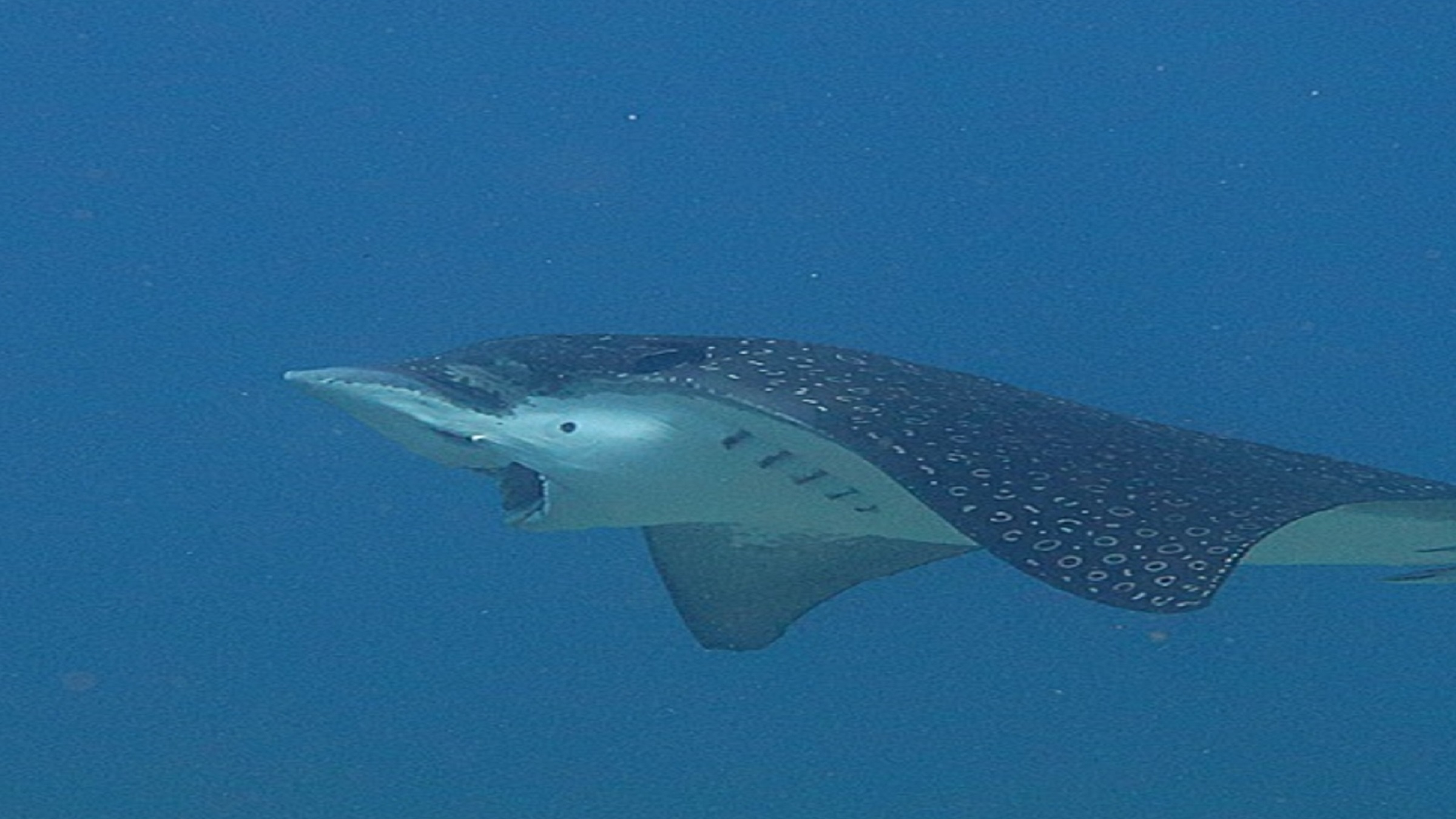
What does an eagle ray's dinner sound like? For scientists at Florida Atlantic University, the answer turns out to be surprisingly distinctive — and now, identifiable by artificial intelligence. Researchers have developed a machine learning model that can detect when marine predators crunch through shells and even determine what they are eating, just by listening to the sound.
The team, led by Matt Ajemian, assistant research professor at the Harbor Branch Oceanographic Institute at Florida Atlantic University, focused on whitespotted eagle rays (genus Aetobatus) — marine predators known for their ability to crush open the shells of mollusks. "A lot of animals out there, particularly marine animals, have the unique ability to crush shells open," Ajemian said in an interview with Mongabay. "But we don't know how much they eat and what they feed on. So we wanted to see if we could remotely detect an animal feeding on a clam versus a gastropod."
The implications extend far beyond curiosity. Understanding what predators eat — and how much — is critical for conservation planning. Knowing the resources a predator depends on helps scientists assess ecosystem health, while data on shellfish consumption rates tells them how much pressure predators put on prey populations. "In a clam bed or seagrass bed, we want to know how much prey is removed by a predator over the course of a year," Ajemian explained.
Traditional methods of studying marine diets have serious limitations. Camera footage often gets obscured by sand when rays dig for food. The older technique of capturing animals and flushing their stomach contents is both intrusive and incomplete — "you don't get everything or the contents are very degraded," Ajemian noted. So the research team took a different approach: training their model on the distinctive sounds shells make when crushed.
The study, published in the journal Ecological Informatics, combined controlled tank experiments with field recordings off the Florida coast. Researchers fed rays known prey at set sizes, capturing the corresponding audio, then validated their findings by observing rays in the wild with cameras and audio recorders. The model learned not only to detect shell-crushing sounds amid ocean noise, but to distinguish between prey types based on acoustic signatures and processing time. Cracking a clam takes longer — the ray must sift through and spit out shell fragments while extracting meat. Snails require less effort: break the single point of attachment, and the meat comes loose.
One of the study's most encouraging findings was practical rather than scientific. "The method that required the most computing power wasn't necessarily the method or approach that yielded the best results," Ajemian said. Simpler models performed nearly as well while demanding far fewer resources, meaning the tool could become widely accessible to researchers working with limited budgets.
Ajemian's team is now planning to expand beyond eagle rays, training the model to identify other shell-crushers like crabs, and applying it to data from animal-borne biologgers. The goal is to deploy long-term recording stations in key habitats and extract detailed information about where and when shellfish are being cracked open — a window into predator-prey dynamics that was previously impossible to observe at scale.