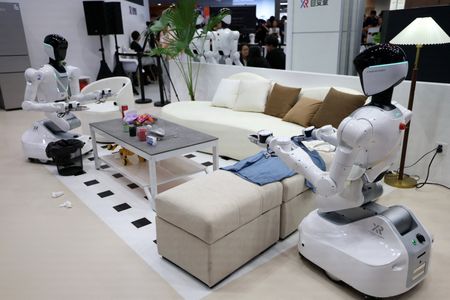
A backflip may win a crowd, but Chinese robot companies are now chasing a harder trick: helping machines learn what to do when the job changes. After years of building humanoid robots that can run, dance and flip, firms are investing in artificial intelligence that could let robots understand their surroundings and take on unfamiliar tasks without being programmed for each one.
That shift is drawing a surge of money into embodied AI, the name for software that helps machines learn and act in the physical world. The stakes reach beyond robotics shows. As competition pushes down hardware prices, companies see smarter software as a way to make robots useful in factories, logistics and other workplaces. The country that best joins AI with machines could gain an edge in industrial automation and the global robotics market.
Chinese embodied AI companies raised 93.5 billion yuan, or $13 billion, across 322 deals in the first half of 2026, according to data firm ITjuzi. That was five times the amount raised in the same period a year earlier. The money is increasingly going not only to robot makers but also to specialist firms building the machines’ intelligence. “The margin won’t come from the hardware but from the brain,” said Dermot McGrath, founder of Shanghai-based consultancy ZenGen Labs.
The race includes strong competitors on both sides of the Pacific. US companies such as Physical Intelligence, Skild AI and Generalist are working on software that can teach robots different skills without lengthy retraining. Generalist says its GEN-1.5 model completed about 60% of simple tasks after watching a demonstration lasting 3 to 12 seconds. China’s X Square has published research on robots learning handling skills from a single human video, without retraining the model for each task.
Chinese startups X Square, Galaxea and Spirit AI have each reached valuations of about $3 billion, according to company disclosures. X Square co-founder Yang Qian said the goal is to move robots from being directed by code to using “common sense.” Established manufacturers are hiring and investing, too. Hong Kong-listed UBTech advertised a chief scientist role for AI model development with compensation of up to 124 million yuan, or $18 million, including equity and benefits. Unitree, a major humanoid robot maker by shipments, has about 30 researchers working on AI that predicts how objects behave, according to a person briefed by the company.
A major challenge is finding enough useful training examples. Chatbots learn from text; robots need to learn from physical actions such as gripping objects or handling flexible wires. Spirit AI has hired around 1,000 people to record everyday and industrial activities, co-founder Gao Yang said. ACE Robotics uses wearable sensors to record workers’ movements and grip forces in stores and hotels. Ant Group’s robotics unit, Robbyant, says it trained a model on 160,000 hours of material, including 50,000 hours of human-guided robot movements. Its training covered 20 robot configurations from 17 brands, with the aim of using one AI system across different machines.
Other firms are testing virtual practice. DexForce uses computer-generated environments, and its chief operating officer, Nicole Yang, said some industrial tasks can be prepared for deployment within 6 to 8 hours. No company has yet emerged as the clear leader. US labs set a high bar in how quickly robots can learn and reuse skills, while Chinese firms can draw on close ties with manufacturers and industrial customers. The next test is whether those advantages can turn promising demonstrations into reliable work on the factory floor.