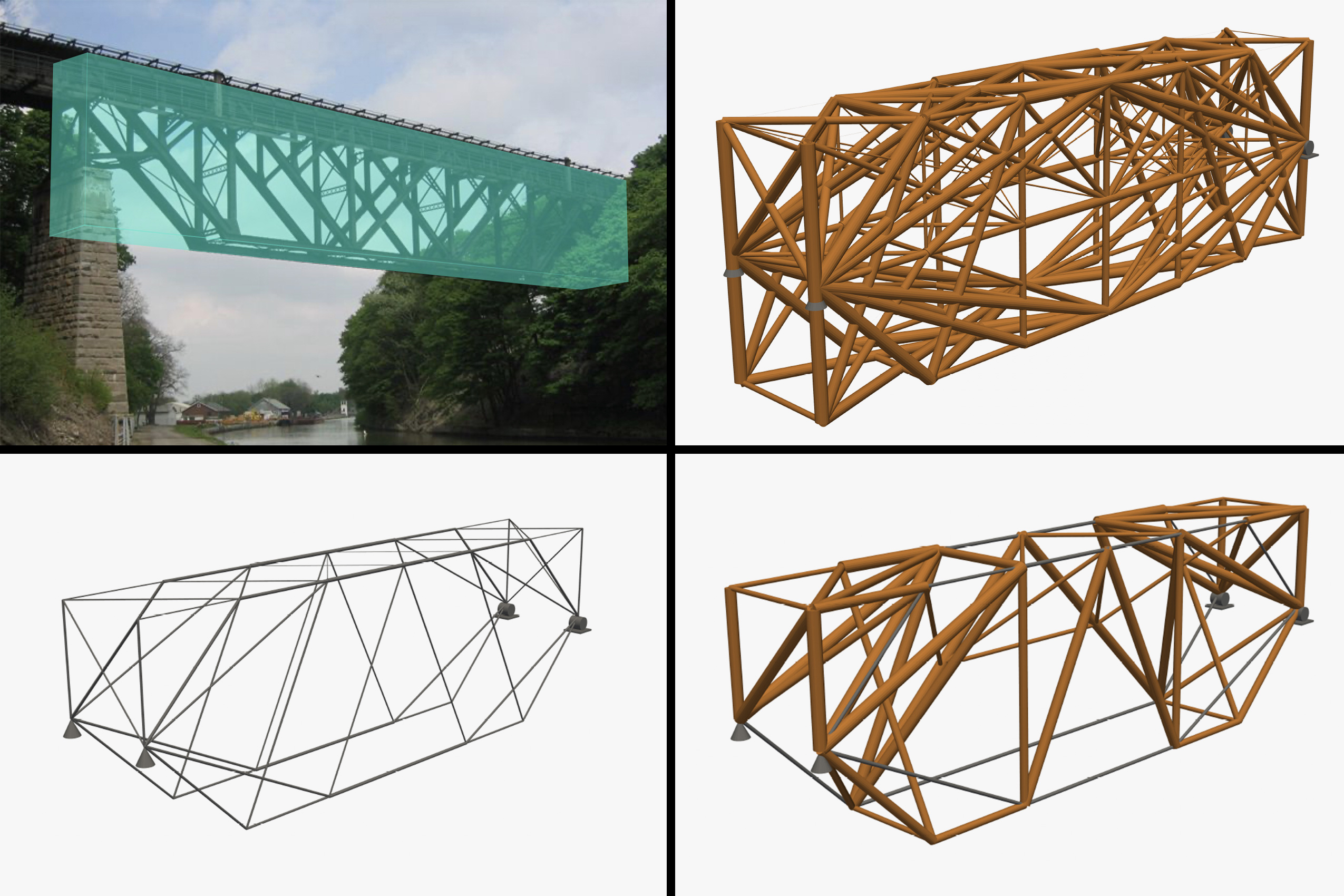
Zane Schemmer was staring at a digital lattice of steel beams—twisting, branching, impossibly light—when it hit him: this structure used 87 percent less material than a conventional design, yet could bear the same load. The catch? No builder would touch it. "It looked like art," says Schemmer, a PhD student at MIT. "Beautiful, but unbuildable." Now, he and Professor Josephine Carstensen have cracked a decades-old problem in structural engineering: how to design ultra-efficient buildings and bridges that don’t sacrifice practicality for performance. Their new framework, detailed in Automation in Construction, reshapes topology optimization—a powerful but long-ignored tool—into something contractors can actually use.
Topology optimization has promised radical material savings since the 1980s, generating designs that distribute material only where needed, often producing organic, web-like forms. In theory, these designs can slash material use by up to 90 percent, potentially cutting millions of tons of carbon emissions from construction. But in practice, they’ve been too complex, too fragile in their connections, and too alien to traditional building methods. "There’s been a gap between the carbon savings on screen and what’s achievable on site," Carstensen says. "These designs were dismissed as too hard to build, so they were never even tried."
The MIT team’s breakthrough lies in making the algorithm speak the language of construction. Using mixed integer programming, their system allows engineers to set real-world constraints: no more than four beams meeting at a joint, no parts smaller than a specified size, and clear material assignments—steel here, wood there, never a hybrid. Crucially, it also models how materials behave under stress: steel resists compression, cables handle tension, timber follows its own rules. The result? Designs that are still radically efficient but now follow the logic of the job site.
In tests, the team generated truss systems for bridges and buildings using steel, wood, and combinations of both. When they applied practical constraints, material use increased slightly—but so did feasibility. One multimaterial bridge design reduced embodied carbon by 62 percent compared to a standard steel equivalent. The framework doesn’t just save material; it tailors efficiency to local realities, like material availability and carbon cost. "Sustainability isn’t just about using less," Schemmer says. "It’s about using the right materials, in the right places, in ways we can actually build."
This isn’t just a lab experiment. With construction responsible for over 7 percent of global carbon emissions in 2022, tools that bridge the gap between digital promise and physical reality could reshape how we build. "We can now add constraints so the design that comes out is never too hard to make," Carstensen says. As the world races to decarbonize, that practicality might be the key to unlocking a new era of lighter, smarter, and truly sustainable infrastructure.