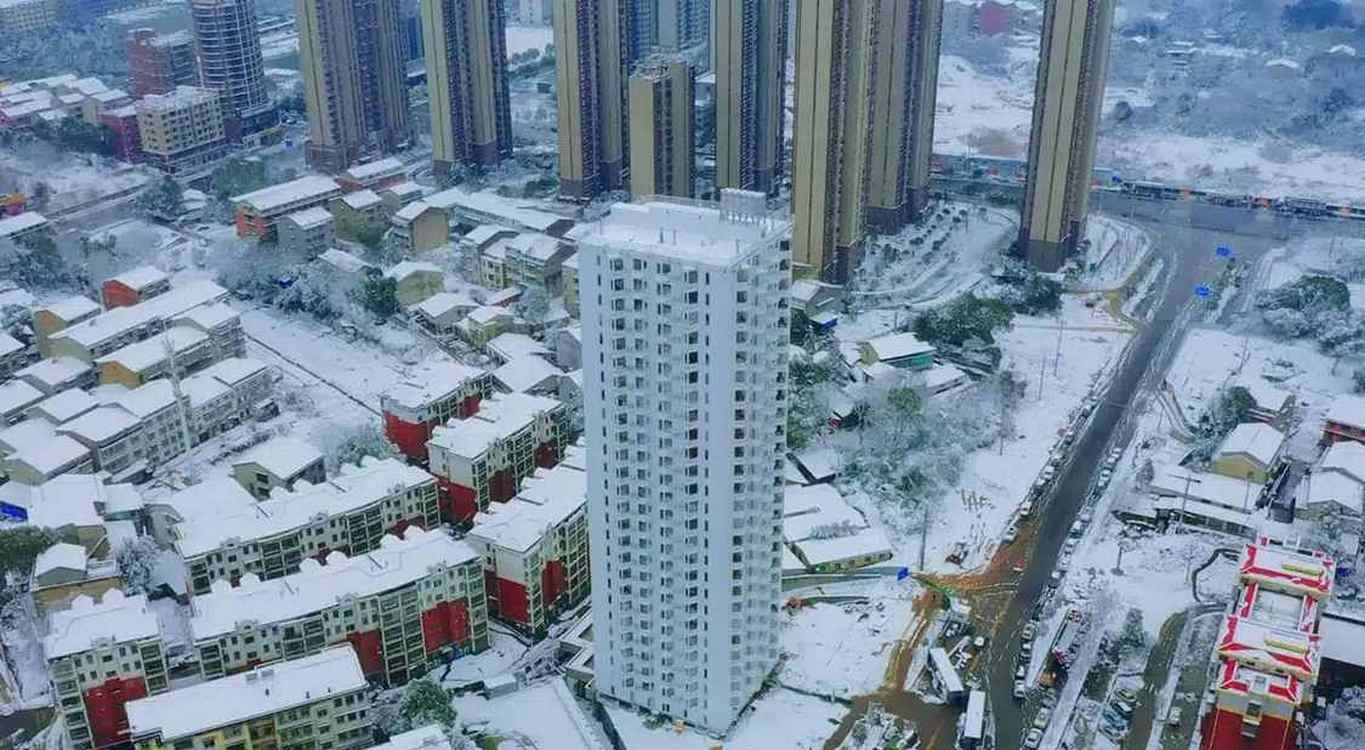
On a rare snowy morning in Changsha, China, flatbed trucks rumbled into an empty lot carrying 26 stories of the future—pre-built, precision-engineered stainless steel modules that would become the Jindu Holon Tower. By January 12, 2024, just five days later, the 26-story apartment complex stood complete, its windows glinting in the winter light, ready for residents to move in.
This wasn’t just fast construction—it was a reimagining of how buildings should be made. Born from the trauma of the 2008 Sichuan earthquake that reduced concrete towers to rubble, the BROAD Group launched BROAD Sustainable Building to pioneer a safer, faster, and more sustainable model. The result: a high-rise assembled not with weeks of on-site pouring and welding, but by stacking 289 prefabricated modules like Lego bricks, each 12 meters long, 3 meters high, and 2.4 meters wide, all manufactured in just 21 days at a nearby factory.
Inside each module, everything was already in place—plumbing, HVAC, lighting, kitchen cabinets, even fixed furnishings. No on-site concrete, no welding, no prolonged disruptions. Just cranes, bolts, and connections. The structural secret? A patented stainless steel “sandwich” called B-CORE, engineered for high tensile strength and exceptional ductility—meaning the building can sway, not shatter, during seismic events. As Andrew Zimman, marketing director at BROAD Group USA, put it: “We’re the first to use stainless steel for load-bearing elements—not just for facades, but for the bones of the building.”
The environmental implications are just as striking. When the building’s lifecycle ends, it won’t be demolished. It will be unbolted, unstacked, and transported elsewhere—zero waste, no dust, no landfill. This reversibility is a radical departure from traditional construction, offering cities a new tool for adaptive zoning, disaster resilience, and circular design.
Zhang Yanwei, a manager at BROAD Group Holon Jianan Co., confirmed that all fixed elements are installed before delivery, though portable appliances like refrigerators and washing machines are left to residents. The company’s vision extends far beyond Changsha: projects are now in development in Ohio, Texas, California, the Philippines, and the UAE, signaling a global shift toward modular, sustainable urban living.
The Jindu Holon Tower isn’t just a building—it’s a prototype for a smarter, safer, and more agile way to house the world. As cities grapple with climate risks, housing shortages, and construction inefficiencies, this 5-day marvel offers a powerful answer: what if buildings didn’t have to be permanent to be strong?