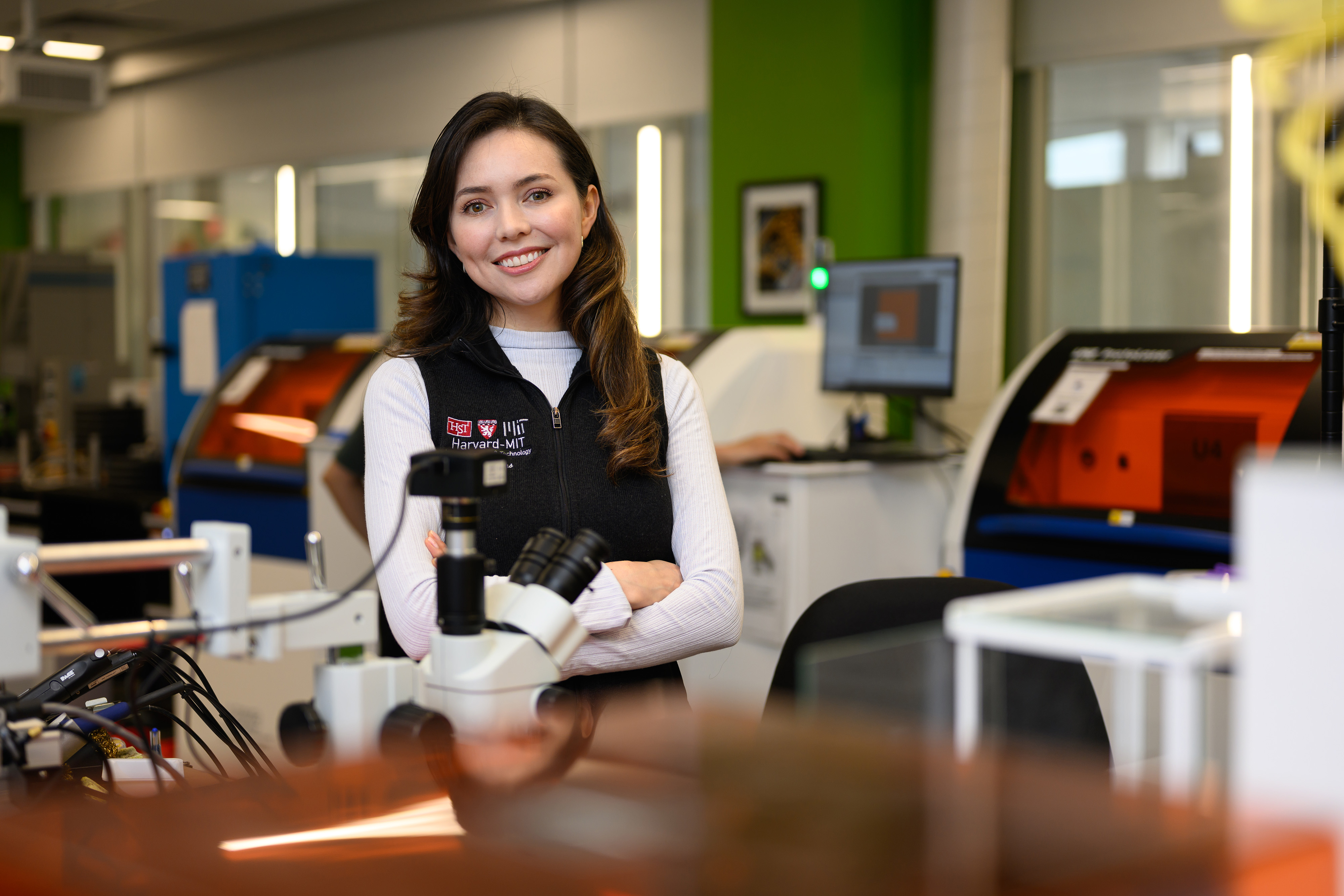
When Diana Grass was growing up in Colombia, whenever someone told her something was impossible, she'd simply say: "I'll figure it out." That attitude has carried her far — from studying how languages evolve, to working as a medical interpreter, and now to designing tiny electronic devices that listen to the conversations happening inside your body.
Grass is a PhD candidate at MIT in a program called the Harvard-MIT Program in Health Sciences and Technology, or HST for short. She builds soft bioelectronic devices — think flexible, body-friendly sensors — that can detect signals passing between the brain and the rest of the body. Unlike older, rigid devices that can damage delicate tissues, her tools gently stick to soft organs without harming them, recording what the nervous system is up to in real time.
"The body is communicating all the time," Grass says. "We still lack the tools to understand its language."
Her path to this work wasn't straightforward. Before becoming a scientist, Grass studied philology — the study of language — and education. She wanted to understand how languages evolve and how knowledge passes from person to person. Then she moved to the United States and took a job as a medical interpreter, translating conversations between doctors and patients with brain disorders. Watching those exchanges day after day, she became fascinated by the brain. "I was intrigued by how a single organ could shape how we communicate, and ultimately who we are," she says.
To learn more, Grass went back to school for neuroscience and joined a research lab at Rutgers New Jersey Medical School, where she studied how the nervous system talks to the immune system. That experience changed her focus. "The nervous system doesn't function in isolation," she says. "It continuously communicates with the immune system and peripheral organs to coordinate physiology." In other words, your brain, your immune system, and your organs are constantly chatting — and to understand health, you need to understand all of it.
That realization brought her to MIT's Bioelectronics Group, led by Polina Anikeeva, a professor in the Department of Materials Science and Engineering. Grass now designs devices that monitor multiple signals at once while also gently recording and stimulating nerve circuits. The goal is to catch diseases earlier and create treatments tailored to each person — what scientists call personalized medicine.
The work has taken on extra meaning since Grass became a mother of two school-age children. She hopes her research will help doctors predict illness before it happens, not just react to it after the fact.
"I want to contribute to a future where medicine understands the body well enough to predict disease instead of simply reacting to it," she says. "Because once you become a parent, every scientific question becomes deeply human."