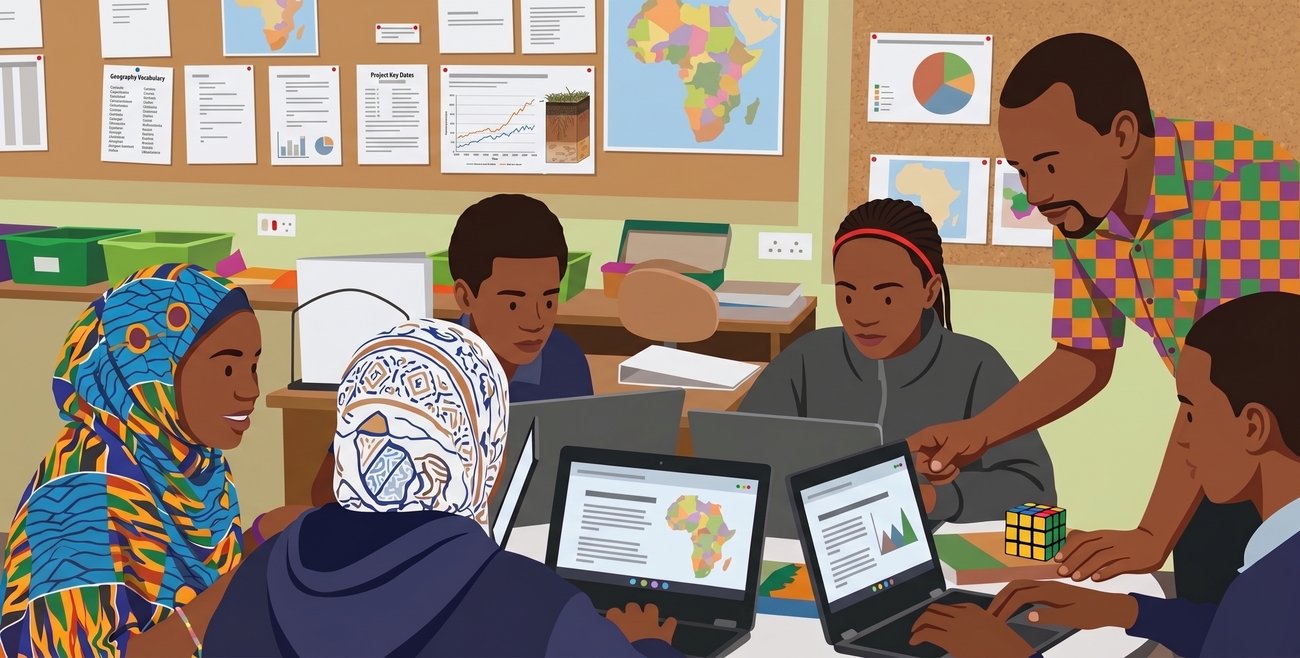
When a teacher in Sierra Leone watched their students lean closer to their screens, asking questions they'd never asked before, something essential shifted in the classroom. That spark—students discovering they could understand fractions and exponents through step-by-step guidance—is now spreading across Sub-Saharan Africa as Google deploys AI-powered learning tools designed with educators and communities, not imposed upon them.
Over 60% of Sub-Saharan Africa's population is under 25, making the region home to more young learners than anywhere else on Earth. By 2030, more than a third of the world's youth will live on the continent. For this generation, generative AI is becoming a transformative tool for learning, offering the possibility of personalized guidance to every student—but only if it's built thoughtfully, in partnership with the people closest to the challenge.
The proof is already emerging. In an eight-week randomized controlled trial conducted with Fab AI and local teachers in Sierra Leone, nearly 1,800 junior secondary students in Grades 7 and 8 across 48 math classrooms used Guided Learning, a tool that coaches students through problems step by step. The results were striking: students who used the tool improved their scores on externally validated assessments by 0.26 standard deviations—equivalent to 1.2 to 1.7 years of typical learning progress in low-and-middle-income countries. For students who reached the recommended 12-hour threshold of use, gains jumped to 0.38 standard deviations, effectively moving an average student from the middle of their class into the top third. The average student used the tool for 15 hours across the trial period.
"With the introduction of Gemini, most students now love maths because the app is teaching them step by step," one teacher reflected—a shift that speaks to something deeper than test scores. When students see themselves as capable of understanding difficult concepts, their relationship with learning transforms.
Yet technology alone changes nothing. Google's approach centers on reducing teacher burden so educators can do what machines cannot. Through a partnership with UNICEF supported by Google.org, the organization is working to reach millions of teachers and students across Kenya, Brazil, India, and Pakistan with AI tools and training tailored to local needs. In Kenya, UNICEF is collaborating with the government and the Institute of Curriculum Development to integrate Gemini for Education and NotebookLM into the country's new curriculum, freeing teachers from administrative tasks so they can spend more time with students.
The ambition extends to universities across the continent. Google has partnered with the African Union Commission to bring Gemini for Education, NotebookLM, and related training to all 55 Member States, including institutions like Kwame Nkrumah University of Science and Technology and the University of Ghana. The goal is training at least 150,000 students and faculty by 2027—building genuine AI fluency, not just digital literacy.
In Ghana, a new Memorandum of Understanding signed with the Ministry of Education during the recent Education World Forum in London signals the next phase. This collaboration aims to integrate Google's AI technologies throughout Ghanaian schools, moving the entire education system toward true AI fluency for both educators and learners.
The choices being made now will shape African learning for decades. When those choices center on what teachers and students actually need—when curiosity is honored over convenience—the transformation becomes real.