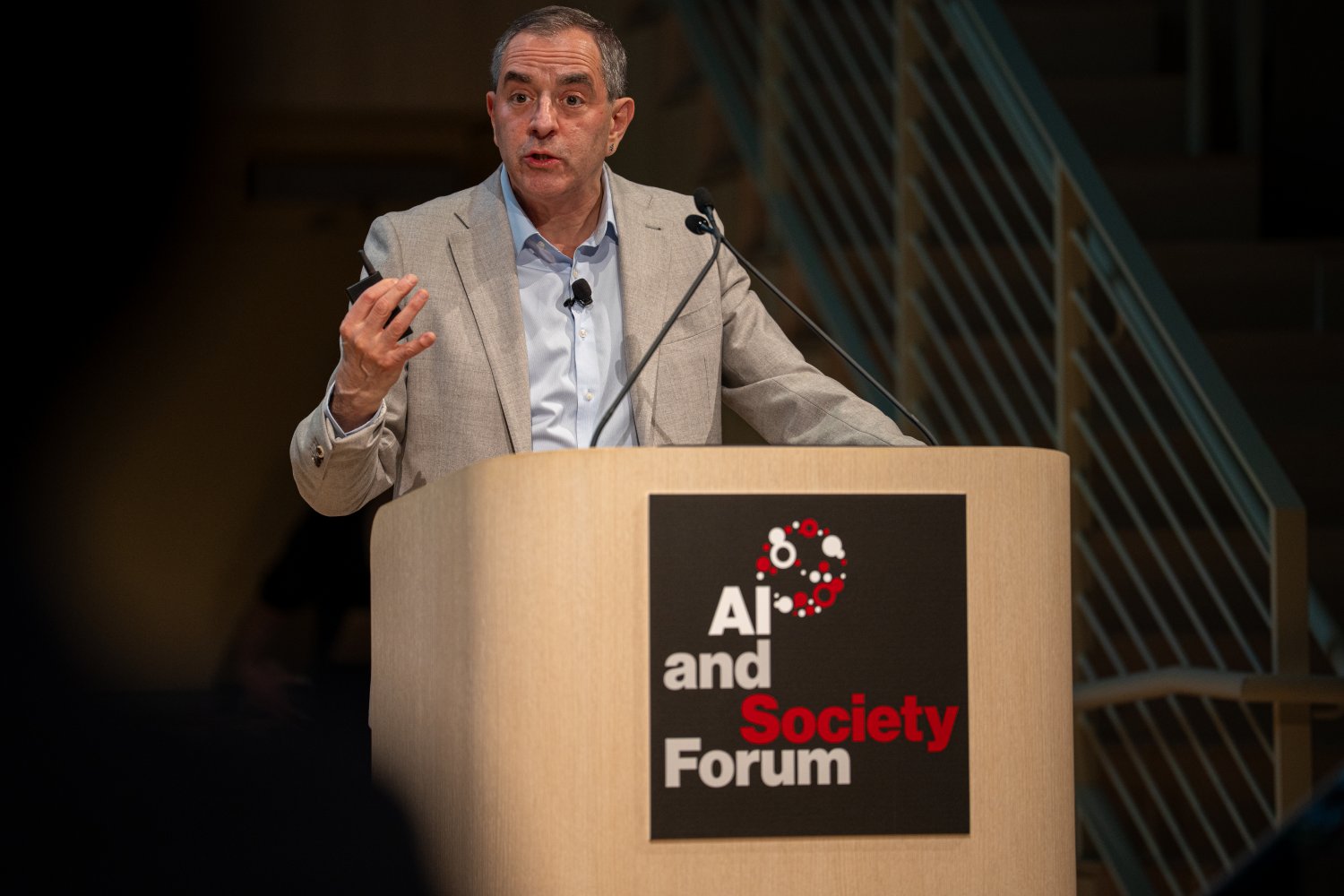
David Autor stood before a packed Tull Concert Hall at MIT, the air humming with anticipation, and challenged a room full of technologists, economists, and ethicists to rethink everything they assumed about AI and jobs. "When I think about how technology interacts with the value of labor, I think about it in terms of how it changes the scarcity of expertise," said the Daniel (1972) and Gail Rubinfeld Professor of Economics, reframing the debate not as man versus machine, but as a recalibration of human skill in the age of automation. His words set the tone for the AI and Society Forum, a daylong gathering co-organized by MIT’s School of Humanities, Arts, and Social Sciences (SHASS) and the Social and Ethical Responsibilities of Computing (SERC), in collaboration with the MIT Generative AI Impact Consortium (MGAIC) and the MIT Human Insight Collaborative (MITHIC). At a moment when AI advances feel both inevitable and opaque, the forum insisted on a crucial truth: understanding AI’s societal impact isn’t a sidebar to innovation—it’s central to it.
From the start, MIT leaders underscored the urgency of interdisciplinary dialogue. Agustín Rayo, dean of SHASS, emphasized that examining AI’s consequences is not a detour from MIT’s mission but a fulfillment of it. Dan Huttenlocher, dean of the MIT Schwarzman College of Computing, added that knowing where AI fails is just as vital as knowing where it excels—critical to avoiding overreliance and unintended harm. That balance echoed through the day, especially in discussions about work. Autor argued that AI’s real threat isn’t mass job loss, but the commodification of expertise—if automation replaces routine tasks, it could elevate human judgment; if it replaces expert tasks, it could erode it. The path forward, he and others agreed, lies in proactive policy: wage insurance, worker retraining, and broader access to capital.
Daniela Rus, director of CSAIL, painted a hopeful vision of AI as a collaborative partner—"your friend and assistant"—but stressed that humans must remain the ultimate decision-makers. David Mindell, professor of Aeronautics and Astronautics, reminded the audience that work has always evolved, and the focus should be on enabling people, especially young innovators, to create the "new work" no one has yet imagined. Even in high-stakes fields like aviation, where six pilots still staff long cargo flights, change will come not through abrupt automation but through careful, safety-conscious evolution.
Sendhil Mullainathan, with appointments in both Economics and EECS, offered a sobering note: while AI may boost productivity, that’s not the same as long-term growth. "It’s hard to believe there isn’t going to be a lot of restructuring," he said, capturing the uncertainty and inevitability of the moment. As the day closed with a generative AI musical performance, the message was clear—technology will shape society, but only if society shapes technology back.