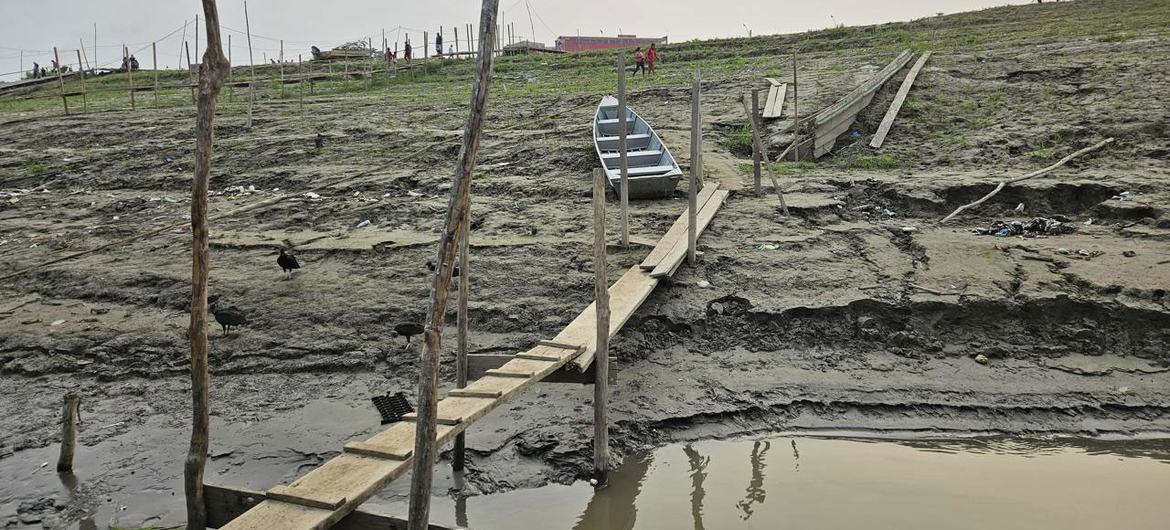
Marciele Albuquerque remembers childhood in the Brazilian Amazon as a time when fruit hung from trees steps outside her village, and swimming in rivers was an everyday adventure. Today, she has to walk much farther to find the same fruits, and even then there are fewer of them. "We can feel it's getting hotter every year," she said. "The fruits are no longer as abundant as they used to be."
Marciele is one of three young Indigenous leaders from Brazil using creativity to fight back against climate change and protect their ancestral lands. She is a dancer and entrepreneur from the Munduruku people. Her fellow leaders are singer-songwriter Kaê Guajajara from the Guajajara people, and photographer Cristian Wariu from the Xavante people.
All three are part of a United Nations initiative called Verified, which works to fight climate misinformation online. They shared their stories ahead of the UN day celebrating Indigenous Peoples on August 9.
For Kaê, who was born in Mirinzal in Maranhão state but raised in Rio de Janeiro's Maré favela, today's environmental crisis reflects a development model that was forced onto Indigenous communities. Music has become her form of resistance. "Our traditional songs once celebrated the beauty of nature and our relationship with it," she said. "Today, those same songs speak about our territories and about being forcibly removed from them. They tell the story of deforestation because we're living it." About half of Brazil's Indigenous population now lives in cities.
Cristian comes from the Parabubure Indigenous Territory in Mato Grosso state, where wildfires are becoming impossible to control. "Life has become increasingly unsustainable because these fires are now uncontrollable," he said. "They severely affect the Xavante people's food chain." He believes his generation is fighting a different kind of battle than their ancestors. "Demarcation is no longer just about politics. It's also about occupying screens," he said. "When I look at the Indigenous movement as a whole, I believe our generation's greatest contribution has been communication."
Marciele made history this year as the first Indigenous woman ever named Cunhã-Poranga — the highest female cultural title — at Brazil's Parintins Folklore Festival, performing with Boi Caprichoso. Her victory song, "Guerreira das Lutas" (Warrior of the Struggles), names Indigenous peoples across Brazil. "I'm not representing only my own people," she said. "I'm representing Brazil's extraordinary Indigenous diversity."
The UN estimates more than 370 million Indigenous people worldwide are already experiencing the impacts of climate change as global temperatures continue to rise. These three young leaders are betting that visibility — online, in music, in art — can help change that.