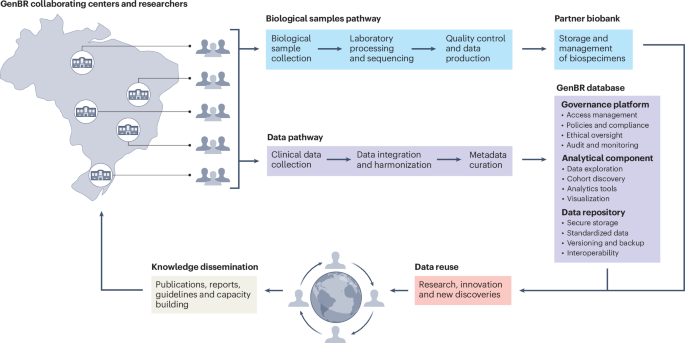
When doctors can read a patient's genetic code as easily as checking their blood pressure, healthcare becomes something entirely new. Brazil is working to make that future real for 215 million people through a program called Genomas Brasil — and the rest of the world is watching.
Researchers led by Giovanny Vinícius Araújo de França published their findings in the journal Nature Medicine in July 2026, describing how Brazil is weaving large-scale genomics directly into its universal public healthcare system, known as SUS (Sistema Único de Saúde). Instead of genomics staying locked inside elite research labs, Brazil is bringing genetic science to the hospitals and clinics where ordinary people actually get care.
The program tackles three big challenges at once: building the machines and labs needed to read genetic code at massive scale, training doctors and nurses to actually use that information, and figuring out how to pay for it all within a public system. Most countries with advanced genetic medicine keep it for people who can afford private care. Brazil is attempting something different — using genomics to improve health for everyone, regardless of income.
What makes Brazil's approach particularly interesting is its ambition to serve as a model for other nations in the global south. Countries in Africa, Asia, and Latin America face similar questions: How do you build genetic healthcare when you don't have the infrastructure that wealthier nations take for granted? Brazil's experience — what worked, what didn't, and what surprised everyone — could save years of trial and error for other nations trying to achieve the same goal.
The researchers call their vision "genomic equity" — meaning that people in São Paulo shouldn't have better genetic healthcare than people in the Amazon region, and that Brazilians shouldn't be left behind while Americans or Europeans get cutting-edge medicine. It's a tall order, but Brazil's unified health system gives it something most countries lack: a single national network that can, in theory, deliver the same care everywhere from big cities to remote towns.
Whether other countries can replicate Brazil's approach remains to be seen, but the attempt itself marks a shift in how the world thinks about who gets access to the most advanced forms of medicine.