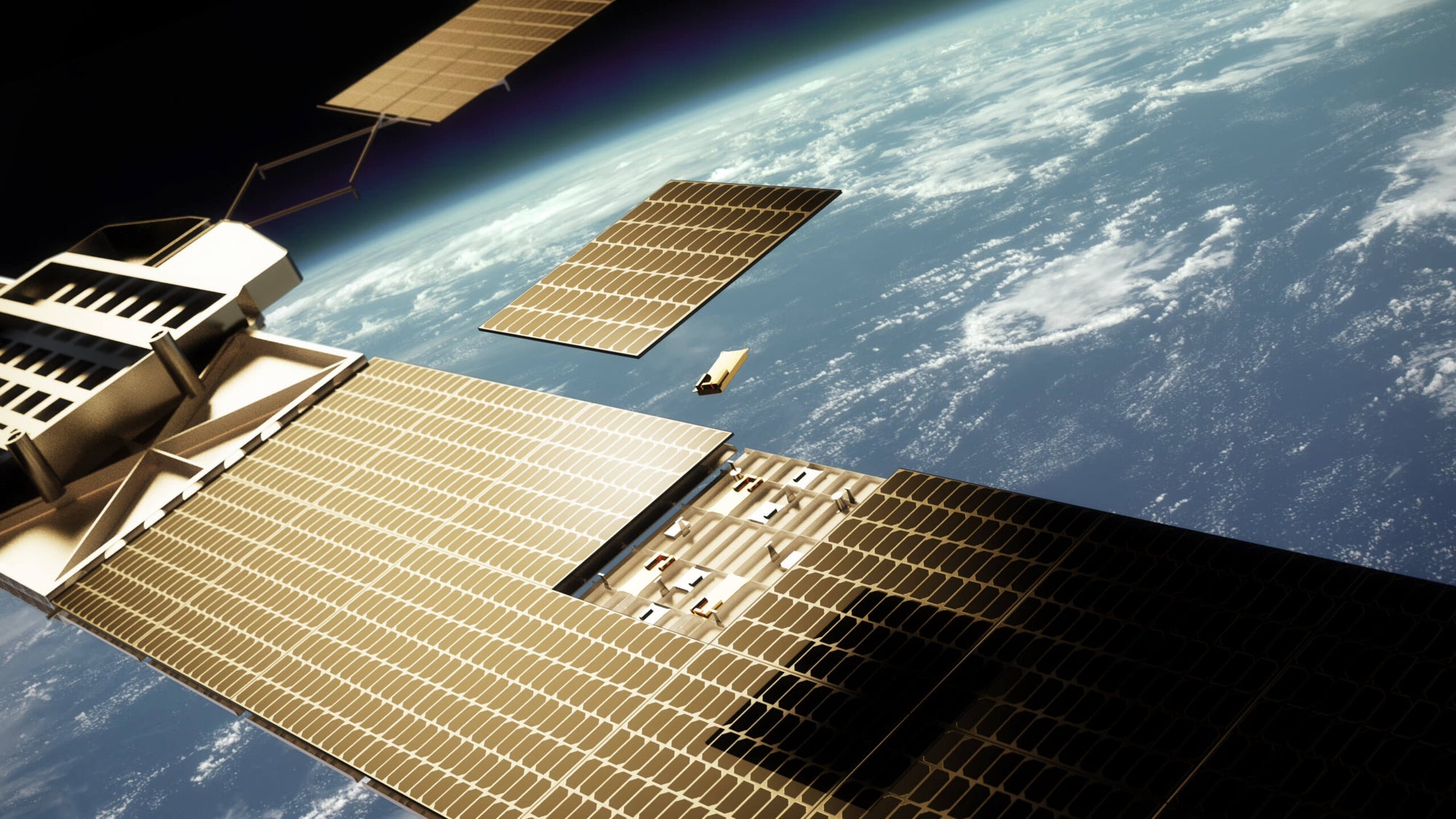
Imagine a future where the question you ask Alexa or ChatGPT doesn't travel to a noisy building packed with computers in Virginia — but instead zings up to a satellite orbiting Earth, gets answered in the cold silence of space, and comes right back to you. That world might be closer than you think. But there's a huge problem standing in the way: heat.
Here's why it matters right now. AI companies are building more and more data centers — those big buildings full of computers that run chatbots, search engines, and smart assistants. In Henrico County, Virginia, 37 data centers have already arrived. The? Residents' electricity bills soared. Schools and government buildings were asked to turn off lights and avoid space heaters just to keep the power grid from buckling. A recent Gallup poll found roughly 70 percent of Americans oppose data centers being built near their homes. "No data center" signs are showing up on lawns across the country.
Yet AI keeps growing. Something has to change. And now, a team from Sophia Space and the California Institute of Technology (Caltech) has patented a solution that sounds like science fiction: a cooling system for computer chips that works in the vacuum of space.
Called Sophia TILE, these small tiles could be linked together by the thousands to form massive orbital data centers — or scattered in smaller groups across Earth's orbit. Each tile contains solar cells, computer processors, memory, and special hardware for communicating with Earth. But the clever part sits underneath: a custom material that converts heat into infrared radiation and dumps it straight into deep space. No fans, no water, no bulky cooling towers — just invisible light carrying the warmth away.
"This patent reflects a different way of thinking about computer infrastructure in space," said Leon Alkalai, founder and chief technology officer at Sophia Space, in a press release. "Instead of beaming down energy to Earth from orbit, we decided to consider putting computing in space and beam down data."
The idea isn't totally new. The International Space Station and satellites already use solar panels that work continuously in orbit, unlike on Earth where panels go dark at night. But AI demands far more power than simple satellites. Traditional space cooling requires huge radiators, and in space, weight equals money. TILE's approach sidesteps that by making each tile its own tiny cooling system.
The team hopes to test their vision by 2030. Meanwhile, competition is heating up. ADA Space (a Chinese company working with Zhejiang Lab) has already launched satellites for its Three-Body Computing Constellation and plans a much larger network. American companies including SpaceX, Starcloud, and Blue Origin are seeking permission for constellations that could grow to include up to one million AI-capable satellites.
The race to build the internet's next backbone — floating in the sky — is officially on.