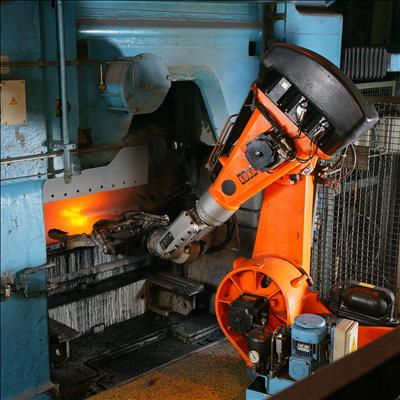
In factories across the world, millions of tireless machines are performing the work that once required human hands—and they're doing it with a precision and endurance that humans simply cannot match. Industrial robots, those automated and programmable machines capable of movement on three or more axes, have become the backbone of modern manufacturing, welding components together, assembling circuit boards, painting surfaces, and packaging products at speeds that reshape entire industries.
The scale of this transformation is staggering. As of 2024, an estimated 4.6 million industrial robots are operating worldwide, according to the International Federation of Robotics. That's not a small corner of the economy—it's a fundamental restructuring of how goods get made, affecting everything from the food on grocery shelves to the devices in people's pockets.
What makes industrial robots so valuable is their combination of capabilities: high endurance, speed, and precision working in tandem across multiple axes. They excel at the kinds of repetitive, demanding tasks that would exhaust or injure human workers. A robot can weld joints with millimeter accuracy, assemble tiny components on circuit boards, palletize bread at a bakery in Germany, or inspect products for defects—all day, every day, without fatigue.
The diversity of robot types reveals how specialized these machines have become. Articulated robots, which resemble a human arm and are the most common industrial robots, offer remarkable flexibility with their multiple joints and degrees of freedom. Cartesian coordinate robots, also called gantry or x-y-z robots, move along three perpendicular axes with precision suited to tasks requiring exact spatial positioning. Cylindrical coordinate robots, with their rotary base and sliding joints, are compact enough to reach tight workspaces. Spherical coordinate robots, relying entirely on rotary joints, were among the first robots deployed in industry and remain essential for die-casting, plastic injection, and welding operations. SCARA robots—Selective Compliance Assembly Robot Arms—are purpose-built for assembly work requiring precise lateral movements, while delta robots, also called parallel link robots, excel at rapid pick-and-place operations that demand high maneuverability.
Beyond these varied designs, robots are engineered with different architectural philosophies. Serial manipulators, designed as a chain of links connected by motor-actuated joints extending from base to end-effector, are common and versatile. Parallel manipulators, by contrast, use shorter, simpler chains that distribute errors and create a stiffness that serial designs cannot match. This closed-loop rigidity makes parallel robots exceptionally stable relative to their individual components.
The implications ripple far beyond factory floors. Industrial robots have fundamentally altered manufacturing economics, allowing companies to increase productivity while maintaining quality in ways previously impossible. They handle material with an efficiency that human workers cannot sustain, and they work in environments—foundries, chemical plants, hazardous assembly lines—where human safety becomes paramount.
As automation becomes ever more sophisticated, the role of industrial robots continues to expand. These machines represent not the replacement of human capability, but an augmentation of it—taking over the work that demands inhuman precision, endurance, and consistency, while allowing human workers to focus on tasks requiring creativity, judgment, and adaptability. The 4.6 million robots operating today are reshaping the future of manufacturing, one precise movement at a time.