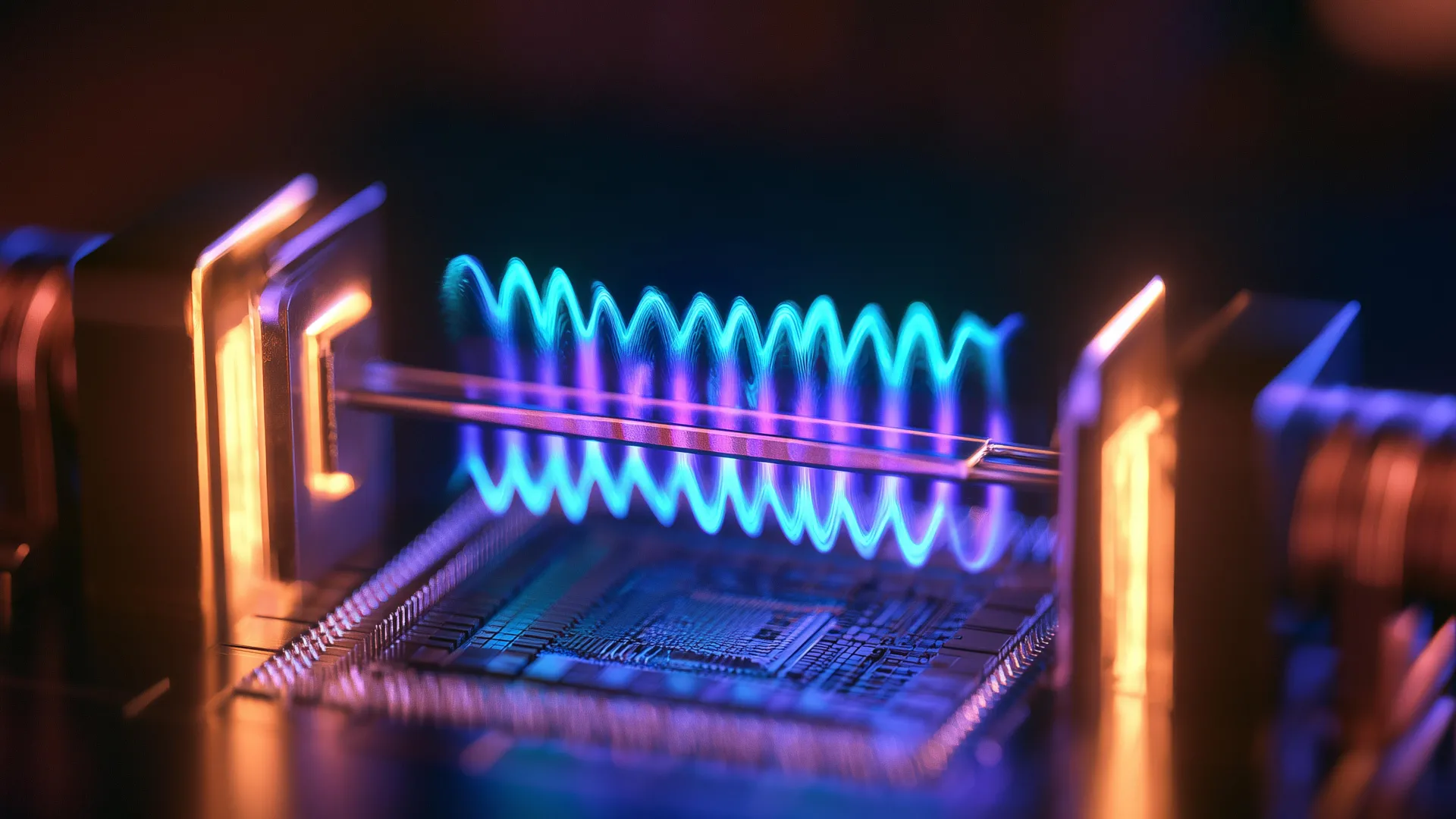
Inside a tiny quantum chip at ETH Zurich, information can be held in vibrations too fast for human ears to hear. Physicist Yiwen Chu and her team have built a quantum memory that stores data in mechanical motion, drawing on the same basic idea as a guitar string vibrating to make a note.
The work offers a new way to organize a quantum computer. Many systems combine the parts that process information and store it closely together. Chu’s design gives them more separate roles, borrowing a familiar idea from everyday computers: a processor works on information, while working memory holds it ready for use. The researchers reported their results in the journal Science.
In the ETH Zurich system, a superconducting qubit acts as the processor and control unit. A qubit is the basic unit of information in a quantum computer. The system’s separate memory uses tiny structures called mechanical resonators. They store information in particular patterns of vibration. When the qubit needs the information, it can access the stored state, carry out an operation and return the changed information to memory.
That is different from the electromagnetic memory used in many existing quantum computers. “In our quantum working memory, however, information is not stored electromagnetically—as is usually the case today—but rather in the form of mechanical vibrations,” Chu said.
Quantum computers are being developed because quantum effects such as superposition and entanglement may help them solve some highly complex problems faster than conventional machines. But their information is delicate: small disturbances can disrupt quantum states and cause data to be lost. Reliable computing depends on moving and changing those states with great care.
The team’s experiment is the first demonstration, according to the source account, that mechanical resonators can work with superconducting qubits to carry out quantum computations. It shows that vibration-based memory is a feasible alternative, though it does not mean that practical, large-scale quantum computers are already here.
Mechanical memory could help with some persistent design challenges. The resonators are substantially smaller than electromagnetic memory systems, which can take up considerable space in experimental devices. A more compact design may make it easier to expand quantum hardware. Resonators can also support many distinct vibration patterns, offering the possibility of storing more information at once. And mechanical vibrations may preserve quantum states longer before the stored information fades—a potential advantage when a calculation needs information to last through several steps.
Those benefits still need to be tested as researchers develop the technology. The crucial question is whether the memory and processor can exchange quantum information accurately and consistently, while keeping it intact. Chu described that link as a foundation for quantum computers that could eventually perform calculations beyond the reach of conventional computers. For now, the result is a clear proof of principle: a computer’s working memory may not need to look like a circuit. In this one, it can vibrate.