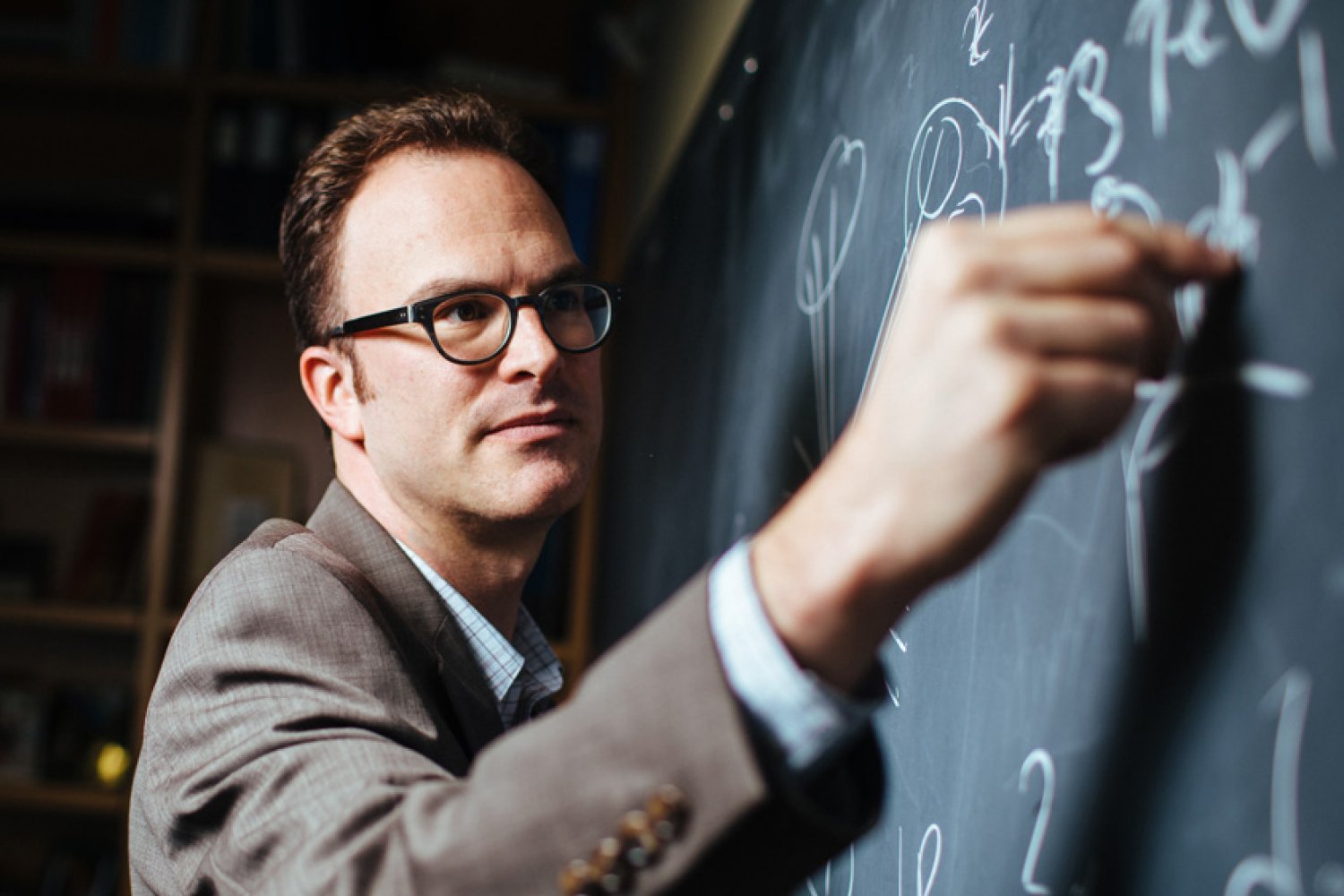
A physicist who teaches machines to hunt for the universe's deepest secrets is taking the helm at one of America's leading nuclear science labs. Professor Jesse Thaler has been named director of MIT's Laboratory for Nuclear Science, effective August 1st, succeeding Professor Bolek Wyslouch, who led the lab for the past decade.
Thaler studies tiny particles smaller than atoms, using both math and artificial intelligence to solve puzzles about how the universe works. Colleagues say he has done groundbreaking work on particle jets at the Large Hadronic Collider — a massive underground particle smasher in Europe — and has become a leader in applying AI to physics research.
"In his research, Jesse has done pioneering work on particle jets at the Large Hadronic Collider and is a leader in combining AI and machine learning with fundamental particle physics," says Nergis Mavalvala, dean of MIT's School of Science.
Since 2020, Thaler has led the NSF AI Institute for Artificial Intelligence and Fundamental Interactions, or IAIFI. That institute was recently renewed for another five years, a vote of confidence in its work. Under his leadership, IAIFI created a new doctoral program combining physics, statistics, and data science, plus special fellowships giving young researchers freedom to work across different fields.
"Giving young scientists space to build connections across domains, universities, and career stages has been transformative within IAIFI," Thaler says. He hopes to bring that same spirit to the Laboratory for Nuclear Science.
The lab, founded in 1946 to study nuclear and particle physics, now stretches into cosmology, gravity, and quantum information science. It is also joining the Department of Energy's Genesis Mission, which focuses on AI-enabled scientific discovery.
Thaler earned his PhD from Harvard University in 2006 and his undergraduate degree from Brown University in 2002. He joined MIT's faculty in 2010 and is the William and Emma Rogers Professor of Physics.
His home research center, the Center for Theoretical Physics, received the largest philanthropic gift ever for the field of theoretical physics — a donation from the Leinweber Foundation to build a network of research institutes. As the new lab director, Thaler will oversee that center too.
Looking ahead, Thaler sees AI as a tool that could unlock discoveries far beyond particle physics. "The algorithms themselves turn out to be valuable well beyond our field," he says, adding that he is eager to bring the lab "into the next wave of discoveries supported by AI-driven capabilities."