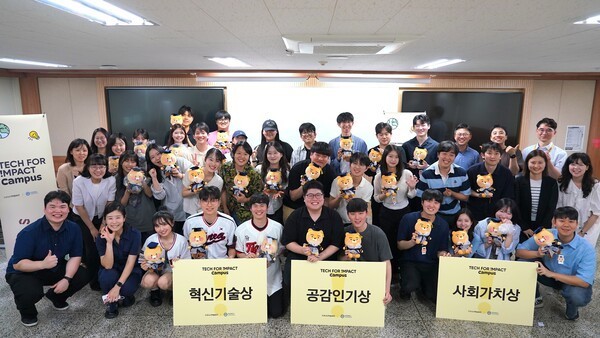
At Hanyang University, a group of students huddle around a laptop, fine-tuning an AI-powered app called Naranhi that translates school announcements into multiple languages for immigrant parents—just one of 42 student-led tech projects born from a semester of field research, mentorship, and purpose. This wave of innovation emerged from the Tech for Impact Campus program, a joint initiative by Kakao Impact Foundation, the Ministry of Education, and the Korean Council for University Education, which wrapped its first-semester showcase on June 19. Since its 2023 launch at KAIST, the credited university course has become a blueprint for experiential learning, now spanning nine schools and engaging 482 students who don’t just code—they connect.
This semester alone, 182 undergraduates from Dankook, Sogang, Ewha Womans, Yonsei, Hanyang, and DGIST universities tackled pressing issues like regional decline, mental health, climate change, and social inclusion. Guided by 45 mentors from Kakao and 12 social innovation organizations, they transformed classroom theory into real-world tools. Among the standout projects was NetLog, a data-driven system that tracks and manages the lifecycle of discarded fishing nets to boost ocean recycling, and Ogu Ogu, an app helping women in their 20s and 30s track consumption habits alongside emotional well-being—a quiet but powerful nod to mental health in everyday life.
The program’s impact goes beyond prototypes. At Hanyang, Professor Shin Hyun-sang, who has led the course for two semesters, now faces a waiting list so long that students must be pre-screened. "In the AI era, higher education must move beyond simply delivering knowledge and provide students with opportunities to understand real-world challenges, collaborate with others and solve problems," he said. That shift is already visible: students aren’t just building apps—they’re building empathy, iterating with community partners, and learning that technology’s highest purpose may be service.
The foundation’s vision is expanding fast. Following a April memorandum with the Ministry of Education and KCUE to co-develop foundational AI curricula, Kakao Impact Foundation will scale Tech for Impact Campus to 13 universities this fall—including five selected for the government’s AI basic education initiative. For Ryu Seok-young, chairman of the foundation, the goal is clear: redefine talent. "People who can meet users in the field, identify the problems society needs to solve and apply technology to address them are the real talent of the AI era," he said. As classrooms evolve into innovation labs, one thing is certain: the future of AI isn’t just smart—it’s deeply human.