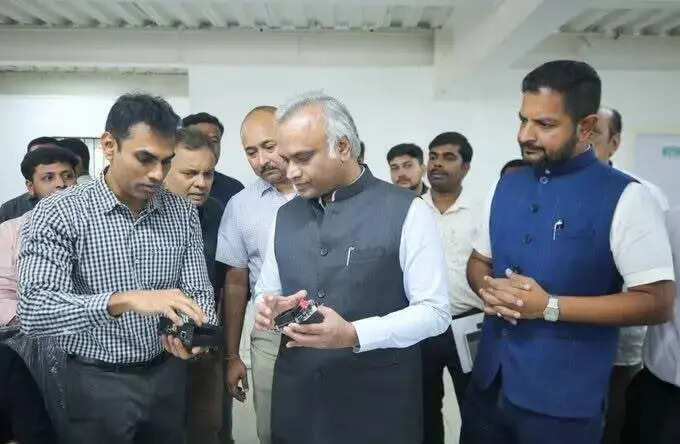
Karnataka Minister Priyank Kharge stepped into the KEONICS manufacturing facility in Peenya this week to watch the assembly line of a machine that may reshape how rural youth access artificial intelligence. The KEO—an indigenously developed, AI-ready personal computer priced at ₹18,999—is being rolled out in its first batch of 2,000 units across the state, marking a deliberate shift away from concentrating technology wealth in Bengaluru.
The digital divide in India has long meant that advanced tools arrive last, if at all, to students in rural areas. KEO addresses this with a design built specifically for scarcity: the device runs on open-source architecture and a RISC-V processor, allowing AI applications to function locally without demanding constant internet connection. In regions where connectivity is weak or sporadic, the system still works. For students in classes six to 10, that means access to AI literacy, spoken English modules, digital skills training, competitive exam preparation, and state learning content—resources that would otherwise require travel to cities or expensive private tuition.
The initiative sits within a larger framework called ArivuKendra.ai and Schools.ai, which aims to place AI-enabled systems across 239 taluks throughout Karnataka. This is not a one-off gesture. The majority of the first 2,000 devices will land in rural libraries, with the remainder distributed across educational institutions—deliberately choosing community spaces as distribution hubs rather than treating this as a consumer product launch.
Kharge's visit to the assembly line and his conversation with engineers underscored official commitment to manufacturing as well as policy. His statement captured the scale of what's being attempted: "This is not just a technology rollout—it is a step towards reducing the digital divide, creating AI-ready youth, and ensuring that the future of technology belongs to every child in Karnataka." Karnataka has positioned itself as a technology state beyond its Bengaluru headquarters, and this deployment reflects that ambition.
The cost point matters. At ₹18,999, a KEO sits within reach for institutional budgets in ways that premium laptops do not. Schools and libraries can outfit classrooms and community spaces rather than remaining dependent on donations or grants for aging equipment. The device's ability to run AI applications offline removes a critical barrier: students no longer need expensive, reliable broadband to learn prompt engineering, engage with learning content, or develop digital competency.
Rural youth have historically waited for technology adoption to trickle down. Instead, Karnataka is pushing the innovation in the opposite direction—manufacturing at scale, pricing with distribution in mind, and deliberately routing hardware to the places where access gaps are widest. Whether the 2,000 units catalyze broader adoption across the 239 taluks, and whether students actually engage with the AI and digital skills content loaded onto these machines, remains to be seen. But the specificity of the rollout—named devices, named locations, named minister overseeing production—suggests this is built to last beyond the announcement cycle. In a moment when AI conversations often sound abstract and far from rural reality, Karnataka is building something concrete: a machine designed to work where the internet doesn't, distributed where youth need it most.