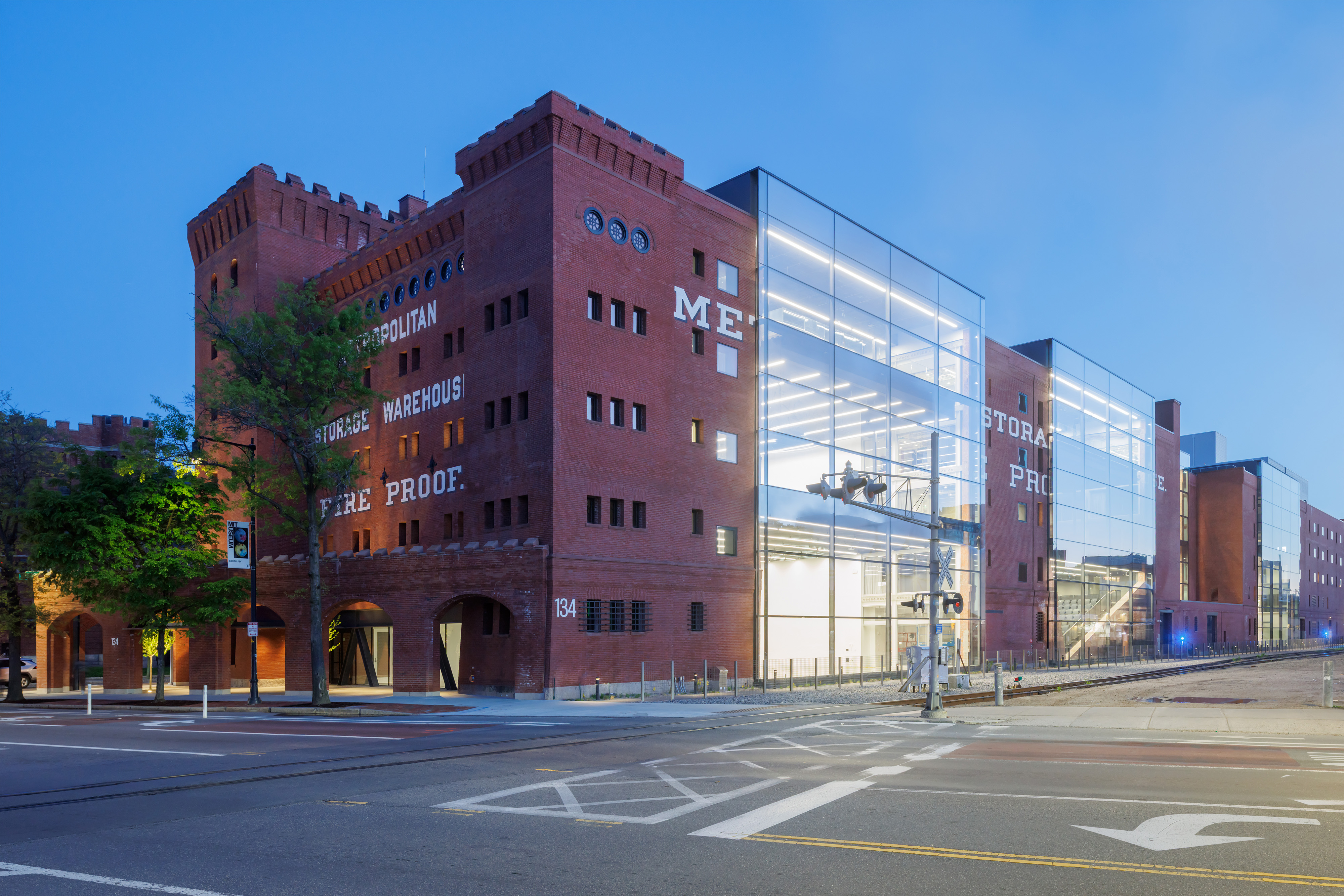
Imagine a fortress-like brick building that once stored 1,500 peoples' belongings behind tiny window slits, now transformed into a sun-filled campus where architects and planners will shape the future. That transformation is happening right now in Cambridge, Massachusetts, where the Metropolitan Storage Warehouse — known locally as the Met Warehouse — has opened as the new home of MIT's School of Architecture and Planning.
The building stretches over 500 feet long and rises five stories high. First opened in 1894 and completed in 1923, it sat as a forbidding landmark visible from across the river in Boston. Only a few people ever had reason to step inside. MIT bought the building back in 1962, and by 2015 it was no longer used for storage. The question then became: what comes next?
The answer, nearly a decade in the making, is a remarkable fusion of old and new. The architecture studio Diller Scofidio + Renfro, the firm behind New York City's High Line and the Broad Museum in Los Angeles, designed a conversion that punches through the fortress walls with four segments of glass, adds double-height studio spaces, and creates building-long walkways overlooking work areas on all five floors — a 21st-century version of MIT's famous Infinite Corridor. The architects expanded the windows, added a connective staircase, and found new ways to flood light into the massive structure.
"Walking through the Met Warehouse, everywhere you look you see the artful melding of the original architecture with the new design," said MIT President Sally Kornbluth. "The new Met Warehouse will create a central home for design at MIT, and together with the new Linde Music Building, the presence of the Met will create a magnetic new west campus district for arts and design."
Dean Hashim Sarkis, who championed the project alongside his collaborators, called it "a big statement on the part of MIT." He noted that the faculty and students wanted more research space, more room for exhibitions and galleries, and more places to work together in person.
"Design is about collaboration, and planning is about community," Sarkis said. "We're expecting the Met to facilitate a very vibrant in-person culture."
Faculty, staff, and students started moving in this month. A ceremonial procession into the building is scheduled for September 8, with a formal dedication on October 1. The public gets its chance to explore on October 3 as part of MIT Future Fest.
The project also sends a broader message about sustainability: instead of demolishing and rebuilding, MIT chose to adapt an existing structure for the future — exactly the kind of thinking its architecture school teaches.