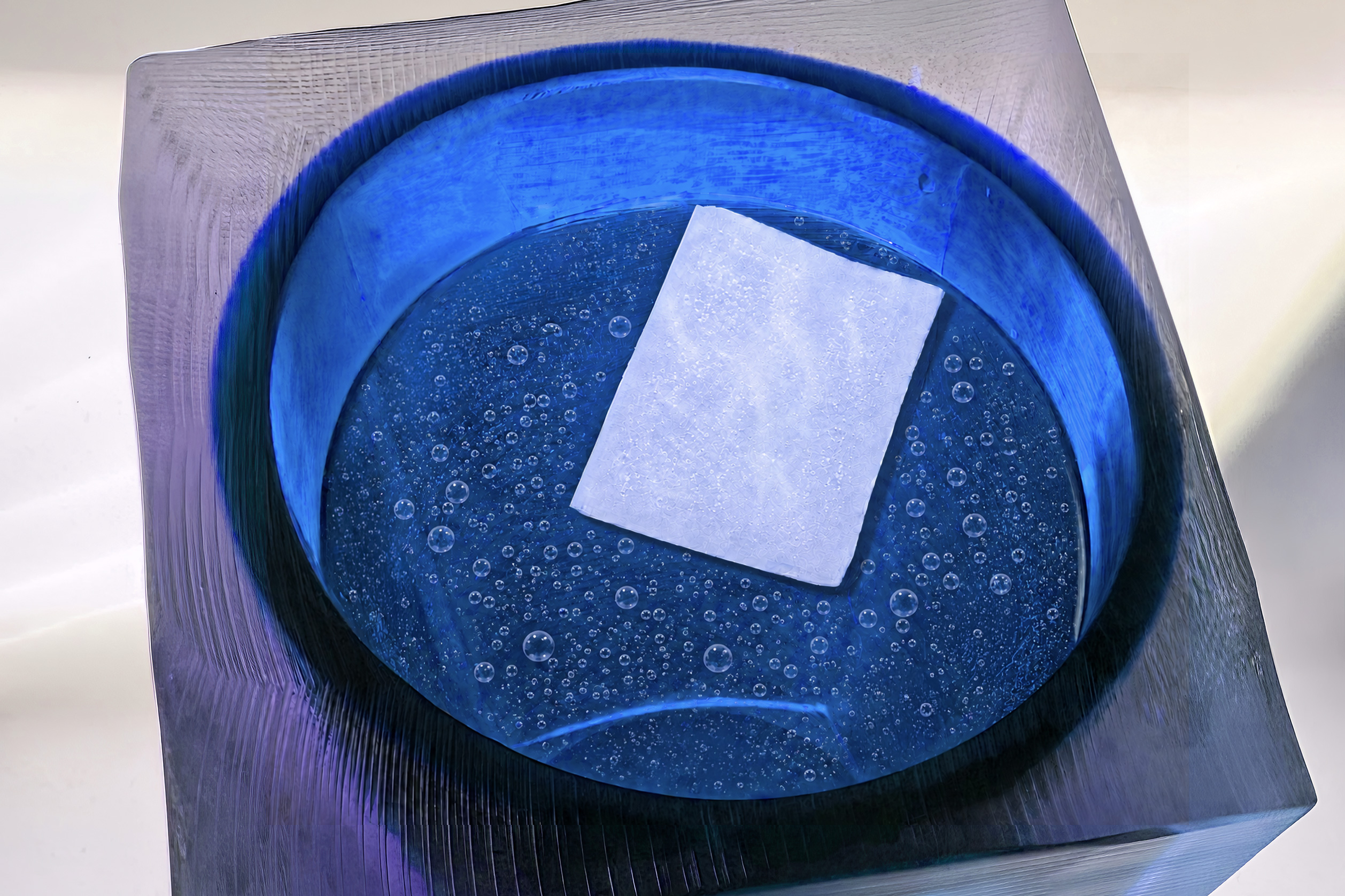
Xuanhe Zhao once posed a question that stumped engineers for years: Why can't you breathe through Jell-O?
The MIT mechanical engineering professor had a reason for asking. His team had been trying to create a hydrogel—a squishy, water-heavy material used in bandages and medical patches—that actually lets air pass through. Hydrogels are incredibly useful. Doctors use them to dress wounds, attach implants, and release medicine slowly over time. The problem? They're basically sealed. Wear a hydrogel bandage too long, and moisture and sweat get trapped underneath, irritating the skin.
"Hydrogel is 80 to 90 percent water, similar to Jell-O," explained Xiao-Yun Yan, a co-lead author on the project. "And you cannot breathe through Jell-O."
But now Zhao and his team at MIT have cracked the problem. In research published in the journal Nature, they describe a new breathable hydrogel that stays soft and stretchy while allowing air to circulate. The secret lies in tiny tunnel networks woven throughout the material.
To create these tunnels, the researchers mixed their hydrogel recipe with a small amount of silica aerogel particles—essentially solid-form air bubbles that act like highways for air to travel through. The particles are hydrophobic, meaning water doesn't penetrate them, so they remain stable even in the wet environment of a hydrogel. Think of them like boba beads scattered throughout the gel, carving out pathways that air can follow.
The team tested the material on real people. Volunteers wore wireless heart monitors attached to their chests with the new breathable hydrogel. After exercising regularly for 10 days, none of the volunteers showed any signs of skin irritation. The heart monitors also maintained clear readings throughout the test, meaning the hydrogel worked well without breaking down.
This matters because current hydrogel products—bandages, cosmetic face masks, contact lenses—often have to be removed or replaced frequently to prevent skin problems. A breathable version could stay on longer and work better.
"Water and oxygen are both essential for life," Zhao said. "Now that we've added air to hydrogels, people can find broad applications."
The research team included 16 co-authors from MIT and other institutions, with Zhao holding the title of Uncas (1923) and Helen Whitaker Professor of Mechanical Engineering. The project took several years to complete.
The breakthrough could eventually lead to longer-lasting hydrogel products, from bandages that heal wounds without irritating skin to health monitors that stay accurate during exercise. It turns out the question wasn't whether you could breathe through Jell-O—it was whether you could redesign Jell-O from the inside out.