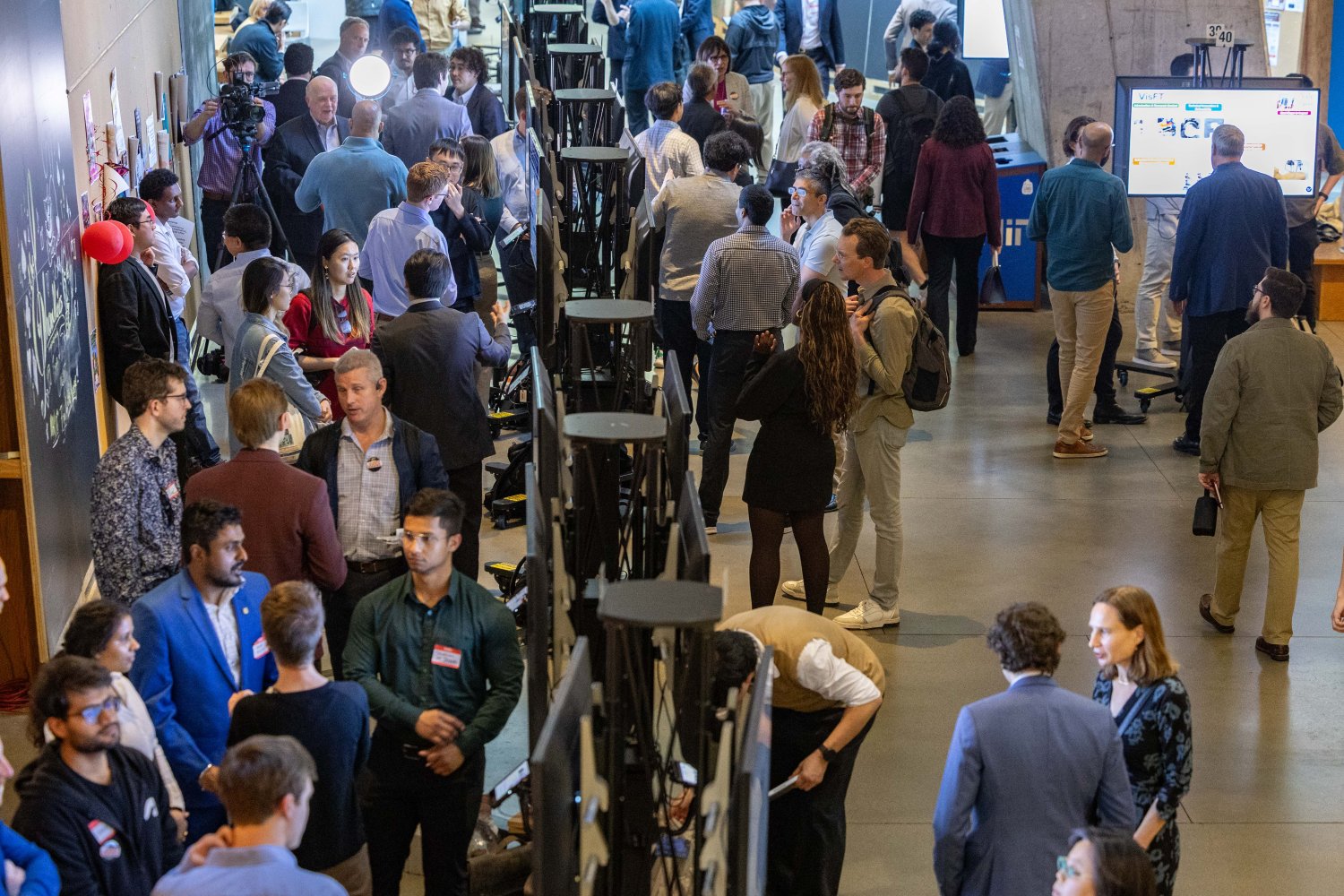
Jake Read, an MIT PhD student, stood in front of a room buzzing with engineers, investors, and industry leaders, presenting a bold idea: a future where manufacturing machines no longer rely on decades-old G-code, but instead use modular, intelligent control systems that accelerate innovation. His project, 'The End of G Code,' won top honors at the Initiative for New Manufacturing’s (INM) first research showcase, one of the highlights of MIT Manufacturing Week in Cambridge this past May. Over four days, more than 800 students, faculty, entrepreneurs, and executives gathered across campus to confront the urgent challenges and opportunities reshaping American manufacturing — from AI-driven factory floors to the looming workforce shortage.
Launched just a year earlier, INM was built on a simple but powerful premise: revitalizing U.S. industry demands collaboration, and MIT has a role to lead it. 'The appetite for change — from students to chief executives — is real and urgent,' says Paula T. Hammond, dean of MIT’s School of Engineering and co-chair of INM’s Steering Committee. That urgency echoed throughout the week, from a cybersecurity workshop co-led by Google Cloud to the MIT MIMO symposium, where AI’s role in manufacturing operations took center stage. A regional research competition brought together over 140 graduate students and postdocs from across New England, showcasing the next wave of industrial innovation.
Among the 140 teams that applied to INM’s inaugural research showcase — representing 17 universities — 40 finalists received mentorship through a partnership with NSF I-Corps New England. Eight teams ultimately shared $50,000 in prize funding. Beyond Read’s top prize for transformative innovation, MIT’s Vatsal Patel and Yale’s Joshua Grace won for 'VisFT,' a breakthrough in scalable six-axis force-torque sensors. Projects spanned AI tools, semiconductor process control, robotics, digital twins, and biomanufacturing, reflecting the breadth of technological frontiers now converging in modern factories.
The momentum extends beyond the campus. First Solar joined during the event as INM’s eighth industry member, alongside Amgen, Siemens, and GE Vernova, signaling growing corporate confidence in the initiative’s collaborative model. These companies are working with MIT on shared challenges — from AI in regulatory environments to workforce transformation — through targeted workshops and working groups. The Cheng Wu Foundation’s support of the research showcase further underscores the broad ecosystem rallying behind this effort.
'Entrepreneurship is a transformative pathway to take research to market, and to drive faster innovation and scale-up,' says John Hart, INM faculty co-director and head of MIT’s Department of Mechanical Engineering. With plans to expand into a nationwide platform, INM is not just building momentum — it’s redefining what modern manufacturing can be.