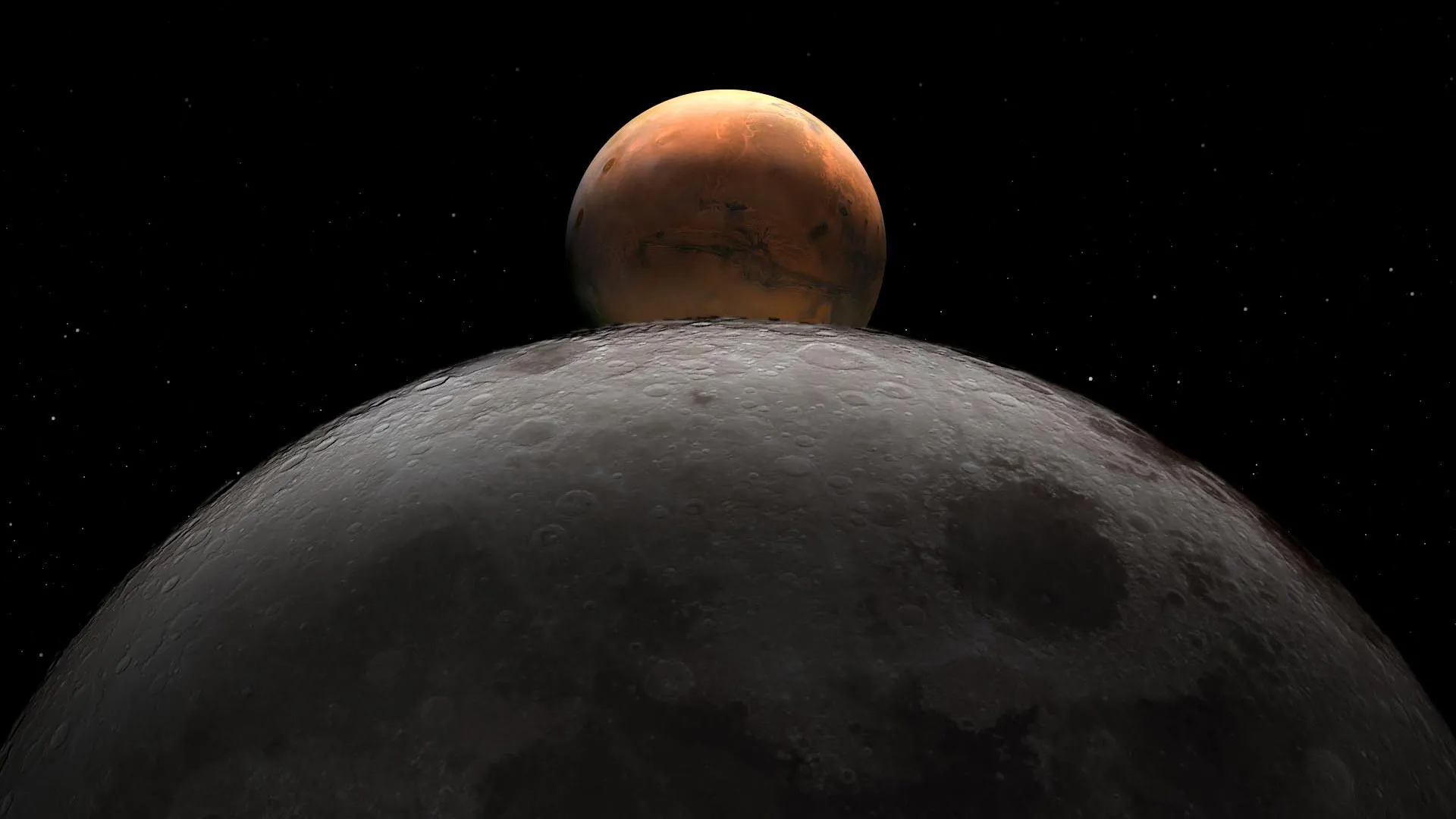
Imagine trying to survive two weeks in complete darkness, with temperatures dropping to minus 280 degrees Fahrenheit. That's what astronauts will face on the Moon, and a company called Lockheed Martin just got picked by NASA to help solve that problem.
NASA announced it has selected 41 technology proposals from 37 American companies as part of its 2025 Announcement of Collaboration Opportunity. The program teams NASA with businesses to develop capabilities needed for missions to the Moon and Mars.
The announcement focuses on building the infrastructure for long-term space exploration — not just sending astronauts there, but keeping them alive and working once they arrive.
"We are empowering American industry to become active partners in NASA's missions to the Moon, Mars, and beyond," said Greg Stover, director of the Advanced Research and Technology Division at NASA Headquarters in Washington.
The program doesn't give companies direct money. Instead, NASA shares its equipment, computer programs, and expert knowledge with businesses. This helps companies develop new technologies faster, and those technologies can later serve both private customers and government missions.
Since the program started in 2015, NASA has supported more than 110 projects. The agency contributed roughly $30 million in resources while companies added $32 million of their own investment. Each partnership lasts between 12 and 24 months.
Among the selected projects, Lockheed Martin will advance a compact, modular power system designed to generate electricity in the Moon's permanently shadowed regions — areas where sunlight never reaches. The company is also working on a wireless power transfer system using fiber lasers.
Another company, Kall Morris Inc., is developing Asteria — a payload attachment system that uses a special non-destructive adhesive to stick to spacecraft without requiring built-in mounting hardware. NASA says the technology could help with satellite protection, spacecraft maneuvering, and extending mission lifetimes.
Moonprint Solutions, a small business, is creating flexible protective covers to shield equipment from the Moon's abrasive dust, which can damage rovers, robotic joints, and other moving parts. This could support long-term operations on both the Moon and Mars.
NASA says these projects could eventually benefit more than just space exploration. As the technologies develop, they could create new markets, lower costs, and introduce entirely new capabilities for the commercial space industry.
The 2025 selections target six priority areas: propulsion components, guidance and navigation systems, landing technologies, in-space servicing, assembly and manufacturing, and energy management systems.
"By tapping into commercial industry, NASA can rapidly develop key capabilities to support its most ambitious missions while fostering the nation's robust space economy," Stover said.