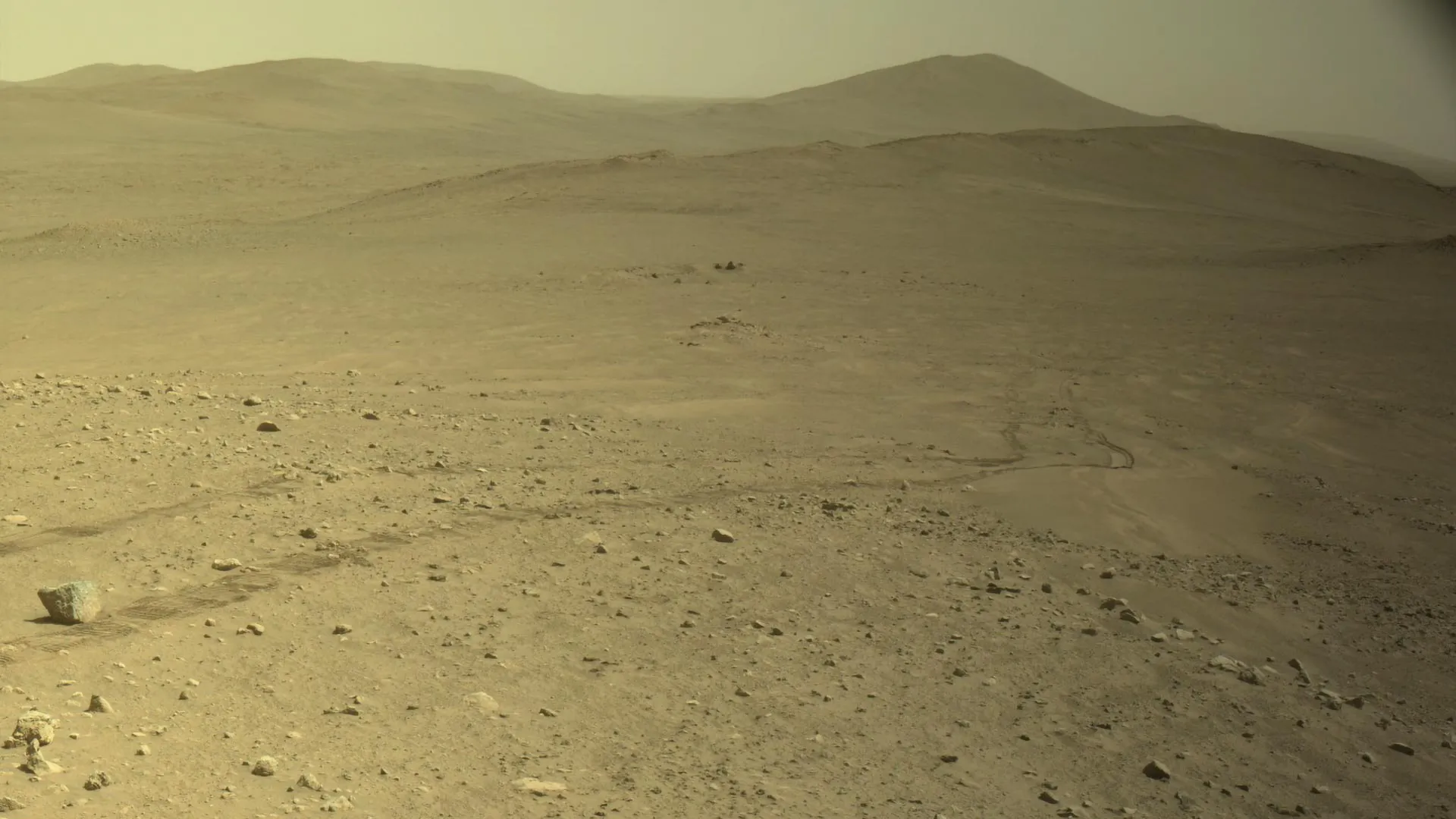
On Oct. 11, 2026, NASA’s Perseverance rover had covered 45.22 kilometers—28.10 miles—across the surface of Mars, more than any vehicle has traveled on another world. The milestone came after the rover spent weeks studying rocks instead of rushing to set a record.
That choice reflects Perseverance’s main purpose: to explore Mars and investigate clues preserved in its ancient landscape. The rover came within 200 meters of the previous travel record on Sol 1947, about two months before it broke through. That distance was short enough for one drive using AutoNav, its system for navigating on its own. But the rover was then among scientifically valuable ancient rock outcrops, so its team kept it there to study exposed surfaces.
Perseverance made short trips between rock locations, grinding away thin layers and taking detailed measurements. After the work was done, it set off again and passed the record. Guinness World Records recognized the achievement with a commemorative plaque presented to the rover’s engineering twin on Earth.
The long journey has also helped NASA improve how the rover handles rough terrain. Perseverance has crossed tight fields of boulders and steep slopes, giving engineers experience with the hazards future routes may bring. After thousands of computer simulations, they changed several limits: the rover can now handle tilts of up to 24 degrees, and its minimum clearance beneath the protective belly pan is 20 centimeters, or about 7.9 inches.
Other updates help it steer and avoid trouble. New braking software helps prevent collisions with rocks, and the current limits for the steering motors have been nearly doubled. Engineers also added “dynamic slip tables” to the flight software. These help the rover estimate how much its wheels may slide on different ground. On slopes, it can use driving paths that help keep its wheels securely on exposed bedrock.
A separate advance may help Perseverance travel farther with less guidance from Earth. Its onboard Global Localization system, called GBLC in the source material, uses a processor first installed in the Ingenuity helicopter’s base station. After a drive, it compares images from the Martian surface with pictures taken from orbit to estimate the rover’s location in global coordinates. Mars has no GPS network, so this gives the rover another way to work out where it is.
The added processor was not designed specifically for Mars’ harsh radiation. Radiation can cause brief changes in computer memory, known as “bit flips,” that may disrupt software. Engineers developed software protections to help the processor keep working reliably.
NASA is also studying whether generative AI could help plan the many separate driving segments in a longer journey, giving AutoNav routes to follow. Perseverance’s record is a measure of distance, but also of what engineers are learning: each careful mile can make future exploration more capable and independent.