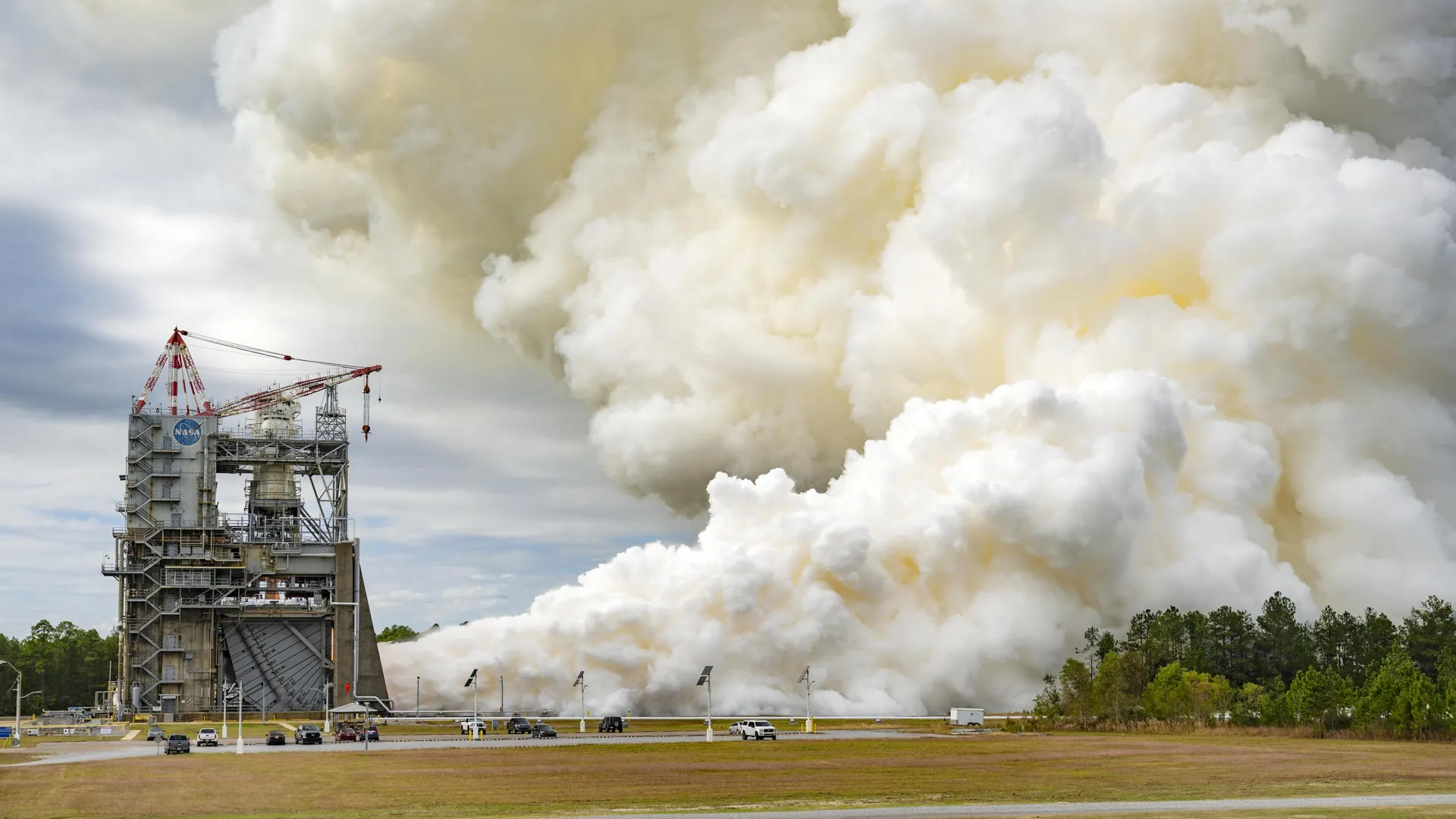
At the Fred Haise Test Stand in Mississippi, RS-25 engine No. 10001 roared for 200 seconds on November 18—the full length of its planned test. The engine stayed on the ground, but the run gave NASA engineers fresh information for the rockets that will carry astronauts toward the Moon.
NASA is preparing a series of Artemis missions to return people to the lunar surface and build experience for future journeys to Mars. For those flights, the agency needs engines that can deliver enormous force and keep working under the strain of launch. Testing helps engineers check how an engine performs before it is cleared to fly.
The developmental engine fired at NASA’s Stennis Space Center, near Bay St. Louis, Mississippi. It ran for three minutes and 20 seconds, or 200 seconds, completing its full scheduled duration. This particular engine is not intended for spaceflight. Instead, NASA and its primary contractor, L3Harris Technologies, will study the test results to improve the power, efficiency and reliability of RS-25 engines planned for future Artemis missions.
The RS-25 is a key part of NASA’s Space Launch System, or SLS, rocket. Each SLS uses four RS-25 engines, which together can produce up to 2 million pounds of thrust. That force helps lift the rocket and its Orion spacecraft away from the launchpad and into space.
One mission in NASA’s plans is Artemis IV, scheduled for 2028. It is intended to land astronauts on the Moon and will launch from Kennedy Space Center in Florida. NASA’s wider goals include exploring the lunar South Pole and establishing a sustained human presence on the Moon. Work there could also help the agency develop the skills and technology needed for a crewed mission to Mars.
The test is one step in a process that puts reliability first. Before an RS-25 engine is approved for a flight, it must be tested at Stennis to check that it can withstand the extreme conditions of a rocket launch. Specialists from NASA, L3Harris Technologies and Nova Space Solutions work together on the testing effort.
A successful ground test cannot guarantee that every future mission will go exactly as planned. But it gives engineers evidence they can use to refine the engines before astronauts depend on them. As preparations continue for Artemis IV and other missions, the data from engine No. 10001 will help shape the power and performance of the rockets meant to carry people back to the Moon.