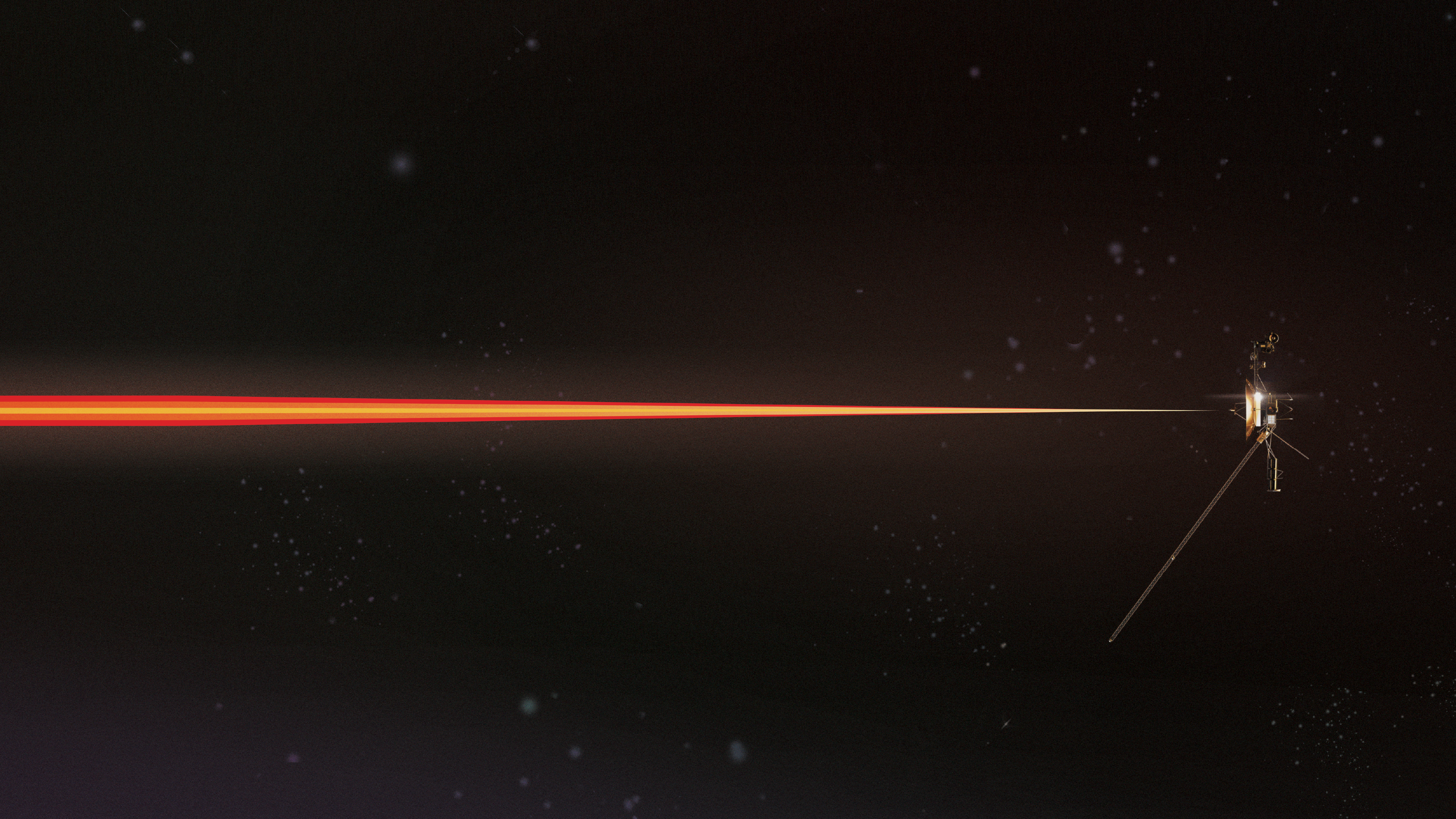
At 2:16 a.m. Pacific time on Nov. 18, 2026, Voyager 1 crossed a distance marker measured in light: one light-day from Earth, or about 16.1 billion miles. The probe’s signal took a full day to travel back to NASA’s team, a reminder that even a message from our most distant spacecraft now moves across an extraordinary stretch of space.
Launched in 1977 with its twin, Voyager 2, Voyager 1 was built to explore the outer planets during a rare alignment. The two probes became the third and fourth spacecraft to visit Jupiter and Saturn, and the first to send back high-resolution images of those worlds and their moons. Voyager 2 later went on to study Uranus and Neptune. Both craft continue to measure changes in the Sun’s magnetic field far beyond the planets.
A light-day is the distance light travels in 24 hours. Light moves through a vacuum at about 186,000 miles per second. Sunlight takes roughly 1.3 seconds to reach the Moon and about four hours to reach Neptune. From Neptune, it takes another 20 hours to reach Voyager 1. A light-year, a more familiar measure of cosmic distance, is about 5.88 trillion miles.
The milestone came during a communications challenge. NASA’s Jet Propulsion Laboratory (JPL) in Southern California had not received science or engineering data from Voyager 1 since Nov. 14. The craft was still sending a carrier signal, the steady transmission normally used to convey that information. Engineers combined that signal with calculations of the probe’s path to confirm it had crossed the light-day mark, while they continued to investigate the data problem.
Voyager 1 entered interstellar space in 2012, becoming the first human-made spacecraft to cross beyond the heliosphere—the vast bubble of particles and magnetic fields created by the Sun. Voyager 2 crossed the boundary in 2018. Scientists say the probes are revealing how the Sun continues to shape the space beyond that bubble. Voyager project scientist Linda Spilker said one open question is where the Sun’s influence finally ends.
The mission’s value reaches beyond its distance records. NASA’s Joe Westlake said Voyager’s outer-planet discoveries were followed by a lasting role in studying the Sun and its effects. JPL director Dave Gallagher credited the teams who built, programmed and still operate the probes across the vast distance. Each spacecraft also carries a Golden Record: a gold-plated copper disc of images and sounds from Earth, made as a message for any advanced civilization that might someday find it.
Voyager 1 has traveled for nearly half a century, and its journey is not over. Its signal now needs a day to reach home, but the probe is still sending a carrier transmission, and mission engineers are working to restore science and engineering data. As the spacecraft continues outward, it may help answer how far the Sun’s reach extends—and carries a record of Earth along with it.