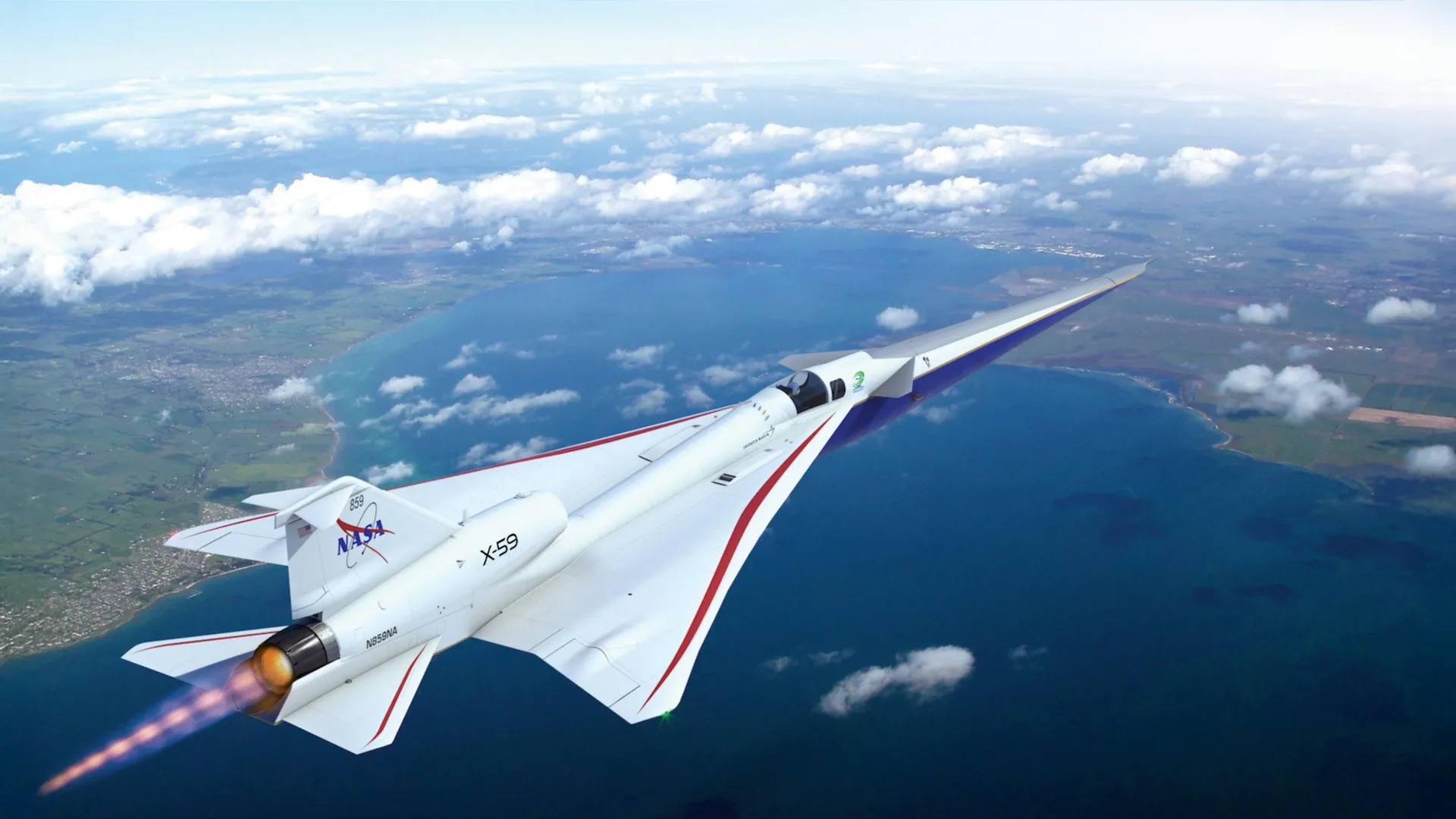
In early June 2026, NASA's X-59 will cross a threshold that has eluded this singular aircraft since its first takeoff: the sound barrier. After fourteen successful test flights since March and meticulous preparation by a team of engineers, the experimental jet is ready to break the speed of sound for the first time—a milestone that represents years of careful design and methodical validation compressed into a single, pivotal moment.
The X-59 quiet supersonic research aircraft exists for a specific and transformative purpose: to prove that aircraft can travel faster than sound without producing the thunderous sonic boom that has long been the signature of supersonic flight. This matters because supersonic travel over populated areas has been prohibited in the United States since 1973, effectively grounding the commercial dream of crossing the country in a few hours. If the X-59 succeeds, NASA's Quesst mission will collect the evidence needed to change that regulation, opening a path toward a future where quiet supersonic flight becomes possible.
The aircraft's first supersonic flight will occur at 43,000 feet, where the X-59 is expected to exceed 630 miles per hour—just beyond Mach 1, the speed of sound at that altitude. This is a crucial but controlled step; the real proof will come with the "mission conditions" flight, when the X-59 climbs to 55,000 feet and accelerates to Mach 1.4, or 925 miles per hour. Those specific numbers matter because they exactly match the performance envelope NASA will use for future flights over U.S. communities, where the true test begins: Will people tolerate the quieter "thump" the X-59 produces instead of a traditional sonic boom?
The path to early June has been methodical and revealing. After its maiden flight in October 2025, the X-59 resumed testing in March 2026 and has logged fourteen flights since then. Engineers have watched it retract its landing gear for the first time, revealing the distinctive shape that reduces shock waves. They have monitored it climb to 43,000 feet and edge up to Mach 0.95—so close to the sound barrier that pilots were flying in territory the aircraft had never fully explored. Throughout these flights, strain gauges embedded in the airframe recorded how the structure flexed and responded to forces. Engineers evaluated fuel systems, hydraulics, environmental controls, and the eXternal Vision System—an innovative camera-based display that replaces a traditional windshield, allowing the pilot to see forward through a live video feed.
What unfolds from June onward will push further still. Beyond the first supersonic flight, the X-59 is engineered to eventually reach Mach 1.6 (1,218 miles per hour) at a maximum altitude of 60,000 feet. A chase aircraft equipped with specialized shock-sensing probes will accompany the X-59 during these flights, capturing the first direct measurements of the aircraft's shock waves—the physical phenomenon that creates the sonic boom. The data will be invaluable, even as the chase plane's louder booms mask the X-59's quieter sound during these initial test flights.
Project manager Cathy Bahm has framed each step as movement toward a larger vision: "Every step of envelope expansion brings us closer to demonstrating the quiet supersonic capability that is at the heart of the Quesst mission." The summer of 2026 is when that vision stops being theoretical and becomes tangible—when an aircraft built to reimagine supersonic travel finally flies the way it was designed to.