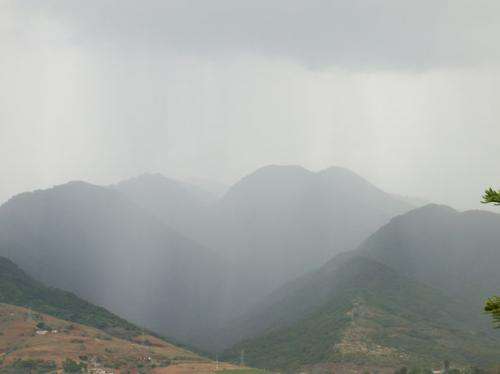
Indian meteorologists are getting better news from the sky, thanks to an artificial intelligence system that can finally tell the difference between a light drizzle and a dangerous downpour. A new deep convolutional spiking neural network, reported in the International Journal of Mobile Communications, outperforms the widely used forecasting models that have long frustrated farmers, water managers, and disaster responders with their missed warnings and false alarms.
The problem with traditional rainfall prediction has always been practical: farmers and water managers don't need to know that 47.3 millimeters will fall tomorrow—they need to know whether it will be light, moderate, or heavy rain, so they can make decisions about irrigation, flooding risk, and emergency preparedness. Earlier AI models have struggled with this, raising false alarms that desensitize people to warnings, or worse, missing major rainfall events entirely.
The new system takes inspiration from the human brain itself. The spiking neural network mimics how brain cells communicate through short electrical pulses over time, allowing it to recognize spatial patterns in weather maps with unprecedented precision. But before the AI even begins learning, the researchers clean the data using anisotropic diffusion Kuwahara filtering, a technique that reduces noise and random errors while preserving the weather patterns that actually matter. This step is crucial because real-world weather datasets are messy—they contain missing measurements and uneven data coverage across India's vast geography.
The team, led by researchers including M. Amanullah, tested their system against established AI methods like recurrent neural networks and gradient-boosting models using the India Rainfall Analysis dataset, which contains historical records from selected regions. The results were clear: the new model not only raised fewer false alarms but also did not miss major rainfall events, a problem that plagued earlier approaches. For a country where monsoons can mean the difference between harvest and famine, where flooding can displace thousands, this distinction is the difference between a model that people trust and one they learn to ignore.
The researchers then refined the system further using something called the sandpiper optimization algorithm—a machine-learning technique inspired by how foraging sandpipers, small shorebirds, search for food in their environment. This additional layer of optimization helps the model fine-tune its internal settings to reduce prediction errors even further, demonstrating that sometimes the best solutions come from watching nature.
The implications ripple outward from India. As climate change intensifies rainfall volatility worldwide, countries across South and Southeast Asia, Africa, and beyond face similar challenges: how to convert raw weather data into decisions that save lives and livelihoods. An AI system that reduces false alarms while catching the storms that matter could transform how governments and communities prepare for extreme weather. For India's agricultural sector, which supports over a billion people and depends on rainfall patterns as much as any economy on Earth, this innovation offers something precious: clarity when it matters most.