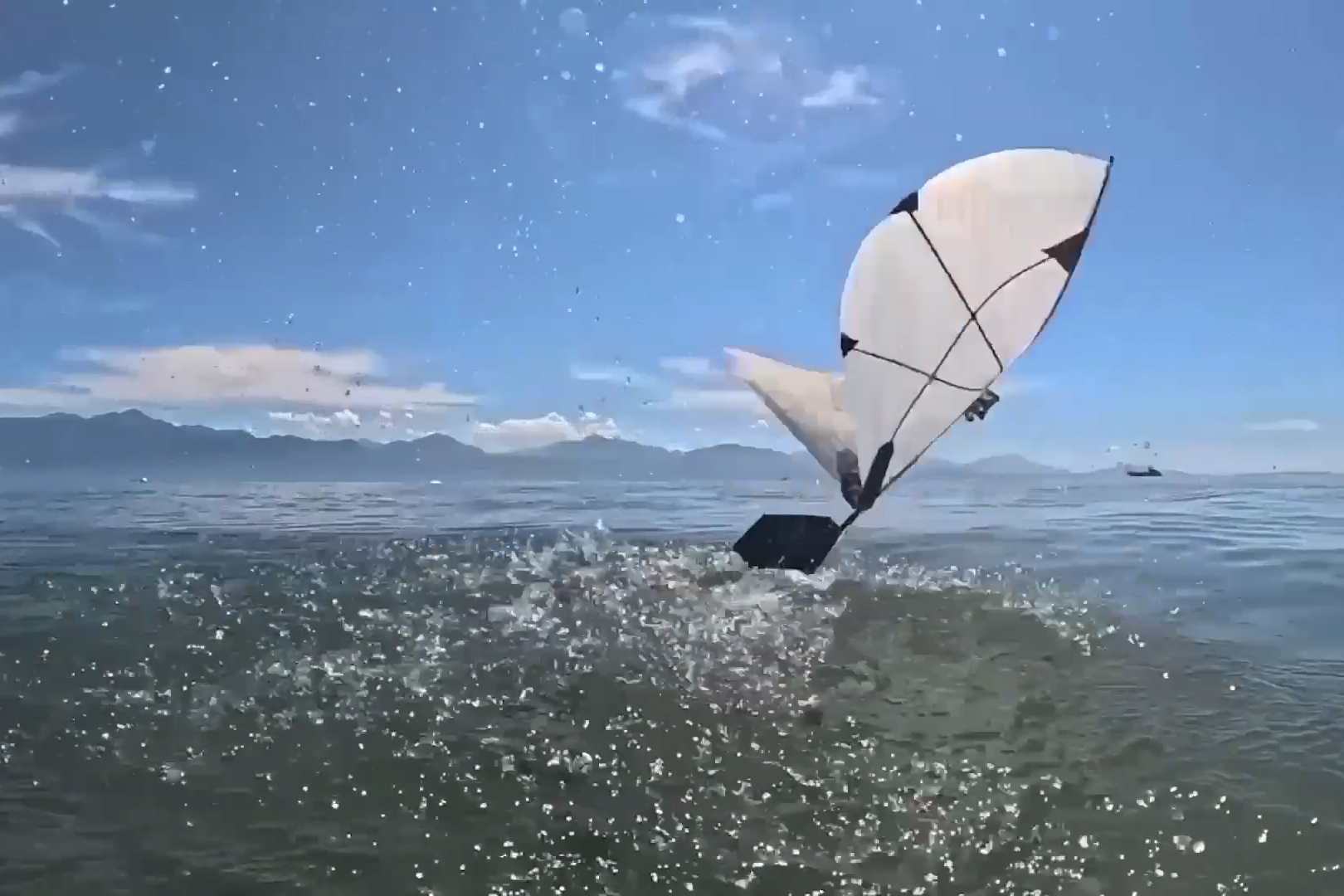
Imagine a bird that can plunge into the ocean to catch fish, then burst back out of the water and soar through the sky. Puffins, loons, and petrels do this every day. Now, engineers at two universities have built a robot that can do the same thing — and it could change how scientists study the oceans.
A team at MIT in Massachusetts and EPFL in Lausanne, Switzerland, created a small robot that can swim underwater, then flap its wings hard enough to break through the surface and fly away. The machine, called a "flapping-wing aerial-aquatic vehicle" (FAAV), weighs less than 300 grams — about half a pound. It has a body, two flexible wings that can be swapped out for different sizes, and a tail that tilts to steer the robot up or down.
"Birds like puffins can fly very fast through the air, and can dive and swim through water at speeds of 3 meters per second," says Raphael Zufferey, who led the study at MIT. "They're able to do pretty amazing things. So we knew it was possible. Just no one had tried this in a mobile robotic system."
To design the robot, the team studied how real diving birds move. Smaller birds like puffins flap their wings about 10 times per second when flying through air, but slow down to around 4 flaps per second when swimming underwater. Water is 1,000 times denser than air, so the mechanics are very different — but the birds make it work, and now the robot can too.
The researchers tested three wing sizes in a water tank and in Lake Geneva in Switzerland. They found the right combinations of wing size, flapping speed, and tail angle that let the robot transition smoothly from swimming to flying. The results were published in the journal Science.
So what could this robot actually do? The team imagines it could one day be launched from a boat or the shore to fly out over the ocean, dive underwater to collect water samples or measure ocean conditions, and then fly back to deliver the data — all at a fraction of the cost of sending traditional research vessels. Coastal communities, oceanographers, and marine biologists could use it to study places that are too dangerous or remote for people to reach.
"Our dream vision is for oceanographers, marine biologists, and members of coastal communities to launch this robot from a boat, or from shore, and it would fly close to the area of interest, such as an iceberg or a port facility, or over a pod of whales," Zufferey says. "It would dive into the water to take a measurement or collect a sample, and fly back to deliver the data at a fraction of the cost of traditional methods."
Zufferey's lab at MIT is called AURA Lab, where he and his students design robots inspired by nature. This new robot is one of the first to successfully mimic the way diving birds move between two very different worlds — air and water.