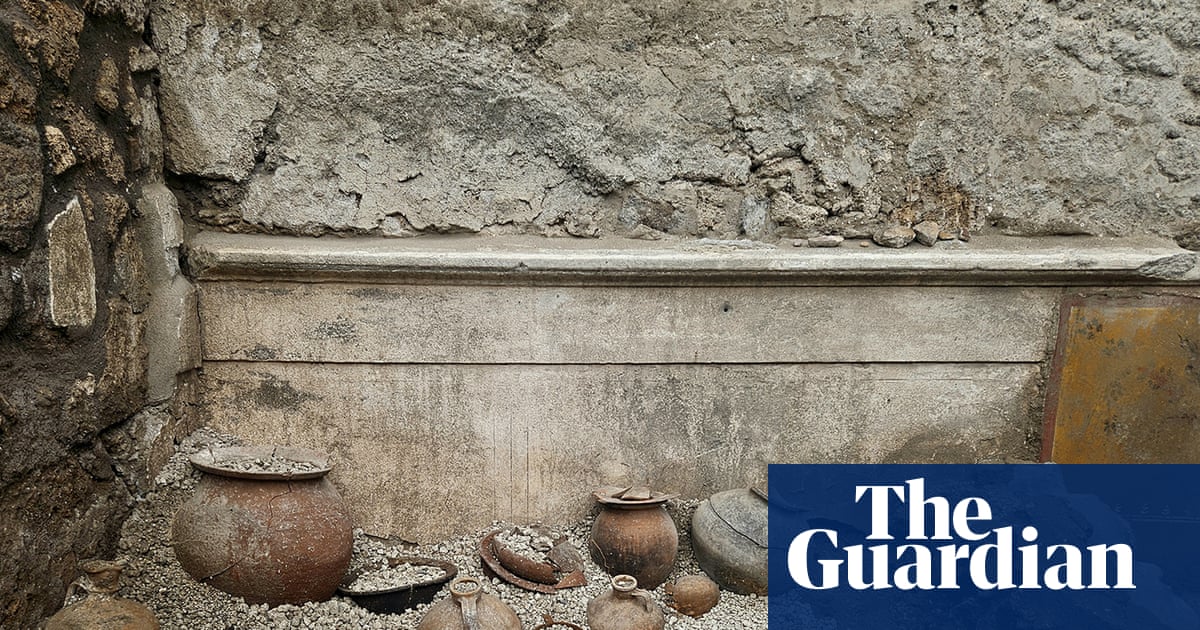
More than 20 tiny charms lay among the belongings in a wardrobe sealed beneath Pompeii for nearly 2,000 years. The necklace, small enough for a child to wear, was found alongside a perfume bottle, coins and tools in a home on Via dell’Abbondanza, once one of the city’s busiest streets.
The objects offer a close look at ordinary life before Mount Vesuvius erupted in AD 79 and buried Pompeii. Archaeologists are now exploring rooms in the home as part of a wider restoration project. Its facade was first excavated in 1912, but some of its interior spaces are only now being examined.
The wardrobe held tweezers, a small glass perfume bottle, an incense burner and a bronze lantern. Its most striking find was a necklace known as a crepundia, a type traditionally worn by children. The charms were made from different materials and showed several deities, including the gods Bes and Mercury.
The little pieces had practical as well as personal meaning. Their rattling could help parents keep track of a child, and the charms could help identify the child. Gabriel Zuchtriegel, director of Pompeii archaeological park, said such necklaces could also remind children of parents who were far away. People often moved around the Mediterranean, he noted, and carried personal objects with them.
Other finds suggest the home was also a place of work. Archaeologists recovered 38 bronze coins, cooking pots and a wooden box containing lead weights. Together, the objects point to someone in the household being a tradesperson. The coins and personal belongings were left behind, which Zuchtriegel said may mean the owners had to flee quickly as the eruption unfolded.
In a storage area, archaeologists also found the fragmented skeletons of two mice inside an amphora, a large storage jar. Inscriptions once linked the home to a person called Cornelius Maximus, though those markings are no longer visible.
The work at Pompeii is bringing attention not only to grand homes and art, but also to the routines and labor that shaped the city. At the nearby Villa of the Mysteries, excavation is under way in the servants’ quarters, rather than the rooms where owners lived and where archaeologists expect to find major frescoes. Zuchtriegel said the aim is to learn more about daily life and the economy of people who lived “in the shadow of history”; most inhabitants of the villa were servants.
Pompeii continues to yield new evidence. A large thermal bath complex was found in a home on Via di Nola in 2025, while a cramped bakery where enslaved people were believed to have been held and made to produce bread was uncovered in the same district in 2023. The newly opened rooms may add another layer to that picture: not just what wealthy residents built, but what people carried, used and left behind when a city’s life was suddenly cut short.