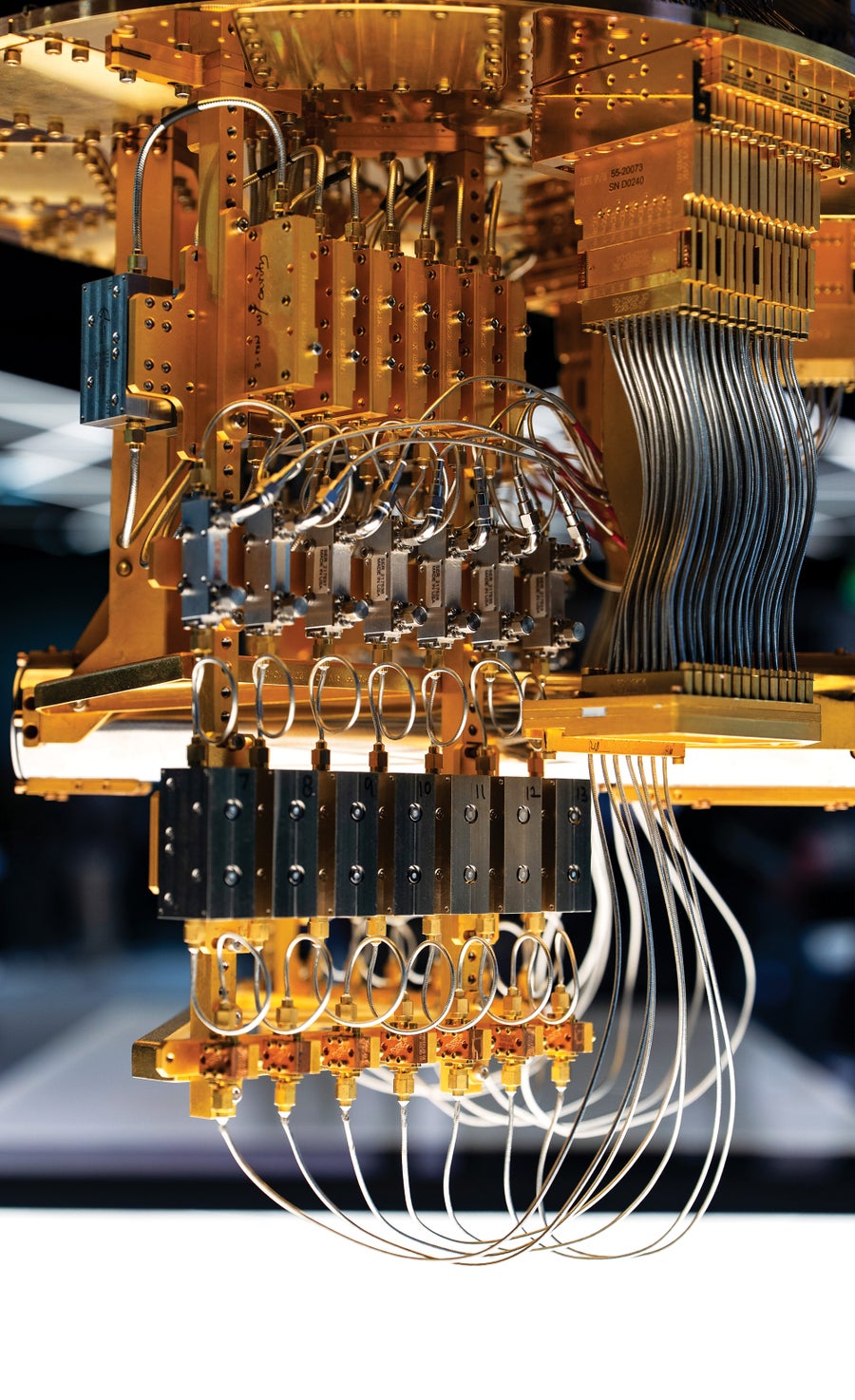
Inside a low-slung office park building near the southeastern edge of the San Francisco Bay, Rigetti Computing keeps a cluster of white refrigeration tanks bathed in blue light, each one a cathedral of superconducting circuits and possibility. Within those tanks, golden chandelier-like structures suspend superconducting chips cooled by liquid helium and nitrogen, etched with the precision of a clean room where white-suited engineers work with room-size machinery and acid baths. What emerges from this meticulous hardware is a company's singular obsession: building quantum computers that could perform certain computations a million to a billion times faster than classical machines, all while consuming a fraction of the energy.
This moment matters because quantum computing has reached an inflection point. After two decades of speculative investment and theoretical promise, companies like Rigetti, IBM, and Google are now racing to scale systems that could solve problems once thought impossible. In 2023 alone, venture capitalists poured $1.2 billion into quantum startups, a staggering bet on technology that remains, in many ways, unproven. The stakes are global—universities and government laboratories worldwide are chasing the same dream, each envisioning different applications. Some see quantum computers revolutionizing drug discovery and weather forecasting. Others, particularly governments, are fascinated by their potential to crack encryption previously thought unbreakable. Still others promise they'll supercharge artificial intelligence, though experts remain skeptical of these bolder claims.
Rigetti's CEO, Subodh Kulkarni, articulates the vision with quiet confidence: "We can potentially solve problems that are unsolvable today." But that potential hinges on solving fundamental physics challenges. Quantum computers operate on principles so counterintuitive that they require thought experiments with Schrödinger's cat to explain. While classical computers process information as ones and zeros, quantum computers leverage superposition—a state where a quantum bit can exist as both 0 and 1 simultaneously until measured. This isn't mere computational speediness; it's a fundamentally different way of processing information that could enable parallel exploration of solution spaces no classical computer could navigate in any reasonable timeframe.
The technology's promise, however, collides with brutal reality. Building and maintaining quantum systems requires near-absolute conditions: supercooled environments, shielded from electromagnetic interference, where even a stray vibration can collapse the delicate superposition states that make quantum computation possible. These are not machines that tolerate imperfection. The industry stands at a crossroads. Scientists believe that within the next few decades, they can scale today's experimental systems to the size needed to achieve "quantum advantage"—the point where quantum computers decisively outperform classical machines at useful, practical tasks. If they succeed, the world changes. If they fail, or if the obstacles prove insurmountable, quantum computing may remain what it has been for 20 years: an elegant promise forever beyond reach.
For now, Rigetti and its competitors continue their meticulous work in those cooling tanks, with the world watching to see whether the dream becomes destiny or remains locked in superposition—simultaneously achievable and impossible—until someone finally opens the box.