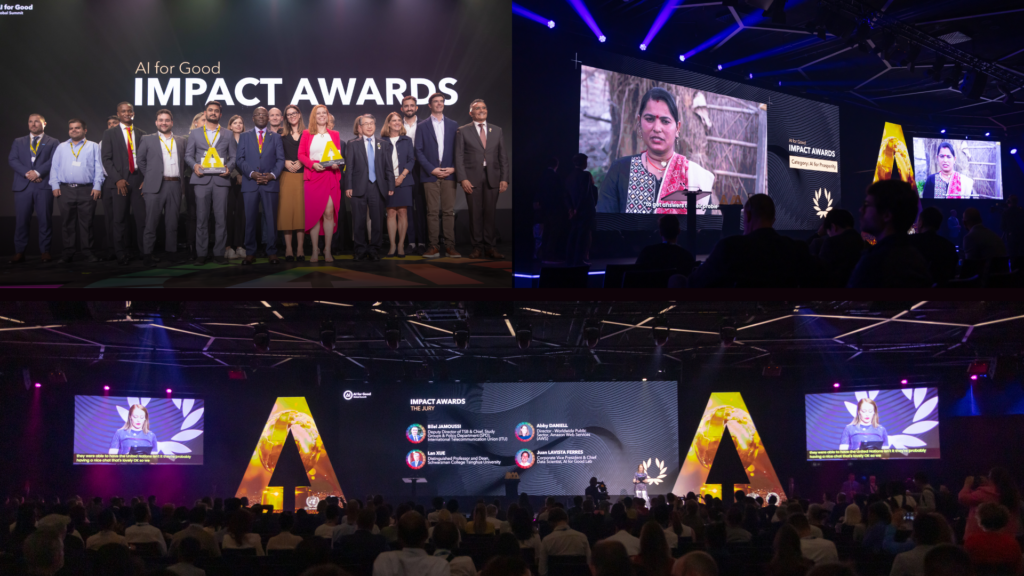
Nearly 300 applications from 65 countries competed for recognition in the International Telecommunication Union's AI for Good Impact Awards 2026, and now nine finalists have emerged as proof that artificial intelligence is moving decisively from laboratory experiments into the real world, tackling hunger, protecting workers, teaching children to read, and safeguarding ecosystems.
The scale of this competition matters. What started as a call for innovative AI solutions attracted submissions from SMEs, multinational corporations, universities, nonprofits, governments, and independent researchers across six continents. The diversity of applicants reflects a crucial truth: the most effective AI solutions for global challenges are coming not just from Silicon Valley or Beijing, but from Sokoine University of Agriculture in Tanzania, from Rising Hope Girls Educational Foundation, and from conservation innovators working in the field.
Among the nine finalists, each represents a different frontier of practical AI deployment. HungerMap Live 2.0, developed by the World Food Programme, combines climate, conflict, economic, and food security data to forecast hunger trends and enable earlier humanitarian action across more than 95 countries. It is, in essence, an early warning system powered by machine learning—a tool that turns data into foresight when lives depend on it. PoBot, created by Migrasia, takes a different approach: a multilingual chatbot that helps migrant workers understand their rights, access information, and avoid exploitation through accessible digital channels. The initiative recognizes that protection and empowerment often begin with information.
In education, ReadBuddy—developed by Rising Hope Girls Educational Foundation—delivers personalized reading support to children in underserved communities, while simultaneously equipping teachers with data to improve their instruction. This is AI as a lever for educational equity, not replacement for human teaching.
The AI for Planet finalists address ecological challenges with equal ingenuity. Happywhale uses photographs to identify individual whales and dolphins, enabling large-scale population monitoring and migration tracking that would be impossible through traditional means. AquaShield from Sokoine University helps communities adopt sustainable fish farming practices, reducing pressure on wild fisheries while supporting livelihoods. Vivent Biosignals decodes electrical signals from plants to give farmers real-time insights into crop health and water needs—turning plants themselves into data sources.
What unites these nine initiatives, according to the award organizers, is a shared commitment to measurable outcomes. These are not proof-of-concept projects or demonstrations designed primarily to attract investment. HungerMap Live 2.0 is actively forecasting hunger in 95 countries. ReadBuddy is measurably improving reading skills. Happywhale is generating actionable conservation data right now.
The international panel of judges—drawn from AI expertise, public policy, scientific research, and sustainable development—evaluated these finalists not on technical sophistication alone, but on real-world impact. This distinction matters. It signals a maturation in how the world thinks about AI: not as a technology to celebrate for its own sake, but as a tool whose value is determined by what it actually achieves for people and the planet.
The 2026 finalists span three categories—AI for People, AI for Planet, and AI for Prosperity—each addressing fundamental gaps: food security, biodiversity protection, worker safety, financial inclusion, and access to public services. Together, they suggest that the question is no longer whether AI can solve complex global challenges, but rather how quickly we can scale the solutions that are already working.