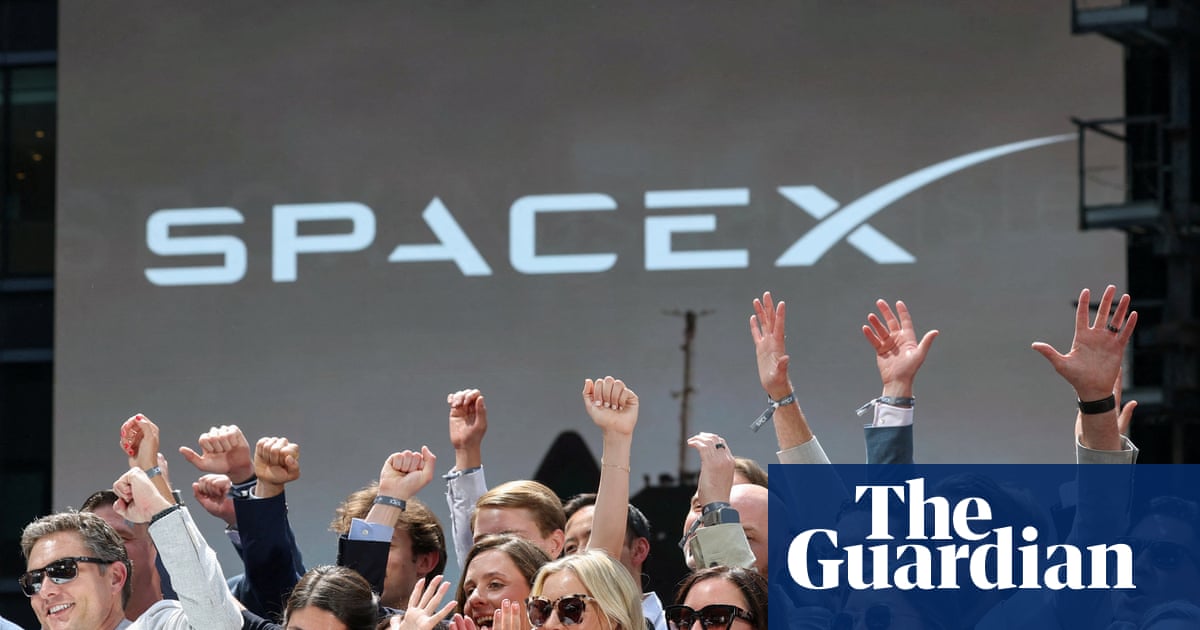
When SpaceX shares opened 13% higher on the Nasdaq last Tuesday, few expected the ripple effect: by midday, the company’s market cap had surged to $2.97 trillion, vaulting past Amazon and securing its place as the world’s fifth most valuable company. This wasn’t just a stock market anomaly—it was the opening act of a new era, one where rocket launches and AI code are converging under one corporate roof. Days after its IPO at $135 a share, SpaceX, long known for redefining space travel, has emerged as a dominant force in artificial intelligence, too, thanks to its $60 billion agreement to acquire Anysphere, the San Francisco startup behind the AI-powered coding tool Cursor.
While Amazon posted $717 billion in revenue and $78 billion in net income, SpaceX reported a 2025 loss of $4.9 billion on $18.7 billion in revenue—yet investors are betting on its future, not its past. The company’s valuation leap reflects confidence in its sprawling ecosystem: the rocket division, the satellite internet service Starlink (its only profitable arm), social media platform X, and now, through its parent structure, xAI. The Cursor deal gives xAI immediate access to over 1 million active developers and their real-time coding data—fuel for training more powerful AI models like Grok. As Gil Luria of DA Davidson put it, “Grok has to have a coding component that enterprise customers can utilise side by side with Anthropic Claude Code and OpenAI Codex.”
The acquisition, to be paid in SpaceX stock and closing in Q3 2026, sidesteps the use of IPO proceeds and minimizes dilution—a strategic win underscored by hedge fund billionaire Bill Ackman, who noted, “One of the things that makes SpaceX so valuable is how valuable it is.” Anysphere, backed by heavyweights like Andreessen Horowitz, Thrive, Nvidia, and Google, has built coding models that deliver high performance at lower computational cost—critical in an industry where training AI eats power. Lacking its own data centers, Anysphere’s growth had plateaued. Now, SpaceX’s infrastructure could unlock its full potential.
Analysts like Harrison Rolfes of PitchBook caution the deal won’t immediately close the gap with OpenAI or Anthropic in the frontier model race. But owning the tool developers trust daily offers a faster path to enterprise revenue than chasing benchmarks. As Matt Britzman of Hargreaves Lansdown observed, “Cursor has built some very impressive coding models relative to cost.” With Elon Musk now estimated by Forbes to be worth $1.3 trillion—making him the world’s first trillionaire—SpaceX’s ascent is as much about vision as valuation. This isn’t just a company reaching for orbit. It’s building the infrastructure for the next decade of tech, one line of code and one rocket launch at a time.