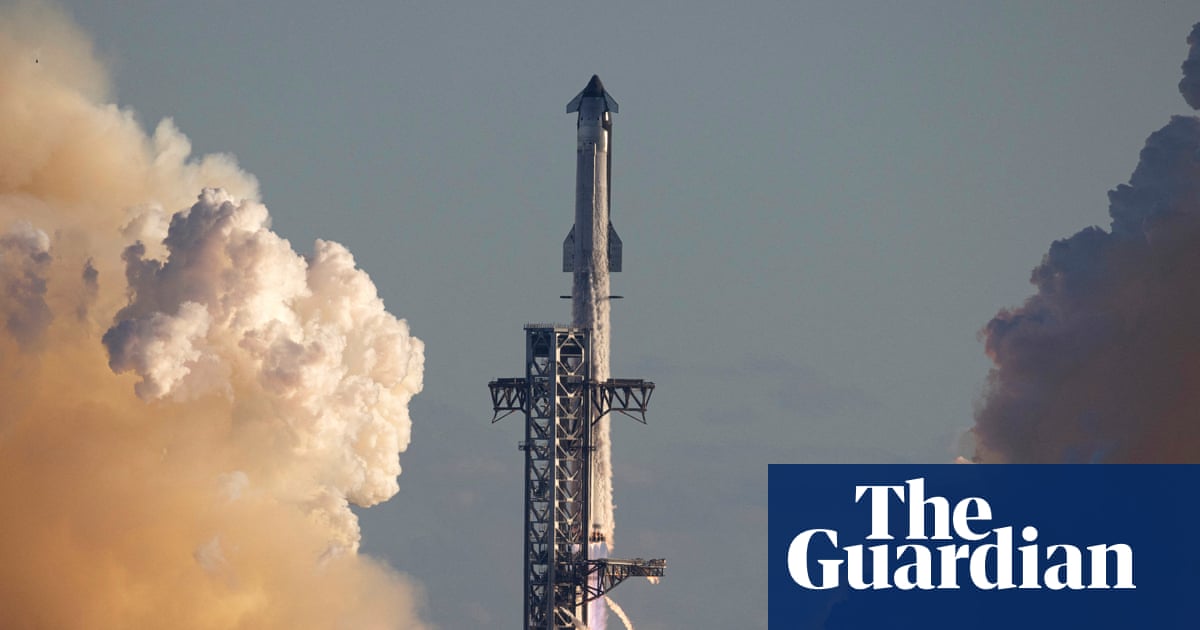
At 407 feet tall, SpaceX’s Starship rose from Starbase in south Texas on Friday afternoon for its 15th test flight, beginning a mission designed to test whether the world’s largest rocket can return to Earth for reuse.
The flight is part of SpaceX’s effort to make its rockets fly again quickly instead of treating them as one-use vehicles. That goal matters to the company’s plans for carrying people beyond Earth: chief executive Elon Musk has said he wants Starship to take humans to the moon and, controversially, to Mars. NASA has also contracted SpaceX and Jeff Bezos’s Blue Origin to build lunar landers for a planned return of astronauts to the moon in 2028.
Starship has two main parts. A 171-foot upper stage sits above the Super Heavy booster, whose 33 Raptor engines fired during liftoff. SpaceX planned for both pieces to return to the launch tower, in a maneuver known as a double catch. But Super Heavy was diverted from that plan and splashed down in the sea. The reason for the change was not known.
The upper stage continued into space. It is expected to circle Earth about 14 times over roughly 22 hours before attempting a return and catch at the Starbase launchpad. If that catch succeeds, it would be the first time SpaceX has recovered the 171-foot upper stage this way. Earlier tests focused on bringing back the booster.
So Friday’s flight did not achieve the planned double catch, but the upper stage’s journey still offers a significant test of the system. Catching a rocket at its launch tower could help SpaceX recover its hardware and prepare it for another flight, a central part of the company’s push for rapid reusability.
The path to that goal has included setbacks. Some Starship test flights have ended in explosions, pointing to design problems that needed attention. In September, the previous test flight marked a step forward by sending the spacecraft into Earth’s orbit for the first time, though an engine failed during ascent. Each flight has therefore served both as a demonstration and as a chance to learn how the vehicle behaves.
The next milestone depends on what happens as the upper stage completes its planned trip around Earth. A successful catch would extend SpaceX’s progress from recovering the booster to attempting recovery of the much larger spacecraft itself. Even without the double catch on Friday, the flight is another test of whether Starship can become a reusable vehicle for future missions to the moon and beyond.