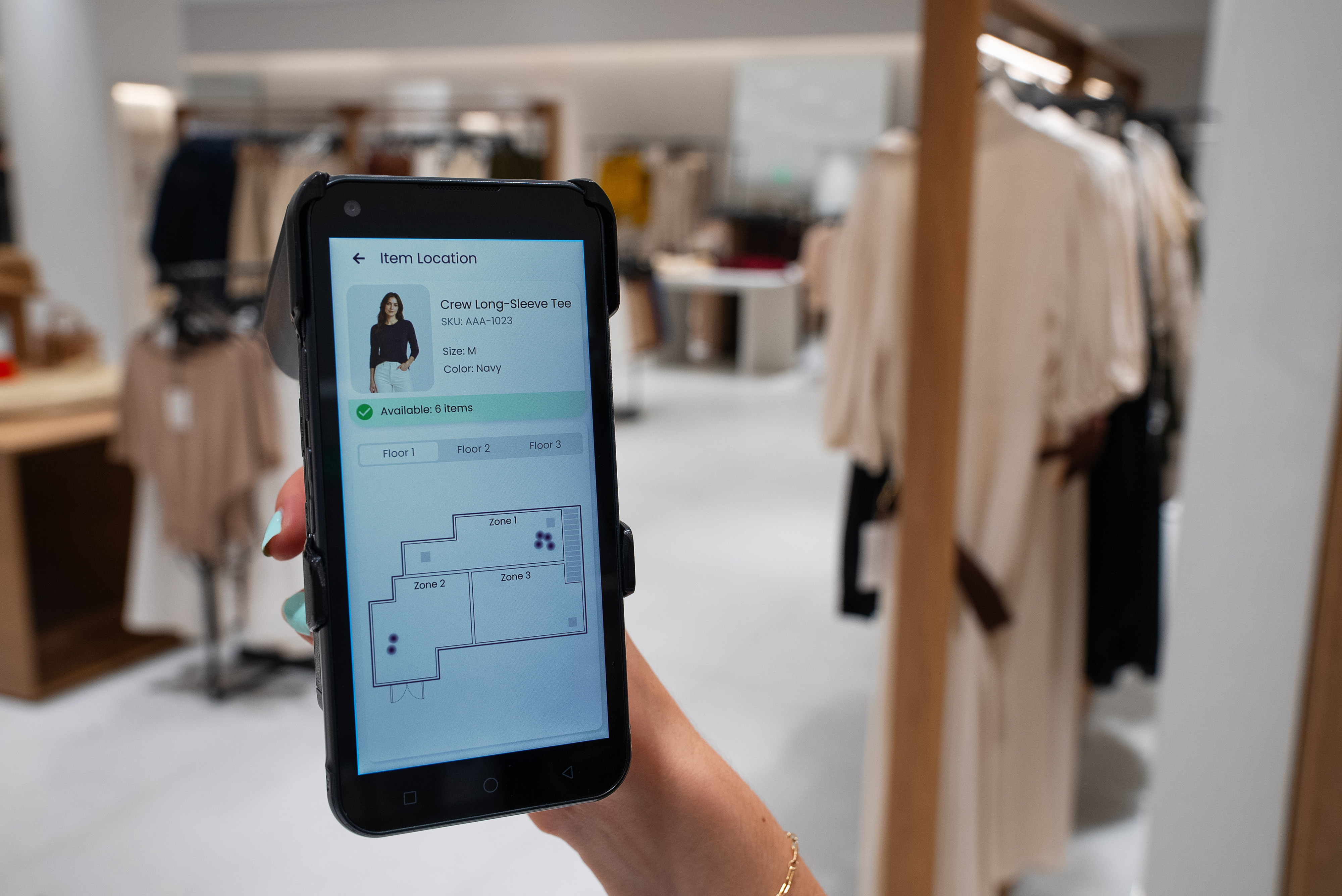
At a mid-sized fashion retailer, a customer asks a store associate if they have a particular shirt in size medium. Twenty minutes later, the employee returns — if they return at all. This scene plays out thousands of times daily across retail stores worldwide, a hidden drain on both customer satisfaction and worker productivity that MIT researchers have now begun to solve.
Cartesian, a startup founded by MIT researchers Fadel Adib and Isaac Perper, has developed a system that uses wireless signals from radio frequency identification (RFID) tags to pinpoint the exact location of any item in a store — whether it's hanging on the shop floor, stacked in a stockroom bin, or tucked away in a back office. The innovation addresses a staggering inefficiency: roughly 50 percent of working hours in retail stores go to managing inventory, representing approximately $15 billion in wasted productivity in the U.S. alone.
Adib, an associate professor at MIT's Media Lab and Department of Electrical Engineering and Computer Science, and his student Isaac Perper developed machine-learning algorithms that process RFID scan data into location patterns with remarkable precision. Rather than requiring retailers to overhaul their infrastructure, Cartesian's platform integrates with the handheld RFID readers and inventory systems that store associates already use daily. "The RFID readers are how stores tell what's in stock and what's out of stock," Perper explains. "We figured out a way to leverage the same scans they're already using with the reader, put the data they generate to work."
The technology emerged from Adib's 15-year research career studying wireless signals at MIT. When he participated in the National Science Foundation's I-Corps program in 2021, which challenges researchers to validate market problems with potential customers, he discovered just how acute the inventory management challenge was for retailers. After receiving an NSF small business award, Adib and Perper officially launched Cartesian in early 2023, working with MIT's Technology Licensing Office to patent their innovations and drawing mentorship support from MIT's Venture Mentoring Service.
The real-world impact has been swift. Last year, Cartesian completed a pilot study with a retailer that demonstrated meaningful annual savings through streamlined inventory tracking, optimized workflows, and improved customer experiences. Today, the platform is deployed in more than 700 stores across 15 countries, including locations operated by Inditex, one of the world's largest fashion groups and the parent company of brands like ZARA, Pull&Bear, and Oysho.
Beyond retail, Adib envisions far broader applications. "The broad vision for what we are doing is spatial AI," he says. "Today, AI does extremely well in the digital world. Now it has to move into the physical world. That means allowing machines to perceive their environment in such a way that they can interact with it." Manufacturers, logistics operators, and robotics companies are already exploring how Cartesian's indoor localization technology could transform their operations.
For retail workers, the shift is immediate and tangible. Instead of wandering stockrooms or consulting outdated systems, employees can now instantly locate items customers request, freeing them to spend their energy on higher-value tasks like building relationships and providing expert service. The innovation reveals a truth often overlooked: the most powerful technology isn't always the most cutting-edge — sometimes it's simply the right tool applied to a problem that's been hiding in plain sight.