Reza Azizian walked into his first data center in 2017 and was confronted by a sight that struck him as absurd: massive, noisy fans filling an entire building, consuming roughly 40 percent of the facility's power just to cool chips. A nuclear engineer by training, Azizian knew there had to be a better way. Now, his startup Ferveret has developed a system that could reshape how the world's data centers stay cool—using a technique borrowed from nuclear reactors and zero water in the process.
The timing matters. As artificial intelligence explodes in capability and demand, data centers are consuming more electricity than ever. The U.S. is projected to see data centers account for 9 to 17 percent of total electricity usage by the end of the decade. Of all that power, roughly a third goes simply to keeping the chips running AI models from overheating. That's where Ferveret enters the picture. Founded in 2021 by Azizian, who spent years at Microsoft and Nvidia before returning to MIT, and Matteo Bucci, an MIT associate professor in nuclear science and engineering, the company has adapted heat-transfer innovations developed over decades in nuclear reactor cooling to solve a modern problem: how to keep increasingly powerful chips from melting down.
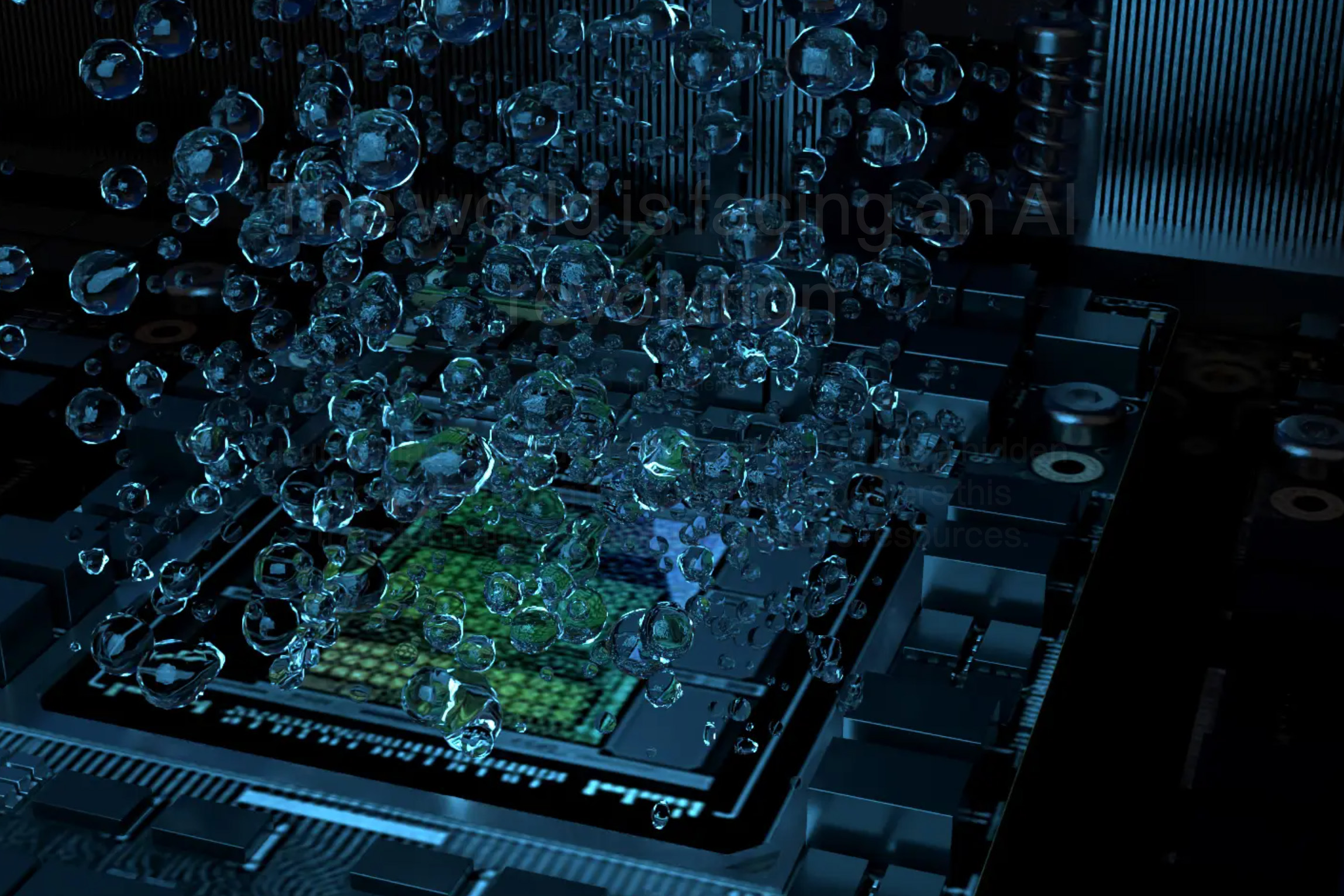
The system works by submerging servers in a specialized liquid far more efficient at absorbing heat than air alone. What sets Ferveret's Adaptive Phase Cooling technology apart from other liquid cooling approaches is the engineering of how that liquid boils. The system produces much smaller bubbles that detach more frequently from the chip surface, dramatically accelerating the heat transfer process. The liquid itself has a low boiling point and contains none of the toxic PFAS "forever chemicals" that other systems rely on—a significant sustainability advantage.
The results speak for themselves. In collaboration with UCLA's Samueli Computer Science Department, Ferveret demonstrated a 15 percent improvement in computational power efficiency compared to state-of-the-art liquid cooling systems already on the market. But the real win is what happens when you layer in Ferveret's power optimization system. By fine-tuning operating conditions, data centers can extract 35 percent more tokens—the small pieces of text or data that AI models process and output—from the same amount of electrical power. In other words: more intelligence from the same watts, with zero water consumption.
The company is already proving its concept works at scale. Ferveret is testing its solutions with CleanSpark, a data center developer; FuriosaAI, an accelerator company; and Switch, one of the largest data center operators in the United States. These aren't academic partnerships—they're real deployments by companies whose profit margins depend on efficiency.
Azizian's journey from nuclear research to AI infrastructure reveals something essential about innovation: sometimes the most advanced solutions come not from inventing entirely new technologies, but from applying hard-won expertise across domains. Nuclear engineers learned to move heat ruthlessly efficiently because heat determines how much energy you can extract from a reactor core, which "translates directly to revenue," as Azizian notes. That same principle now applies to data centers, where every watt saved matters both economically and environmentally. As AI continues its relentless expansion, systems like Ferveret's suggest the industry can grow without proportionally growing its power consumption—a rare piece of good news in the climate conversation.