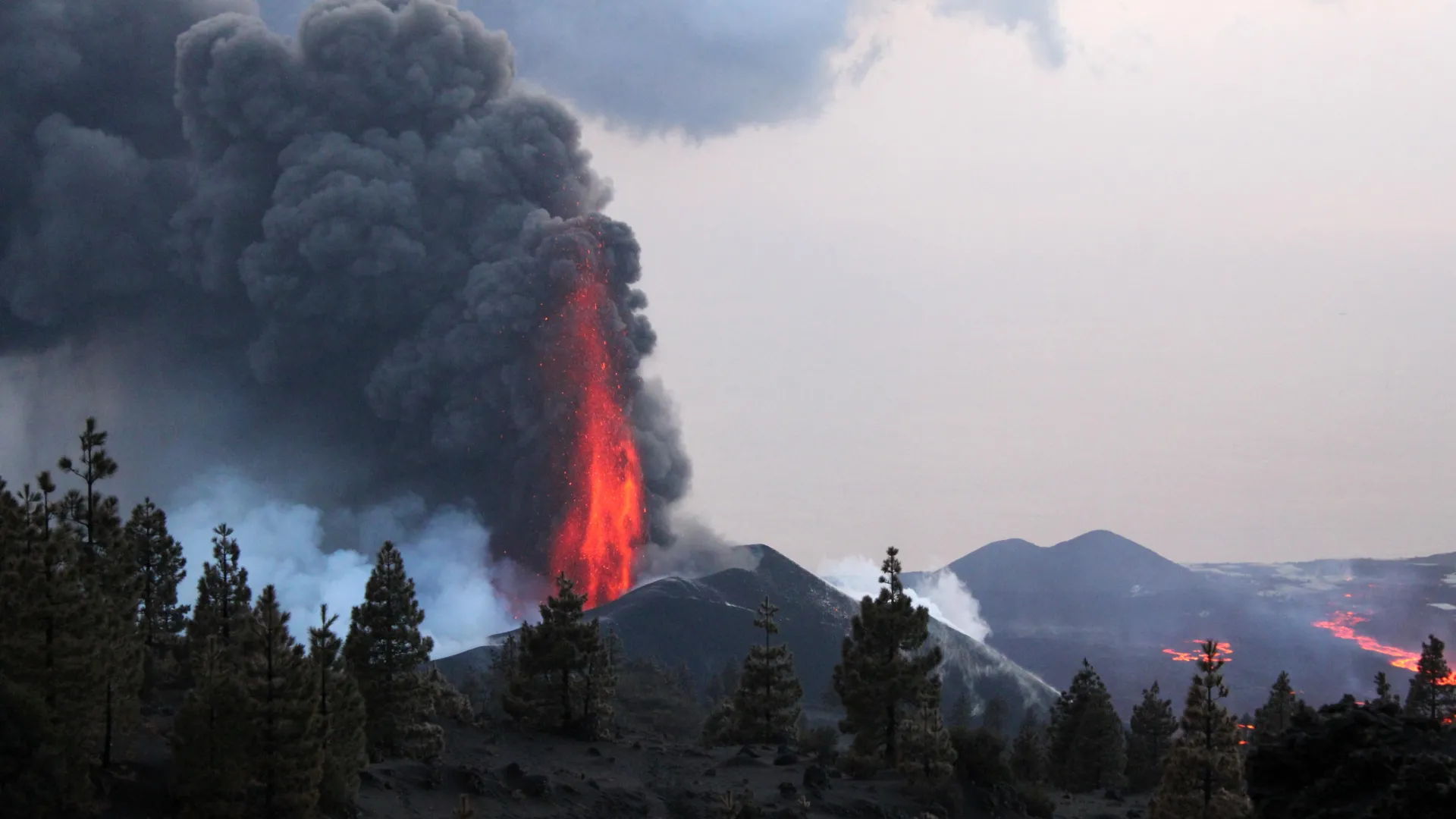
On La Palma, magma from the 2021 Tajogaite eruption may have stayed crystal-free for more than eight hours after being superheated—a delay that could help explain why some volcanoes send lava high into the sky.
Scientists know that eruptions can differ sharply: some produce towering fountains, while others release molten rock more calmly. A new study suggests that magma’s heat history, not just its temperature and chemical makeup, may help shape that difference. The findings, published in Nature Communications, come from an international team led by The University of Manchester.
Magma is molten rock mixed with gases and sometimes solid crystals beneath Earth’s surface. As it cools, tiny crystals usually begin to grow, often using existing crystals as starting points. More crystals can make magma thicker and harder to move. That change in flow can affect how quickly magma rises and how volcanic gases escape.
The researchers focused on superheating: when magma becomes hotter than the temperature at which its crystals would normally remain stable. Strong heat can dissolve tiny crystal “seeds” and change the molten material’s structure, making it less likely that new crystals will form right away.
To test the effect, the team used material from the Tajogaite eruption and recreated underground volcanic conditions in laboratory experiments. At Diamond Light Source, a major research facility, they used powerful X-rays to watch crystals form inside samples in three dimensions and in real time. A specially designed pressure vessel let the X-rays pass through while the samples were held at controlled temperatures and pressures. The team also carried out longer experiments in Prague.
The difference was striking. Samples that were not superheated began forming crystals after about 20 minutes. With strong superheating, crystallization did not begin for more than eight hours. That long pause could keep magma more fluid than expected as it moves upward.
Lead author Dr. Barbara Bonechi, a research associate at The University of Manchester, said the growth of crystals and bubbles can strongly affect an eruption because crystals change magma’s viscosity—how easily it flows. She said the team had not fully understood how crystal growth behaved after magma received a burst of superheat shortly before rising. The X-ray setup allowed them to observe the process inside the samples rather than infer it only after the experiments.
The researchers added their measured delays to computer models of magma rising through Earth’s crust to explore what the results might mean for real eruptions. The work offers a possible explanation for how superheated magma can remain fluid for longer, potentially rise rapidly, and help produce dramatic lava fountains. It does not mean every superheated magma will create a fountain, but it points to a factor scientists can now examine more closely.
By linking a measurable delay in crystal growth to magma’s movement, the study adds a new piece to the puzzle of volcanic behavior. Further work can test how often superheating occurs and how strongly it shapes eruptions, helping researchers build a clearer picture of what happens beneath a volcano before lava reaches the surface.