Imagine trying to find your way through a dark room without bumping into furniture. You might reach out your hands, feeling around for obstacles. Now imagine doing that with your face — using stiff hairs on your cheeks to feel the walls and judge how far away they are. That's exactly what mice do every night, and scientists at MIT just figured out how their tiny brains turn those whisker-touches into a precise sense of distance.
Fan Wang, a professor at MIT's McGovern Institute for Brain Research, has discovered a remarkable system in mouse brains that works almost like an internal ruler. The research, published in the journal Neuron, shows how neurons in the brainstem use signals from whiskers to measure exactly how far objects are from the face — not just "near" or "far," but specific distances.
"Mice whiskers are like a built-in set of rulers," Wang explained. That's because a mouse's whiskers come in different lengths, and as the animal sweeps them back and forth while exploring, the whiskers bend against whatever they touch. Sensory neurons at the base of each whisker fire more when the whisker bends close to the face than near its tip — providing information about how close an object is.
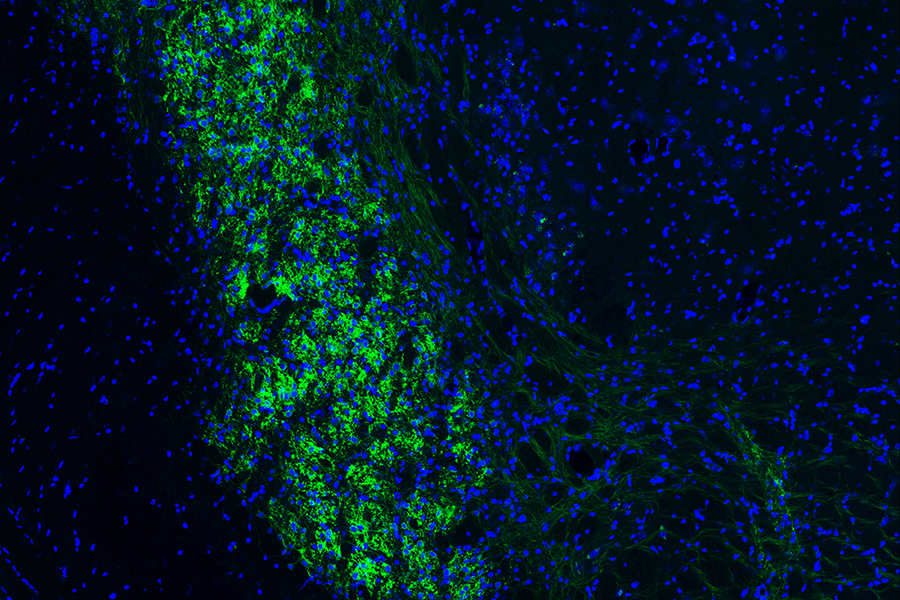
To understand how the brain reads this signal, graduate student Wenxi Xiao and research scientist Kyle Severson monitored what happened in a part of the brainstem where whisker signals first arrive. They had mice walk on a treadmill while brushing their whiskers against a wall positioned at different distances.
They found two types of neurons at work. Some simply reported how close the wall was — the closer the wall, the more they fired. But others were tuned to specific distances. Some neurons peaked their activity when the wall was exactly 23 millimeters away, near the tips of the longest whiskers. Others responded to intermediate distances.
"Each of these neurons represents a specific distance, and together they span the full range reached by the longest whisker, like tick marks on a ruler," Wang said. Her team showed the brain calculates these precise distances by comparing signals from different whiskers — using one signal as an estimate and subtracting another to find the accurate middle value.
This body-centered sense of space — knowing where things are relative to yourself rather than to landmarks — is called an egocentric map. Wang notes that scientists know much more about how we map space using external landmarks than about this internal system, even though it's vital for everyday actions like reaching, stepping, and avoiding hazards.
The findings open new questions about how this map code connects with other brain systems. For mice, whiskers are the tool. For humans, our fingertips and full-body senses work similarly. Understanding this shared brain machinery might one day help explain how all of us navigate the space immediately around our bodies.