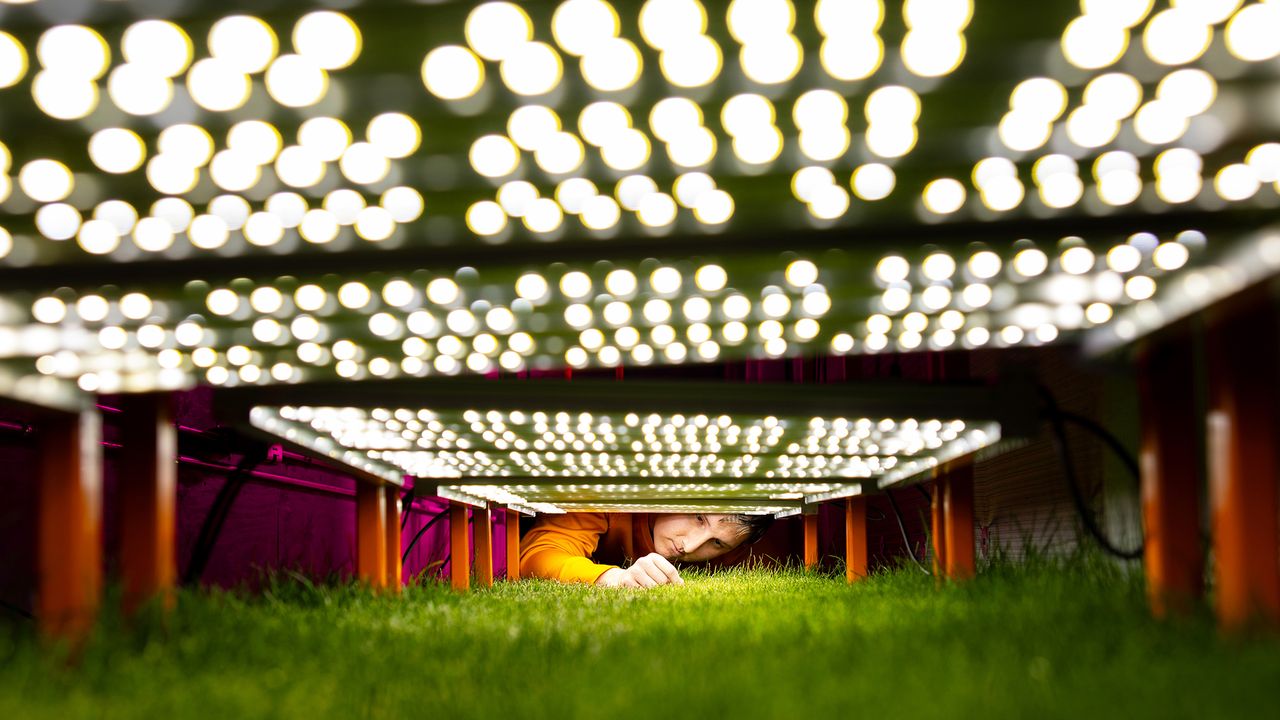
John Sorochan stood on a miniature pitch in Knoxville, Tennessee, watching a bright red machine fire footballs across experimental turf while a steel contraption with a mechanical boot pounded the surface below. Eight years of work—more than 170 different experiments—had led to this moment: the race to perfect grass for the 2026 World Cup.
The stakes became brutally clear at the 2024 Copa America in Atlanta. When Ángel Di María, one of Argentina's greatest footballers, received the ball just eight minutes into a crucial group-stage match, what should have been a decisive moment crumbled. As he dribbled toward the goal with only the keeper to beat, the ball seemed to defy control, bouncing erratically beneath his feet. Argentina's coaching staff didn't mince words afterward: the pitch quality—a temporary grass surface hastily installed days before the tournament—had sabotaged their performance. Players described the ball jumping like a "springboard" on what they called a "disaster" of a pitch.
That criticism stung because it was avoidable, and it cannot happen again. With the 2026 World Cup now just weeks away and 104 matches to be played across 16 stadiums in the United States, Canada, and Mexico, tournament organizers have made turf science their obsession. Sorochan, a professor at the University of Tennessee contracted by FIFA to oversee grass installation and care at all 16 stadiums, carries the weight of that lesson. "It's a lot of pressure," he says.
The challenge is staggering in its specificity. Just five millimetres can be the difference between a pitch that plays like "velcro" and one that flows like pristine natural carpet, enabling the quick passing that makes football beautiful. To find that exact height, Sorochan's team measured grass blade by blade by millimetre. They shot footballs from machines and observed bounce patterns with scientific precision. They wheeled a boxy steel contraption across test pitches, its attached mechanical boot repeatedly pounding the surface to measure springiness and traction. They tested for divots, wet spots, and player safety—because a poor surface doesn't just affect play; it can end careers.
The geographic spread makes the work exponentially harder. The 16 stadiums span radically different climates: from the humid heat of Mexico City and Miami to the cool of Toronto and Boston. Add to that five domed stadiums, where sunlight—essential for plant growth—simply won't reach the grass naturally, and the problem becomes almost architectural. "The Sun's gonna come up," Sorochan says of the domes, "but it's not going to come up inside."
The researchers responded with bespoke solutions for each location. Warmer climates will use Bermuda grass; cooler zones will have custom grass mixes. Each stadium has its own root systems, irrigation schedules, and maintenance protocols tailored to local conditions. The researchers have even choreographed the final installation: they wait until sunset when the grass is dry, then roll it up and load it onto refrigerated trucks for transport.
What emerges from eight years of stamping, feeding, watering, and measuring is not just grass. It's the culmination of decades of turf science applied to a single, visible stage where billions of fans will watch. In just a few weeks, 22 players at a time will pound these pitches across 104 matches, their performances and legacies riding on millimetres of carefully cultivated blade.