Imagine ordering a bridge to appear on demand — not built by workers, but by a swarm of tiny robots clicking together on the water. That future just got closer, thanks to a team at MIT in Cambridge, Massachusetts.
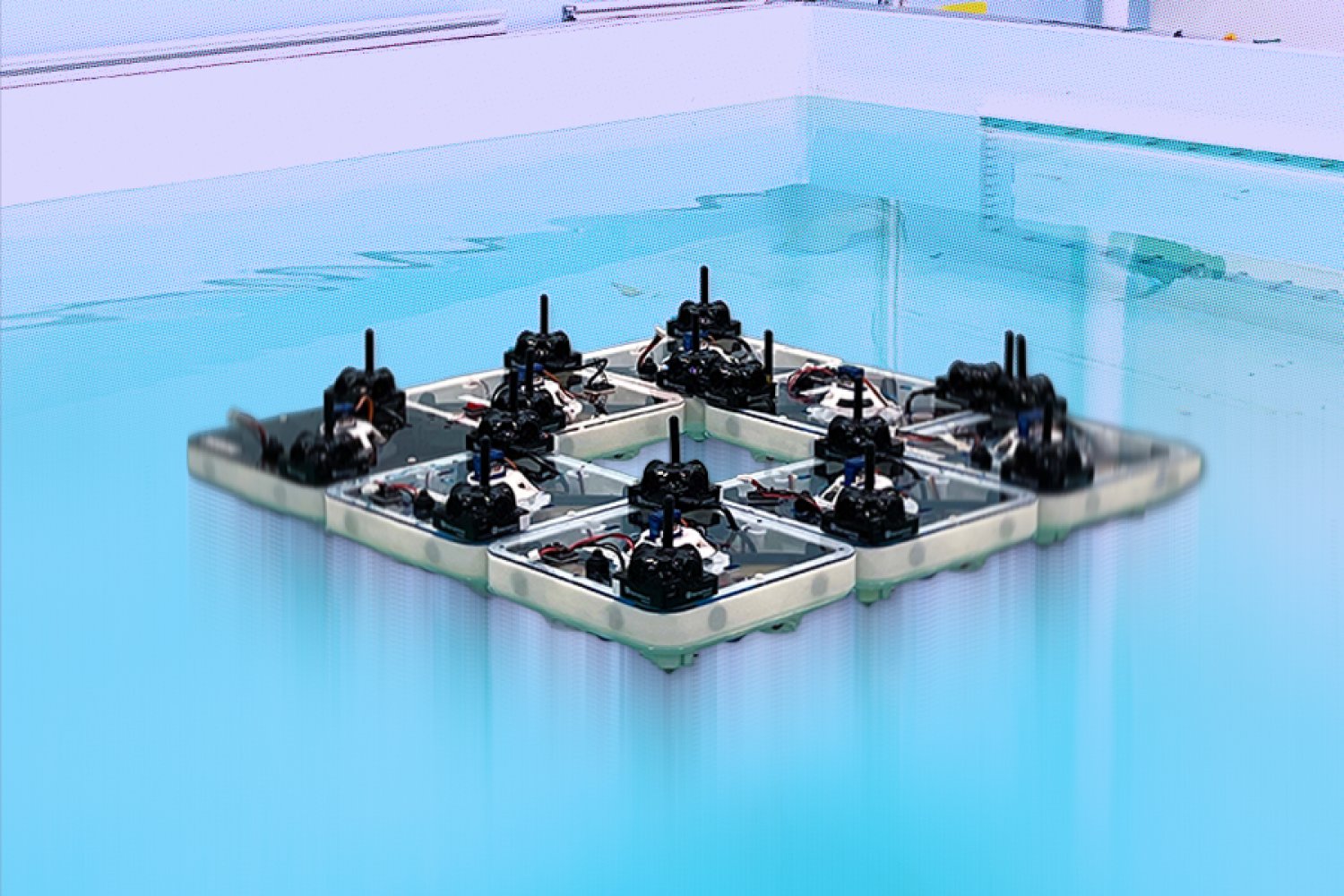
Their system, called FloatForm, uses small square robotic boats — each about the size of a dinner plate at 21 centimeters — that can self-assemble into bridges, platforms, and other structures, then break apart and rearrange into something completely different. No blueprints, no crane operators. Just a fleet of little machines working together.
"We are essentially turning static water surfaces into dynamic, programmable spaces," said Wei Wang, who led the research and now runs the Marine Robotics Lab at the University of Wisconsin at Madison.
The inspiration for the project came from an unexpected place: fire ants. When floods hit, these tiny insects link their bodies together to form living rafts, with no ant directing the others. Each ant follows simple rules, and a sturdy structure emerges on its own. The MIT team built that same idea into their robots.
Most existing robot systems need one computer calling all the shots — which is risky because if that computer fails, the whole system stops. It also gets messy as you add more robots: the math required to plan everything explodes. FloatForm flips that approach. The robots figure out most of the work themselves, sharing their locations with nearby neighbors and moving together as a team. A central computer steps in only to perfect the final shape, something purely self-organized systems struggle to do.
"What we're trying to do is have minimal central intervention, and have them all move together at the same time," said Alejandro Gonzalez-Garcia, a former MIT researcher.
In tests at MIT, a fleet of eight robots repeatedly gathered from random positions, latched into a rigid structure, broke apart on command, and reassembled into a new shape — each run taking just four to eight minutes. The team eventually wants to scale this up to hundreds or even thousands of boats.
The project grew out of Roboat, an earlier MIT effort with Amsterdam to put full-size autonomous vessels in that city's famous canals. Those canals once moved the city's goods; today, they mostly carry tourists. Researchers wondered whether they could carry more.
"Urban areas are getting denser, so could you expand public space onto water that's currently underutilized?" asked Niklas Hagemann, an MIT graduate student who has worked on the project from the start.
The vision goes beyond novelty. Picture a temporary platform appearing after a flood to deliver supplies. A floating market setting up on a canal for a weekend festival, then vanishing when it's over. A bridge forming itself to ease traffic after an accident. All built by tiny robots that never need a lunch break.
The work was published in the journal Nature Communications and involved researchers from MIT's Computer Science and Artificial Intelligence Laboratory and the Senseable City Lab. While real-world applications are still years away, the team has shown that the technology works — and that the waterfront, long considered just the edge of the city, might one day become part of the city itself.