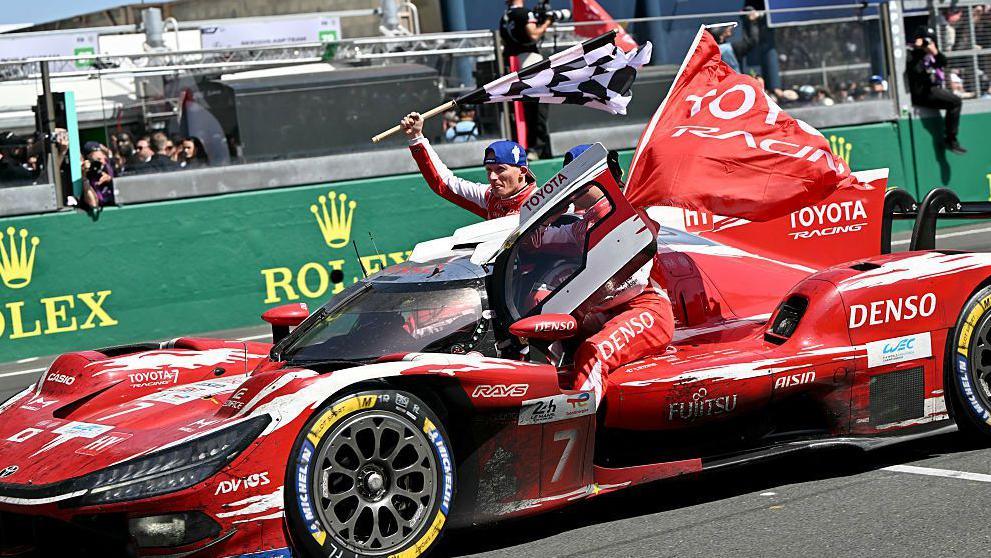
Kamui Kobayashi, former Formula 1 driver, guided the Toyota TR010 across the finish line at Circuit de la Sarthe just 10.9 seconds ahead of Robin Frijns's BMW, reclaiming Le Mans's crown after three consecutive victories by Ferrari. The 2024 Le Mans 24 Hours marked a dramatic return to the top for Toyota, whose minor hypercar upgrade and rebranding proved decisive in one of motorsport's most gruelling endurance tests.
This victory matters because it signals a fundamental shift in the hypercar class, which has become motorsport's most prestigious arena since new rules launched in 2021. Ferrari's three-year dominance seemed unshakeable, but this result demonstrates that the playing field is tightening as manufacturers including Peugeot, Alpine, BMW, Genesis, Cadillac, and Aston Martin push deeper into competition. With roughly 350,000 fans packing Circuit de la Sarthe annually and the series expanding—Ford and McLaren are joining the hypercar fold next year—Le Mans has rediscovered its place as motorsport's beating heart.
The race itself told a story of precision under pressure. Kobayashi's number seven car crossed the line ahead of Switzerland's Sebastien Buemi in the number eight Toyota, who finished 9.5 seconds further back. Britain's Mike Conway, now 42 years old, claimed his second Le Mans victory with the Japanese team alongside Nyck de Vries, completing a dominant Toyota one-two. The American Cadillac V-Series R, driven by ex-Formula 1 driver Will Stevens, came heartbreakingly close in fourth place, just 11.9 seconds behind Buemi—a near-miss that illustrated how tight competition has become at the sport's highest level.
Ferrari's fall from grace was swift and conspicuous. The Scuderia had ruled since returning to Le Mans in 2023, but this year their 499Ps struggled throughout. James Calado's number 51 finished more than two minutes behind Toyota, while last year's winning number 83 car, driven by Poland's ex-F1 champion Robert Kubica, limped home in seventh. Early contact incidents for both Ferrari cars compounded their misery, and some drivers pointed fingers at the hypercar class's controversial "balance of performance" regulations—the measurement system designed to keep competition fair but increasingly questioned when it favours certain manufacturers.
Kobayashi's relief was palpable. "Finally we bring in a new car and that's made it happen," he told reporters. "Mr Toyoda-san has been supporting big time—finally we're back on top." Toyota's return to victory marked their sixth Le Mans triumph overall, though they remain far behind Porsche's record of 19. What sets Toyota apart is their unwavering commitment: they stayed in sportscars through leaner years when others departed, winning consecutively from 2018 to 2022 against comparatively sparse competition.
Beyond the hypercar heroics, Le Mans delivered historic moments. Jamie Chadwick, Britain's former W Series champion, became the first female to pilot a hypercar at Le Mans during pre-race testing, driving the new Genesis entry. Though her team finished 13th in its hypercar debut, her presence signalled the series' growing inclusivity. Corvette captured the LMGT3 class through Ben Keating, Nicky Catsburg, and Jonny Edgar, while Polish team Inter Europol secured the LMP2 title.
Next year promises even greater drama. Silverstone will host a new six-hour WEC race, while Ford's return to hypercar competition resurrects their legendary Ferrari rivalry. Rumours swirl that four-time F1 world champion Max Verstappen eyes a Le Mans entry following his GT racing forays. For now, Toyota's renaissance stands complete—not through dominance inherited from years past, but through perseverance and a crucial mechanical edge.