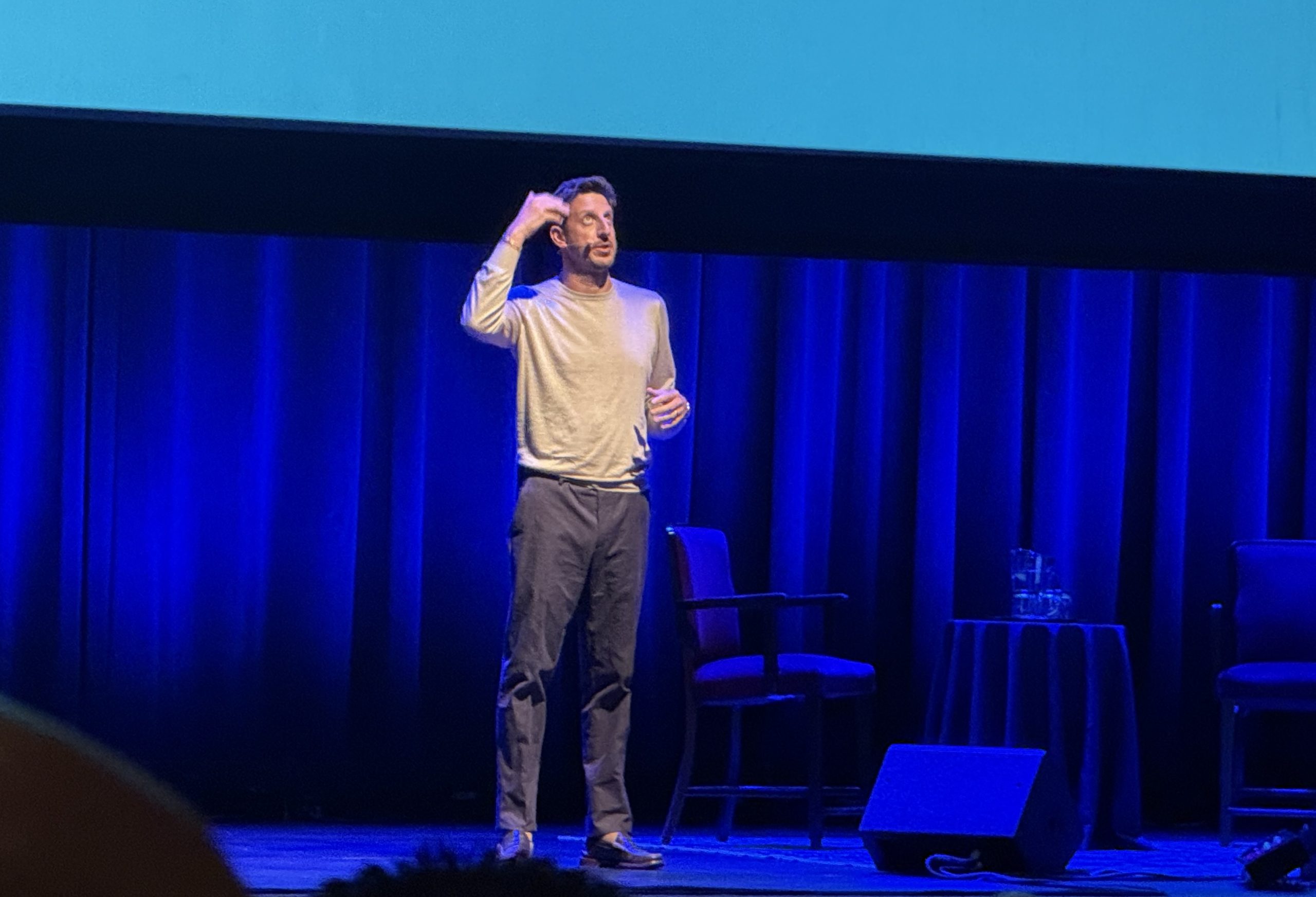
At UC Santa Barbara's Granada Theatre, an economic summit last week offered a strikingly optimistic view of artificial intelligence and a concrete roadmap for solving housing affordability—backed by 40 years of regional economic data and lessons from a Texan boomtown.
Peter Rupert, UCSB's economics professor and director of the Economic Forecast Project that has tracked Santa Barbara County since 1981, opened the conversation by placing AI within a larger historical arc. Artificial intelligence joins steam, electricity, and computing as waves of technological revolution that have sparked the same fearful question for generations: will this destroy jobs? And in every case, the answer has been the same.
"Every time, however, the answer has been no," Rupert explained to the audience. "It has not created mass unemployment. It has created jobs, and it has also lost jobs."
The transition comes with real costs—entire professions like blacksmiths and carriage makers vanished—but new ones emerged in their place. Auto workers, mechanics, and truck drivers filled the void. AI will likely follow that pattern, Rupert said, though some of the jobs it creates probably don't exist yet. The panel included Igor Mezić, a distinguished professor of mechanical engineering at UCSB, and Zack Kass, the global AI advisor and former head of go-to-market at OpenAI, who provided their own frameworks for thinking about the technology's trajectory.
The more immediately solvable problem, the panelists argued, was housing. Rupert presented a striking comparison: Austin, Texas built 120,000 housing units between 2015 and 2024—a 30 percent increase in its stock—and rents there have actually fallen when adjusted for inflation. Over the same period, the United States as a whole added only 9 percent to its housing supply. The difference shows in the speed of construction. A building permit in Austin takes an average of 22 days. In Los Angeles, it takes 180 days. In San Francisco, 760 days.
Kass, a Santa Barbara native, was blunt about the solution. "The way out of a housing crisis is to build more housing," he said, pointing directly to Austin's example as proof that housing affordability crises are not inevitable—they are policy failures. He criticized the city's pursuit of rent control and suggested that non-resident taxes and policies discouraging property hoarding could free up inventory. Montecito, he noted, has a 56 percent vacancy rate while families struggle to find homes.
Beyond policy, Kass framed AI optimistically through a lens most attendees likely never considered: "We are all descendants of people whose jobs were automated to our collective economic benefit, and we never think twice about them. We celebrate the fact that we don't have to do the work they did." He called out what he termed the "zombie apocalypse" phenomenon—the contradiction of wanting automation to improve our own lives while fearing it will destroy others' livelihoods.
Mezić offered a more cautious but ultimately hopeful view, emphasizing that the outcome depends on human choice. "There's progress to be made, a lot of it," he said. "There are also worlds to be ruined." The key, he argued, is developing AI that is "context-aware, adaptive, reasoning" and, crucially, "benevolent."
The summit offered Santa Barbara County a rare moment of clarity: the future is not predetermined. Whether through technological change or housing policy, the choices made now—by policymakers, builders, and the technologists shaping AI—will determine whether the next decade brings broadly shared prosperity or widening inequality.