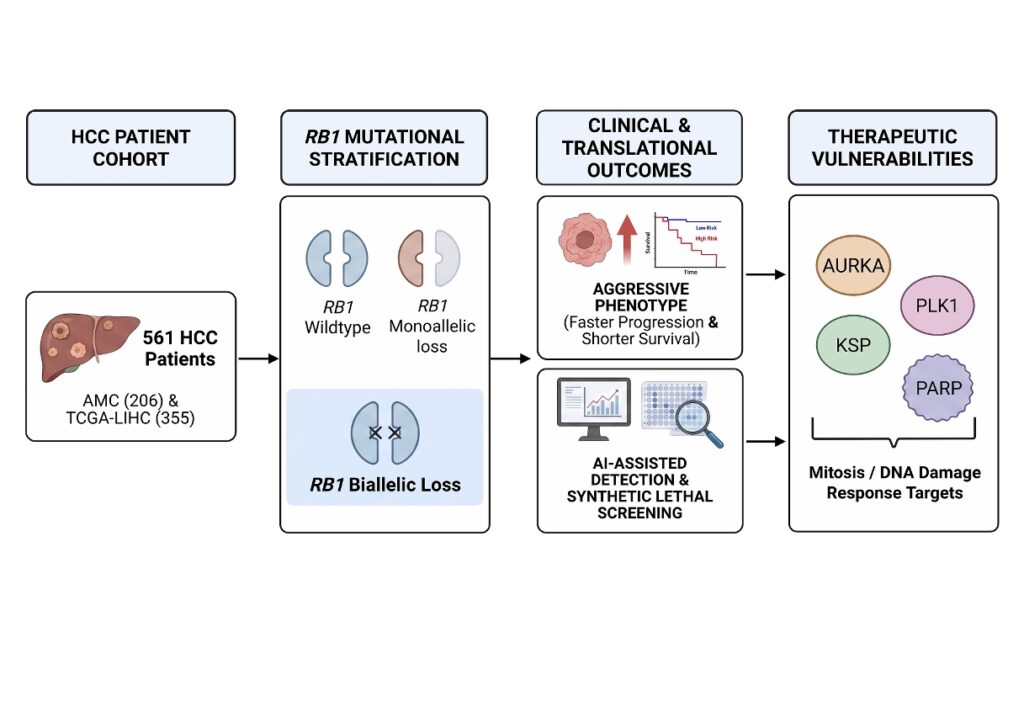
When Xiumei Zhang peered at liver cancer cells under the microscope in her University of Macau lab, she wasn’t just looking at tissue — she was hunting for a hidden pattern that could save lives. Her team, led by Associate Professor Joong Sup Shim, had uncovered a dangerous subtype of liver cancer lurking in about 1 in 7 patients, driven by the complete loss of a gene called RB1. This aggressive form spreads faster, resists standard treatments, and carries a 3.32 times higher risk of death. But the team didn’t stop at discovery — they built an AI tool to spot it quickly and found a powerful drug combo that shuts it down in lab tests.
Liver cancer is one of the deadliest cancers worldwide, and hepatocellular carcinoma (HCC) makes up most cases. In East Asia — including China, Mongolia, and South Korea — nearly half of all HCC cases occur, often diagnosed too late for effective treatment. One reason progress has been slow is that not all liver cancers are the same, and many patients lack clear biomarkers to guide therapy. The RB1 gene, known for keeping cell growth in check, had been suspected in cancer before, but its full impact in liver cancer wasn’t clear — until now.
By analyzing data from hundreds of HCC patients, the international team found that 14.6% had both copies of the RB1 gene inactivated — a condition called biallelic loss. These patients had poorly differentiated tumours and much worse survival rates. To make diagnosis faster and cheaper, the researchers trained an AI model to detect RB1 loss just by scanning routine H&E-stained tissue slides — the kind used in nearly every hospital pathology lab. No expensive genetic tests needed.
Then came the breakthrough in treatment. The team ran drug screens and discovered that RB1-deficient cancer cells are uniquely vulnerable to a combination of mitotic inhibitors (like AURKA, PLK1, and KSP inhibitors) and PARP inhibitors, which target DNA repair. In lab models, this combo shrank tumours dramatically without harming healthy liver tissue. It’s a classic case of synthetic lethality — where two weaknesses together become fatal to cancer, but safe for the body.
This study, published in the journal Signal Transduction and Targeted Therapy, lays out a full roadmap: detect the high-risk subtype with AI, then treat it with a precise drug combination. For patients who’ve had few options, this could be life-changing. The work was a global effort, with key contributions from South Korea’s Asan Medical Center, POSTECH, Hanyang University, and Harvard Medical School, supported by funding from Macau and Shenzhen. Now, the team hopes to move this strategy into clinical trials, bringing hope to a group of patients who need it most.