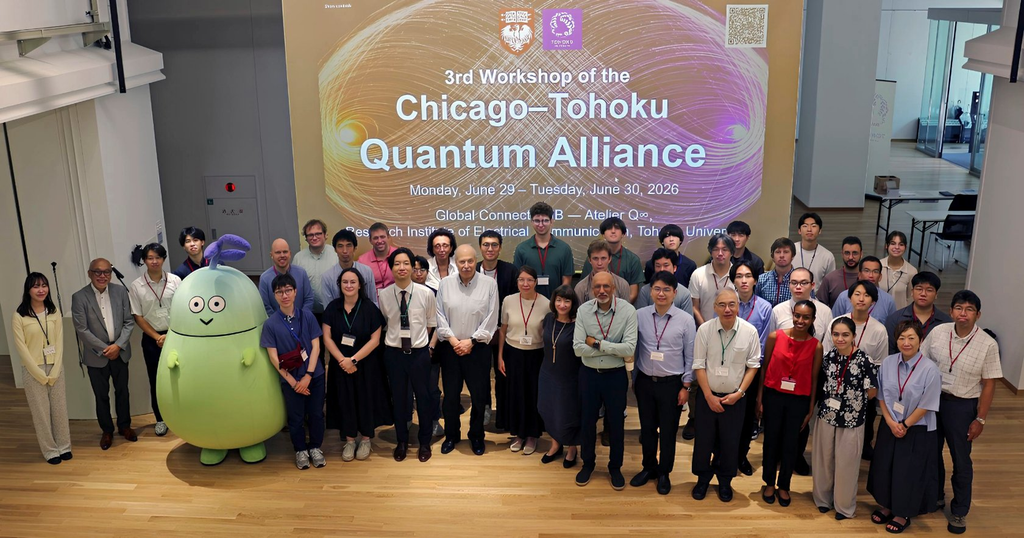
At NanoTerasu in Sendai, Japan, researchers can use intense soft X-rays to examine the tiny structures and spins that may one day help power quantum devices. That facility is part of a new five-year partnership between the University of Chicago and Tohoku University, which has opened a dedicated Quantum Hub at Tohoku’s Research Institute of Electrical Communication.
The hub brings together work that often happens in separate stages: designing promising materials on computers, making them in a lab, and testing how they behave. Better links between those steps could help researchers discover materials suited to quantum technologies, including devices that use carefully controlled electron spins to store or process information.
The two universities contribute different strengths. The University of Chicago brings expertise in theoretical modeling, quantum control and device simulation. Tohoku contributes experience in spintronics, nanofabrication and materials characterization. The partners have set up two joint experimental laboratories at Tohoku for making and measuring materials and devices. Researchers will combine computer-based design and electronic-structure theory with experimental synthesis and testing.
A key resource is NanoTerasu, a 3-billion-electron-volt synchrotron radiation facility in Sendai. A synchrotron produces powerful light that scientists use to study matter. At NanoTerasu, soft X-ray spectroscopy can help probe electron interactions, crystal structures and spin defects in candidate materials. The teams plan to examine solid-state substrates, topological insulators and defect-based spin qubits—possible building blocks for quantum devices.
The collaboration also has a leadership and training plan. David Awschalom and Giulia Galli, professors at the University of Chicago’s Pritzker School of Molecular Engineering, have been named distinguished visiting professors. They will help lead research that connects theory to working devices. Graduate students and postdoctoral researchers are expected to rotate between the two campuses and work under joint mentorship, giving early-career scientists experience in both research settings.
The partnership grows out of the Chicago-Tohoku Quantum Alliance, established in 2023 after agreements formed during the G7 Summit in Hiroshima. It is funded through Japan’s University for International Research Excellence initiative, a government program supporting universities, along with commitments from both institutions and annual joint research funding from Tohoku.
The plan reaches beyond university labs, too. Tohoku intends to create a startup incubator for quantum businesses modeled on Duality, a Chicago accelerator focused only on quantum ventures. Duality is run by the University of Chicago’s Polsky Center and the Chicago Quantum Exchange. If the approach takes hold in Sendai, researchers may have a clearer path from laboratory discoveries toward new companies and products.
The five-year hub is designed to connect research, training and entrepreneurship across Japan and the United States. Its next test will be whether those close ties can turn promising materials into devices—and help prepare people to carry the work forward.