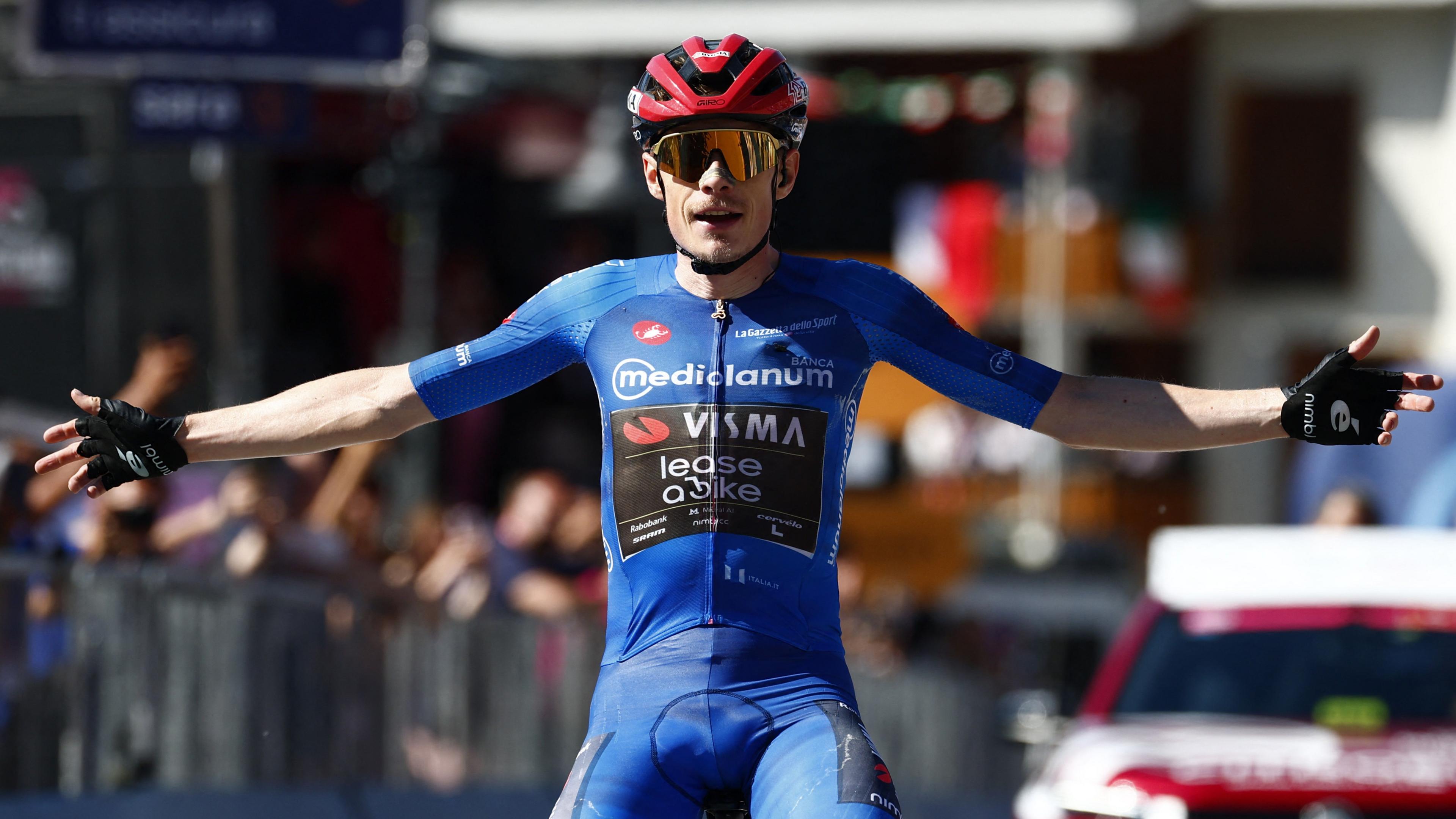
Jonas Vingegaard crested the brutal 16.6-kilometer climb to Pila on Saturday afternoon and rode away from his rivals with a late, explosive attack that announced him as the commanding force in this year's Giro d'Italia. The Danish cyclist, already a two-time Tour de France champion, claimed the pink jersey for the first time in his career — a moment that carried the weight of something larger than a single stage win. With 49 seconds separating him from second-place Felix Gall at the line, Vingegaard had done more than win stage 14 of the 2026 Giro; he had signaled his arrival as a legitimate threat to become the eighth rider in cycling history to win all three Grand Tours.
This was Vingegaard's third stage victory of the 2026 edition, but it was the manner of the win that mattered most. His Visma-Lease a Bike team controlled the race from the opening of the final climb, methodically hunting down the breakaway group with tactical precision. Davide Piganzoli, Vingegaard's team-mate, led him to the front of the peloton at the decisive moment, and from there Vingegaard's power became evident. While the mountains of the Giro have tested even the strongest riders this season, Vingegaard rose to the occasion on a mountainous 133-kilometer stage that separated the pretenders from the genuine contenders.
The strategic victory displaced Portugal's Afonso Eulalio from the top of the standings. Eulalio, who had held the pink jersey since stage five, slipped to second overall — now nearly two and a half minutes adrift. For a rider making his Giro debut, Vingegaard's takeover of the race leadership felt almost inevitable in hindsight, though his ability to execute the plan so decisively speaks to both his physical dominance and his team's coordination.
What made Saturday's performance resonate beyond the numbers was Vingegaard's own reflection on the victory. "Today we made a plan from the start with the team, and we wanted to control the race, and that's what my team-mates did," he said, his gratitude genuine and unguarded. "It was really impressive how they rode, and I'm so proud of my team-mates, and I'm proud that I can pay them back — it's a super nice win." In an era of cycling where individual talent often overshadows collective effort, Vingegaard's emphasis on his team's role was refreshing. He understood that the pink jersey on his shoulders was not solely his own achievement but the product of months of preparation and strategy executed by eight other riders who had sacrificed their own ambitions to place him in position to attack.
Australia's Jai Hindley, a former Giro winner, finished third on the day, a reminder that even experienced Grand Tour champions find themselves chasing Vingegaard on the mountain finishes. With nearly half the race still remaining, Vingegaard's lead is significant but not insurmountable in a cycling event where fatigue and drama often reshape the standings. Yet his combination of tactical awareness, team support, and raw climbing power suggests that the pink jersey may well remain on his shoulders as the Giro approaches its final act. For now, Denmark's cycling star has announced that he belongs among cycling's elite — not just as a Tour de France specialist, but as a complete Grand Tour champion.