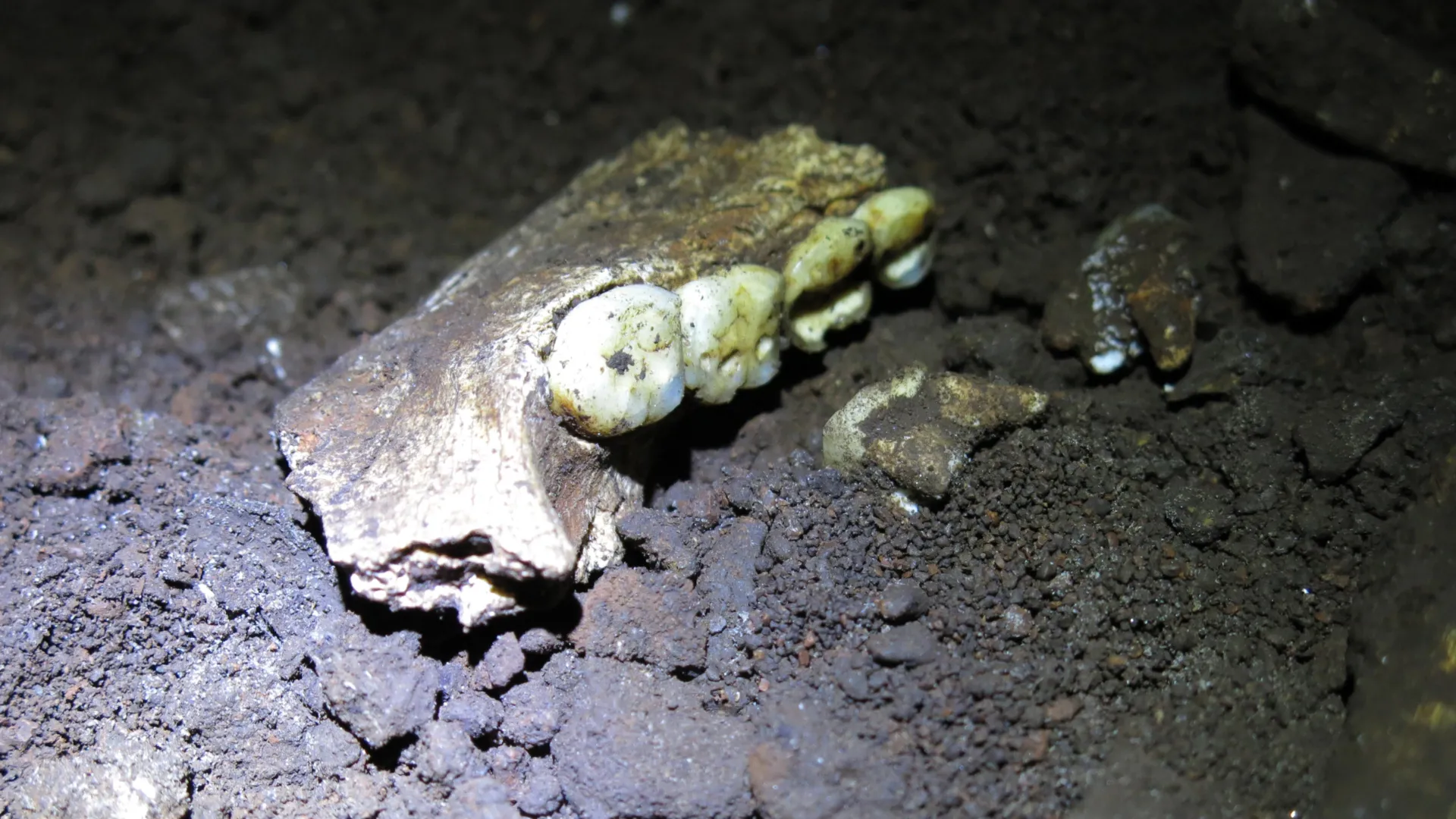
A search of 23 ancient teeth from South Africa’s Rising Star Cave found no trace of a protein marker linked to males, raising a striking question: were the Homo naledi individuals in one chamber all female?
The fossils come from the Dinaledi Chamber, deep within the cave system. Homo naledi lived about 335,000 to 241,000 years ago, and its remains have puzzled researchers since the species was discovered in 2013. Adult fossils from the chamber look remarkably alike, with less physical variation than scientists might expect between males and females. Now, proteins preserved in their teeth offer a new way to investigate who they were.
An international team, including researchers from the University of York and the University of Copenhagen, studied 23 teeth from at least 20 individuals. They used a gentle acid treatment to lift out tiny protein fragments, called peptides, from the teeth’s enamel while limiting damage to the fossils. The team searched for Amelogenin-Y, a protein made from a gene on the male Y chromosome. They found no evidence of it in the samples.
Researchers at the University of York checked the amino acids in the samples and confirmed that the proteins were ancient, not modern contamination. The work, published in the journal Cell, is the largest collection of individuals from an extinct human relative studied with ancient protein analysis.
One possible explanation is that the chamber held only females. If Homo naledi deliberately placed female members of its community there, the site might offer evidence of a burial custom set aside for one sex. It could also point to complex social practices among a human relative other than Homo sapiens. But the protein result does not prove that interpretation.
The researchers say a genetic explanation is also possible. If Homo naledi lived in a highly isolated population, the gene that produces Amelogenin-Y might have changed or disappeared. In that case, some individuals could have been male even though their teeth lacked the marker scientists normally use to identify them. The findings therefore leave the chamber’s story open, rather than settling it.
Teeth may help answer more questions. Their enamel is the hardest tissue in the human body and can protect proteins from environmental damage over very long periods. Palesa Madupe, who worked on the research during her postdoctoral study at the University of Copenhagen, said this makes enamel a valuable source of evidence from deep time. Protein analysis could help researchers learn about ancient human relatives when bones alone leave important questions unanswered.
For now, scientists have a new clue, not a final answer: 23 teeth carry no detected male-specific protein, while the reason remains uncertain. Further study may reveal whether the Dinaledi Chamber reflects an unusual genetic trait, a distinctive social practice, or a combination of both—and show what ancient proteins can still tell us about lives far beyond our own.