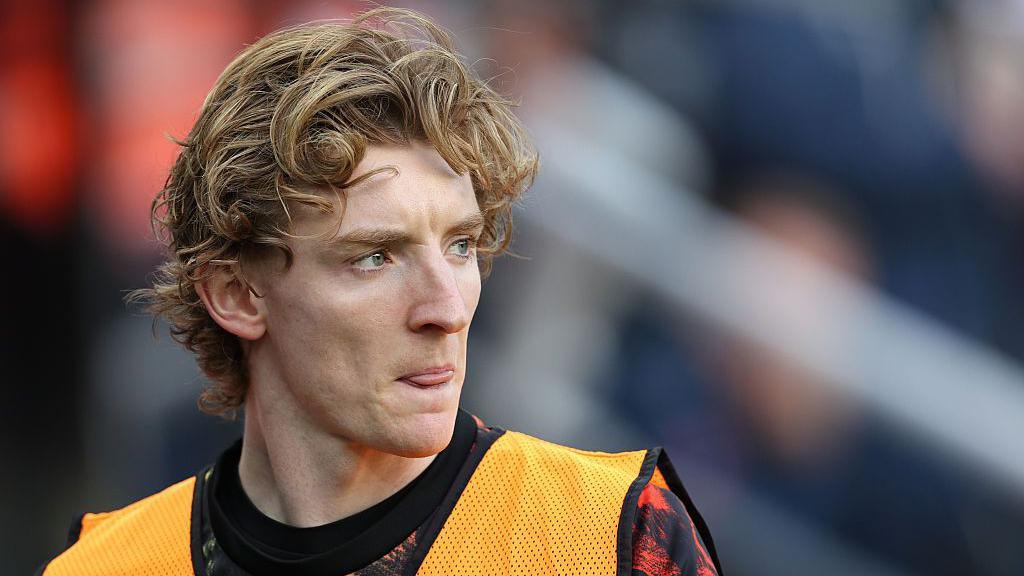
Anthony Gordon sat alone on the steps of the Nou Camp tunnel in March, listening to Barcelona's anthem "Cant del Barca" echo through the stadium just minutes before Newcastle faced the Spanish champions in a Champions League knockout tie. He could not have known then that he would return to that very pitch as a Barcelona player within months, but the path seemed almost inevitable given his relentless drive to reach football's summit.
The 25-year-old English forward has completed his £69.3 million move from Newcastle United to Barcelona, a transfer that reflects both his ambition and the remarkable trajectory he has traced through European football. While Gordon spent what he considers the best three and a half years of his life at Newcastle, where he remains grateful to manager Eddie Howe and his coaching staff, his hunger to compete at the absolute top level proved too powerful to resist. Barcelona chose Gordon over making Marcus Rashford's loan from Manchester United permanent, betting instead on a younger player with lower wages and untapped potential who offers versatility across the left wing and through the middle.
What ultimately convinced Barcelona and fellow suitor Bayern Munich was Gordon's electrifying form in European competition. In the Champions League this season, he scored 10 goals—fewer only than Kylian Mbappé's 15 and Harry Kane's 14—a performance that reflects not just clinical finishing but a palpable comfort in the game's highest arena. His numbers reveal the gap between his European form and domestic performance with striking clarity. In the Champions League, Gordon converted 38.5 percent of his shots compared to just 12.5 percent in the Premier League. He averaged a goal or assist every 64 minutes in Europe versus one every 227 minutes in the English top flight. Per 90 minutes, he also recorded more shots, more touches in the opposition box, and more successful dribbles in Champions League matches than in domestic ones.
The difference speaks to more than statistical variance. Gordon has been vocal about his preference for European football's style—its emphasis on flowing movement and tactical chess rather than the "slower and more set-piece based" nature of the Premier League. Barcelona manager Hansi Flick, who described Newcastle as "very intense," clearly recognizes Gordon's speed, aggression, and relentless work rate as precisely the qualities his side requires. Flick values application as much as artistry, and Gordon has proved he brings both, particularly against elite opposition where his competitive edge sharpens rather than dulls.
Matt Ritchie, Gordon's former Newcastle teammate, articulated the essence of what drives him. "It's his work ethic and application," Ritchie said. "He's laser-focused on being the best he can be. He dreams big, he thinks big, and you can see with his personality on the pitch." That personality—part controlled arrogance, part tireless striving—is precisely what Barcelona believes can flourish in the competition for places at one of world football's grandest stages. The challenge ahead is formidable: delivering week after week against world-class opponents while competing with established stars like Raphinha for regular football. Yet this is a test Gordon appears designed by temperament to embrace, another milestone on his journey to the very top.