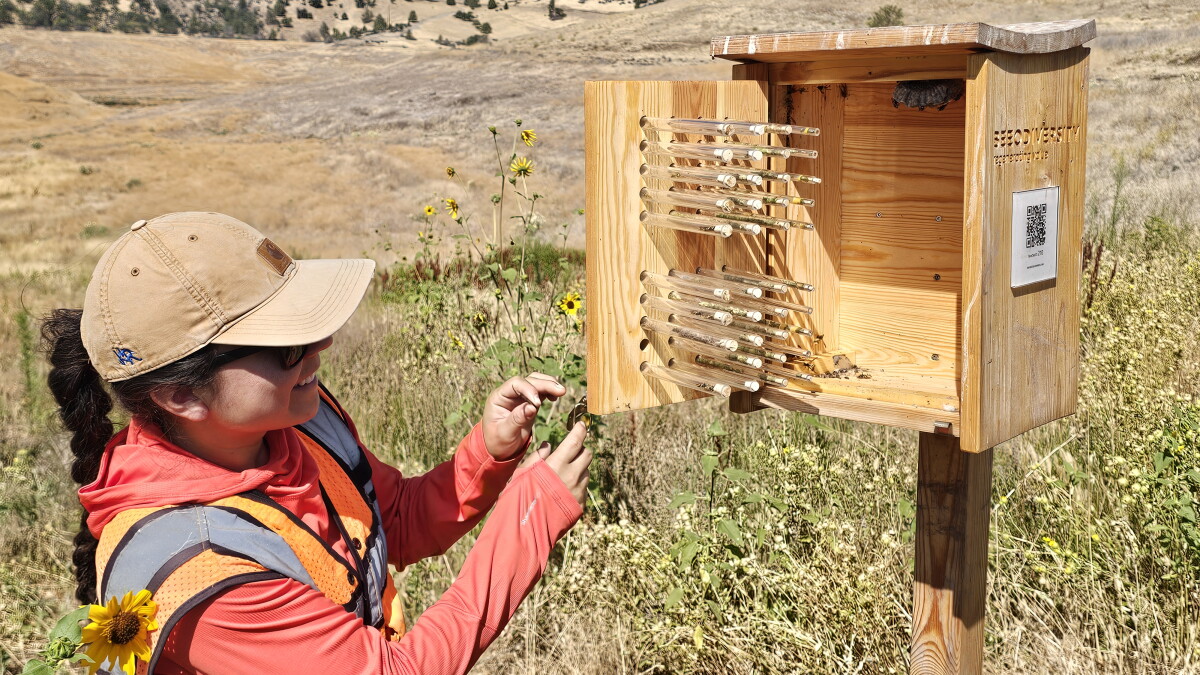
At Long Gulch, a spring-fed wetland near the former Iron Gate dam, Brissa Garcia lifted a clear tube from a wooden bee hotel and found crushed leaves, bands of bright yellow pollen and a tiny bee egg. The scene offers restoration workers a close-up view of how wild bees are using the land taking shape along the Klamath River.
The former reservoirs in Northern California and Southern Oregon were drained in 2024. RES, the company leading restoration work at three reservoir sites with the Yurok Tribe, has planted billions of seeds and thousands of trees, shrubs and flowering plants. Those plants can provide nectar and pollen for pollinators. But the team also wants to know which plants bees actually visit, and what materials they use to build nests. That information can help guide choices as the habitat recovers.
Garcia, a wildlife biologist with RES, checks the bee hotels every week during the field season. RES and Belgium-based BeeOdiversity installed six of the wooden structures across the former reservoirs. Each holds tubes of different sizes, where solitary, cavity-nesting bees can make individual nests. Unlike honeybees, these wild bees do not live in hives. They may use plant hairs, leaves or mud for nesting material, while pollen serves as food for their young.
Some tubes go to a lab for DNA analysis. The team can study pollen to identify plants the bees have visited and learn which pollinator species are present. RES can compare those results with weather records and plant surveys, building a more detailed picture of how the site changes over time. BeeOdiversity’s North American coordinator, David Strelneck, said bees collect millions of environmental samples every day, offering a detailed view of the landscape.
The approach has already produced useful results elsewhere in the Klamath Basin. At Lakeside Farms, on the east side of Klamath Lake in Oregon, pollen analysis from honeybee colonies helped track wetland restoration. Over the first three and a half years, the number of plant species recorded at the two-square-mile site rose 93%, Strelneck said. The data also detected an herbicide used to control invasive yellow flag iris. Managers changed how they applied it, and a year later bee samples showed a large drop in the chemical’s presence.
The new BeeOtels focus on wild bees, which travel shorter distances than honeybees and can offer clues from a more local area. BeeOdiversity began installing some of the first wild-bee hotels on land RES is restoring in summer 2025. Across the wider Klamath Basin, the company gathers data from 13 wild BeeOtels and 13 honeybee colonies.
For the restoration team, the tubes are small but useful records of a changing landscape: which flowers are feeding bees, what materials are available for nests, and how those patterns shift. Continued monitoring can help RES and the Yurok Tribe see whether the plants they are putting back are supporting the insects that depend on them—and adjust their work as the recovering river corridor grows.