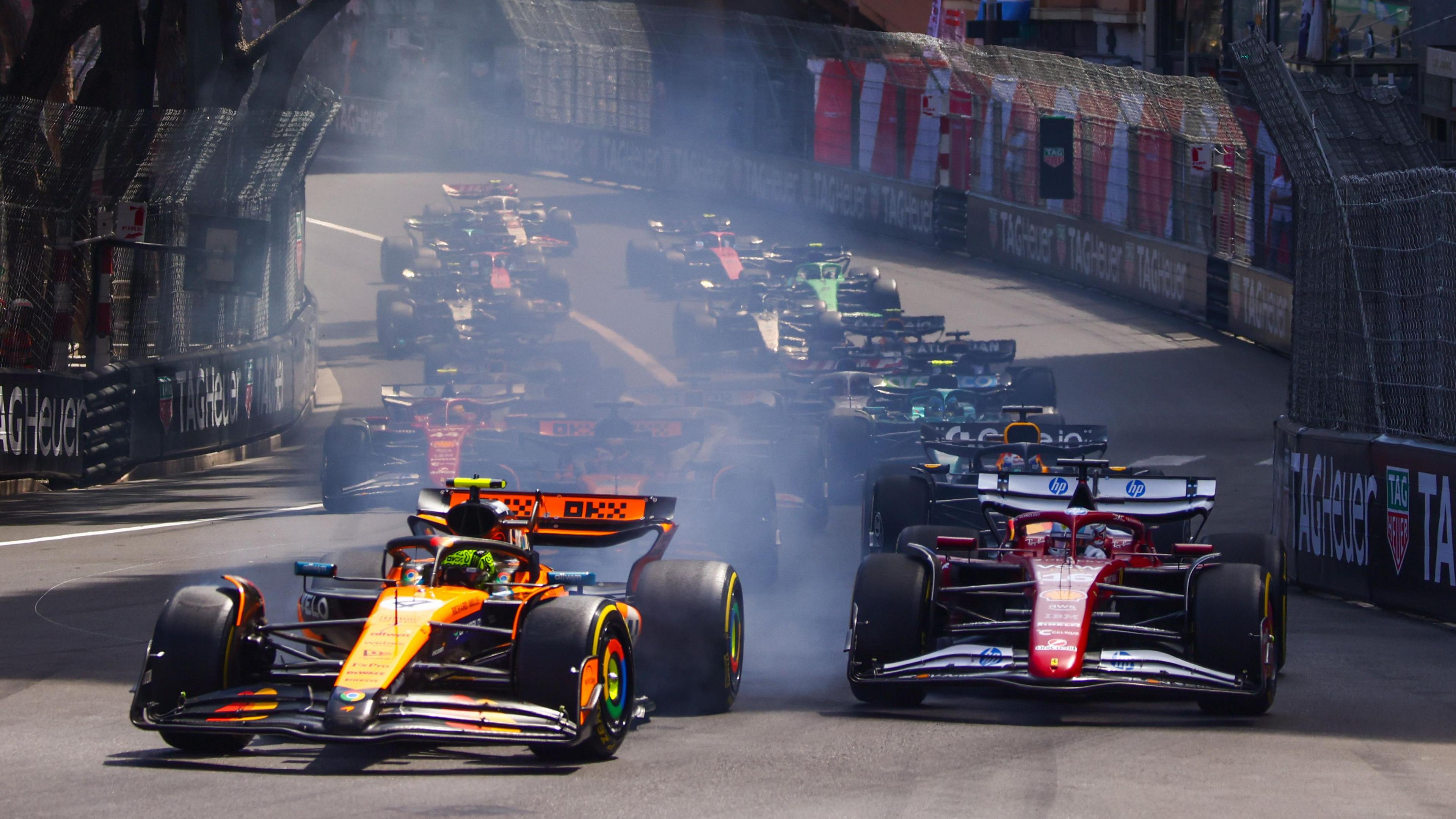
Lewis Hamilton arrives at Monaco this weekend expecting his Ferrari to shine where raw horsepower matters least. "It's the one track where power is not king," he explains. "It's definitely car performance. Our car could be really strong there." But beneath this familiar optimism lies something potentially far more significant: Monaco's notoriously processional races might finally be transformed by Formula 1's radical new hybrid power system and overtake mode.
For decades, the principality's narrow streets have been a graveyard for on-track battles. Last year's 78-lap race produced just four overtakes—a figure so bleak it underscores why Monaco has earned its reputation for soporific processional racing, where the leader controls the pace knowing that passing is nearly impossible. This season's average across 24 grand prix races is 66.9 overtakes per event, a dramatic contrast that speaks to how different modern F1 has become.
The 2026 cars, with their 50-50 split between internal combustion and electrical power, introduce a mechanism that could reshape racing at Monaco: overtake mode. When a driver trails within one second of a car ahead, they receive an extra 0.5 megajoules of electrical energy per lap—the equivalent of an additional 350 kilowatts, or roughly 480 brake horsepower. This innovation has already created what drivers and commentators describe as "yo-yo racing" elsewhere on the calendar: cars swap positions repeatedly as the advantage in electrical deployment oscillates between pursuer and pursued, each gaining overtake mode in turn.
Yet Monaco presents a paradox. The very energy-starvation that makes qualifying a nightmare for modern F1 drivers—they cannot drive flat-out for entire laps because the cars cannot recover enough electrical energy—works in Monaco's favor. The circuit's high density of corners and scarcity of long straights means energy recovery happens naturally and constantly. There are fewer opportunities to deploy that energy, making the cars "energy rich" rather than energy starved. In other words, the offset in power between car and car diminishes precisely where overtake mode might otherwise shine.
This is not to say nothing will change. If the car ahead suffers significant rear tyre degradation—a real possibility after 78 laps on unforgiving street circuits—its grip during acceleration weakens. Combine that vulnerability with overtake mode's extra electrical power, and an opening might emerge. As one senior figure in the sport puts it: "In the end, it's Monaco. It won't be about overtaking." Yet even the possibility represents a shift in a race that has grown notorious for its absence of genuine competition on track.
The new cars are also 10 centimeters narrower than before, though they remain wider than their counterparts from two decades ago. Drivers have long complained that modern machinery is too bulky to race wheel-to-wheel in Monaco's tight confines. The marginal reduction offers psychological relief more than mechanical advantage. Overtaking at Monaco between evenly matched cars has been nearly impossible for at least fifty years—a fact no small adjustment to vehicle dimensions can overcome.
What unfolds on Sunday afternoon will provide the first real answer. Monaco's unique geography may prove immune to the yo-yo racing that has defined this season elsewhere, or it may finally crack open what has long seemed immovable. Either way, the narrowest circuit on the calendar is approaching its date with F1's most ambitious hybrid experiment with genuine uncertainty—a rare thing at a race where tradition typically dictates the outcome.