Imagine you could test whether a new car design is safe in a crash — without building a single prototype. Or predict exactly how wind would push against a skyscraper before construction begins. That kind of virtual testing could save companies billions of dollars and help engineers build better products faster.
That's the goal behind a new artificial intelligence system called GeoPT, developed by researchers at MIT's Computer Science and Artificial Intelligence Laboratory and Tsinghua University in Beijing. The system learns physics by watching tiny particles bounce off and stick to 3D shapes — like marbles rolling across a plastic dinosaur until they settle into its grooves.
GeoPT studied 1.3 million of these particle interactions to develop what researchers call a "feel" for how the physical world works. It learned what happens when forces like wind, water, or collisions push against an object — and how that object responds.
"We believe physics is the third modality for AI models, after text and pixels," says Minghao Guo, a PhD student at MIT and one of the project's lead researchers.
The results are striking. GeoPT reached peak performance twice as fast as existing simulation tools, while using up to 60 percent less data. In one test, it modeled how a boat hull would handle both air and ocean waves — achieving the same accuracy as other tools, but four times faster and with much less information to work from.
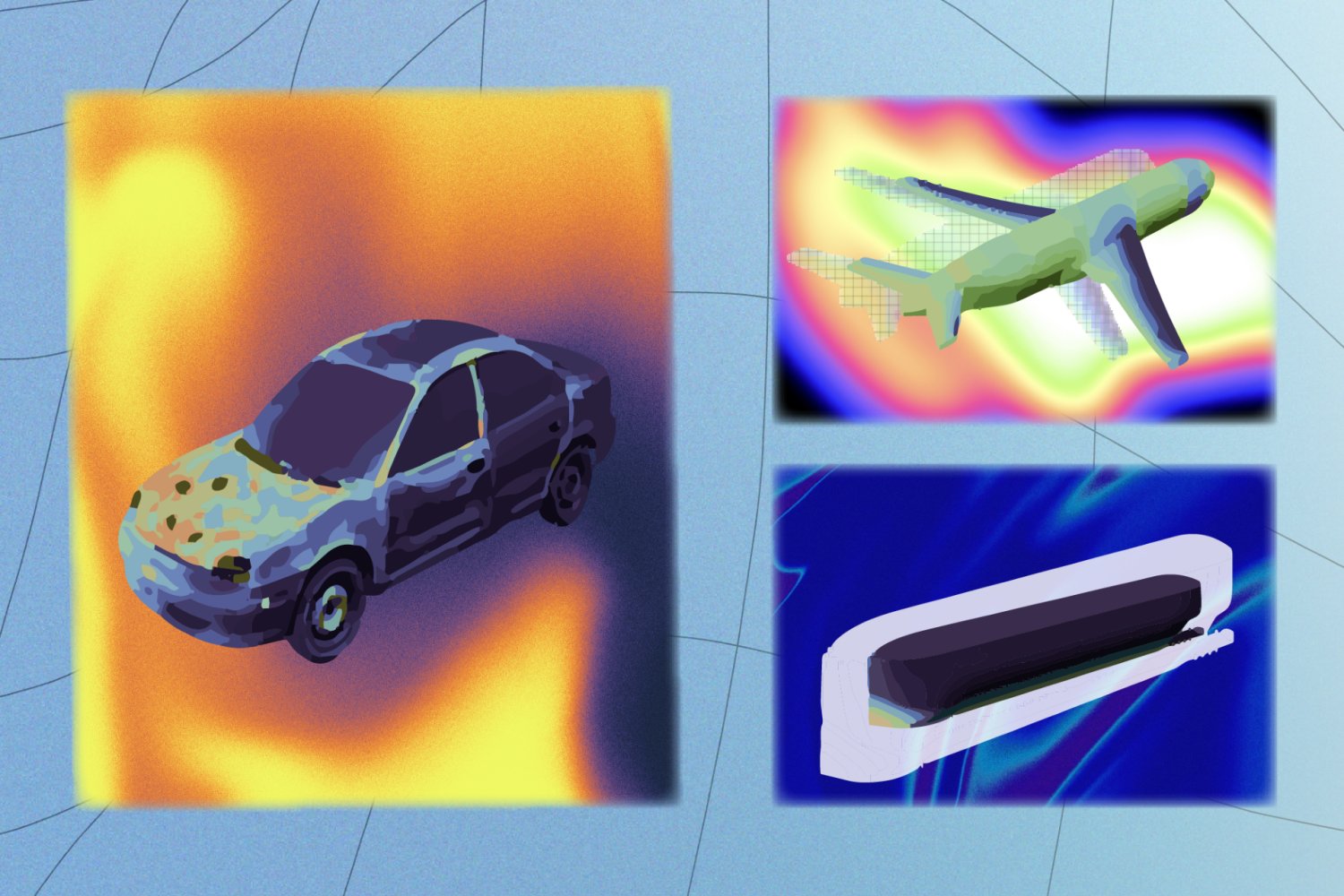
The system works simply: users upload a 3D model of something — a car, a fighter jet, a battleship — and tell GeoPT which direction a force is coming from and how strong it is. The AI then generates a heat map showing exactly how the object would bend, flex, or deform.
Haixu Wu, a postdoctoral researcher at MIT who co-led the project, says the team's success on tough industrial tests proves the system can handle real-world challenges. "If your model performs well on industrial benchmarks, that means it can solve the hardest physics tasks," Wu explains.
GeoPT even managed to accurately simulate how cars crumple in crashes and how light bounces through objects it had never seen before — without ever being trained specifically on crash tests or optics.
The researchers hope GeoPT could eventually become part of what they call a "physics foundation model" — a backbone system that helps all kinds of AI tools understand the physical world more accurately. That could mean more realistic video game physics, better robotics training data, and faster virtual prototyping for engineers designing everything from coffee mugs to aircraft.
For now, the team is sharing their work openly, hoping other researchers will build on it. In a world where understanding physical forces matters for everything from bridge safety to climate modeling, teaching AI to feel gravity, friction, and pressure could be a big step forward.