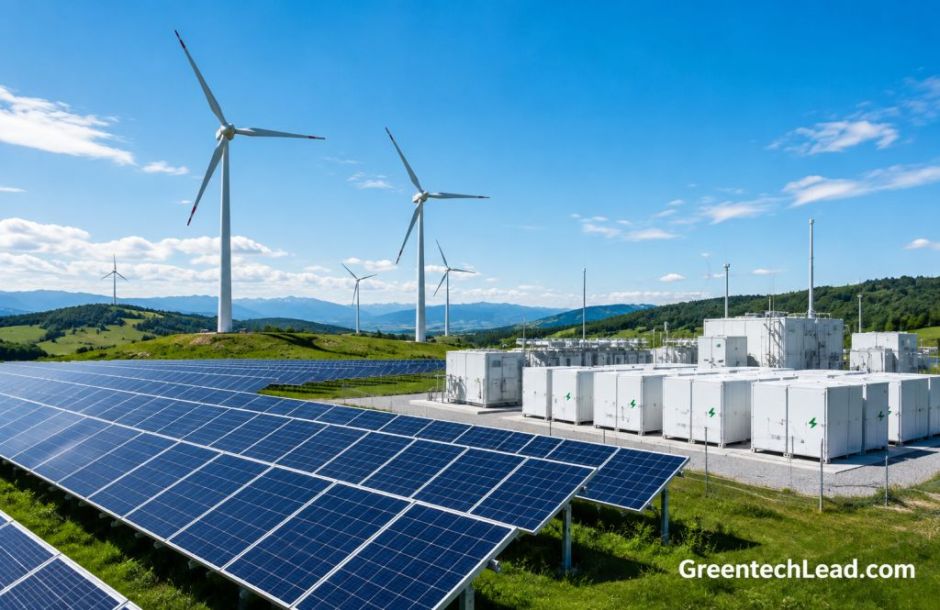
The number is staggering: 1,286 gigawatts. That's how much solar capacity China had switched on by the end of July 2026 — enough to overtake coal as the country's single largest source of power for the first time in history. As Tsvetana Paraskova reported for OilPrice.com, solar now accounts for 31.5% of all installed generation in the world's largest emitter, a milestone Bloomberg dubbed a "key moment for the country's green-energy boom."
Just a year earlier, green-energy watchers were marveling that coal and solar sat neck-and-neck at roughly 1,275 GW each. Now the gap is real, and the direction of travel is unmistakable: coal's share of China's actual electricity output dipped below 50% for the first time on record in the first half of 2026. The country that once seemed addicted to fossil fuels is quietly becoming its own best proof that the great energy transition is not hypothetical — it's measurable.
That same spirit of stubborn, patient renewal is unfolding on the ground, far from the grid. In Brazil's Cerrado — the world's most biodiverse tropical savannah, which has lost over half its native vegetation — a coalition of more than 180 partners is stitching the landscape back together across nine states. In the Sahel and Saudi Arabia, two more World Restoration Flagships were awarded the UN's top accolade on August 26, 2026, at UNCCD COP17 in Mongoliadarro. Together, the three programs commit to restoring nearly 5 million hectares by 2030 — an area equal to about 7 million football fields, as EnviroNews reported.
"Restoring ecosystems brings significant benefits for all — including food security, new jobs, and greater resilience for millions of people," said Inger Andersen, UNEP's executive director voice. UNCCD chief Yasmine Fouad was blunter: "These programs show that restoration works."
The proof isn't just in policy papers. Mongolia's own National Greening Programme has already brought one million hectares of degraded land back under restoration and planted 159 million trees freely.
Across the Atlantic, one man's decades-long obsession makes the point personal. M.C. Davis, an 85-year-old multimillionaire, bought 51,000 acres of degraded land in the Florida Panhandle and set about reviving the once-vast longleaf pine forest — the signature ecosystem of the American Southeast that once covered 90 million acres. What emerged is now the largest private restoration project east of the Mississippi River, a living rebuke to the skeptics who insist there isn't enough nature left to save.Meanwhile, the economics are catching up with the ecology. In the DRC, CrossBoundary Energy flipped the switch on August 12, 2026, on a 233 MWp solar-plus-battery plant powering Kamoa Copper's mining complex — replacing thermal baseload with renewables at 95% annual availability. In Maryland, REV Renewables won approval for a 20-year PPA for the 300 MW Jade Meadow III solar farm, built on reclaimed coal-mining land near Westernport and expected to create over 1,200 jobs. And in Denmark, a single 53.4 MW solar park in Central Jutland now lets small companies band together to access long-term clean power traditionally reserved for industrial giants.
Separately, these are headlines. Together, they tell a single story: we are past the argument that restoration and renewables are luxuries. They have become the default — the strongest defense we have against drought, desertification, and an unstable climateines. From a Chinese grid that just toppled king coal to an 85-year-old ecologist's pine forest in Florida, the planet is being rebuilt by people who refused to accept the ending.
The best part? The story is still being written — and we're all holding a pen. Every rooftop panel, every reclaimed field, every small buyer who joins a community solar deal is a line in it.
Sign in to join the conversation.
Comments (0)
No comments yet. Be the first to share your thoughts.